
Best AI Corporate Learning Management System for Business
AI Corporate Learning Management System helps businesses and organizations streamline their operations using advanced AI-powered technology. It automates complex tasks, improves accuracy, and provides data-driven insights to enhance productivity and decision-making. With features like automation, real-time analytics, workflow management, and seamless integrations, AI Corporate Learning Management System enables teams to reduce manual work, save time, and improve overall efficiency. On SoftwareAdviser.ai, you can explore, compare, and choose the best AI Corporate Learning Management System solutions that fit your business needs and help you scale faster with the power of AI.
 Researched and Written by Akash Patel
Top 3 Featured Softwares


List of Top Corporate Learning Management System in USA
Get Free Consultation


Leapsome is a dynamic employee development and performance management platform designed to enhance workplace productivity, engagement, and growth. It provides businesses with a uni...
View Profile

Absorb LMS is a cloud-based learning management system that enables organizations to efficiently deliver, manage, and track training programs. It offers a user-friendly platform fo...
View Profile

Deel is a cloud-based global payroll and compliance platform designed to help businesses hire, manage, and pay remote employees and contractors across 150+ countries. By provid...
View Profile

LearnWorlds is a powerful and intuitive cloud-based Learning Management System (LMS) designed for entrepreneurs, educators, and enterprises to create, manage, and monetize onli...
View Profile

Trainual is a cloud-based training and process documentation platform designed to help businesses organize their knowledge, standardize operations, and streamline employee onbo...
View Profile
Docebo is a Cloud Learning Management Solution for corporates that uses AI to deliver an optimized online learning experience. It offers modules for employee onboarding, developmen...
View Profile

iSpring Learn is a powerful cloud-based Learning Management System (LMS) designed to deliver and manage online training programs efficiently. It enables organizations to train ...
View Profile
Kallidus Learn

Simplify compliance. Focus on potential.
Kallidus Learn is a modern learning platform designed to make learning simple, fast, and effective. It combines classroom, online, mobile, and social learning into one single scala...
View Profile

TalentLMS is a cloud-based learning management software that comes with an array of attractive features that upgrades its utility value. It contains multiple training features as w...
View Profile

360Learning is a one-of-its-kind collaborative learning platform that allows teams to create, learn, and improve online courses together at one place. The platform enables users to...
View Profile
Creating courses is simple. To get started, upload your existing content, such as PowerPoint presentations, training videos, Word documents, or any other file type. Then, use the...
View Profile

LearnUpon's LMS is designed to help businesses train their employees, partners, and customers. The platform is built to deliver high-quality experiences in a scalable way. With Lea...
View Profile

Cornerstone Learning is an intuitive Learning and Development Software (LMS) that provides a comprehensive learning experience to everyone. The software brings together learning,...
View Profile

Bridge
By Bridge
Bridge is a Learning & Performance platform that helps you manage learning programs, career development, and performance review processes all in one solution. With Bridge, you ...
View Profile

eFront is a learning management system that is designed to handle the most demanding and complicated learning environments. You determine what you need your training platform to ...
View Profile

WorkRamp
By WorkRamp
Automated assignments and notifications save managers and trainers valuable time.Unlike many learning management systems, WorkRamp doesn't have tiered pricing packages or upcharges...
View Profile

UpsideLMS
By UpsideLMS
What is UpsideLMS?UpsideLMS is a cloud-based Learning Management System (LMS) designed to simplify and enhance corporate training, compliance programs, onboarding, and eLearning de...
View Profile

Paradiso LMS software is a powerful learning management system that enables you to manage your courses, quizzes, and lessons with ease. With its user-friendly interface, you can ...
View Profile

Lessonly is a training software that helps teams learn, practice, and do better work. By getting teams on the same page, they can stay ahead of change and deliver amazing experienc...
View Profile

What is Adobe Captivate Prime?Adobe Captivate Prime is an AI-powered learning control platform that permits organizations to supply customized, engaging, and data-driven learning t...
View Profile

Table of Content
What is Corporate Learning Management System?
A Corporate Learning Management System (LMS) is a system that automates the planning, monitoring, and administration of corporate training services. It helps companies in training staff, onboarding new staff, and reskilling with minimal effort. Corporate LMS solutions support training modules, assessments, and progress tracking and offer businesses an LMS system intended for the enhancement of efficiency, compliance, and ongoing education activities on an organizational level.
1. Conclusion
The corporate LMS market is quickly shifting as AI, analytics, and customizable content are integrated into employee training. A corporate learning management system needs to complement the objectives of the business, be adaptable, and provide actionable insights. Advances in technology will increase the importance of enterprise LMS solutions for personnel development so that companies remain relevant in a knowledge-intensive market. You can visit SaaS Adviser for learning more.
2. Kinds of Corporate Learning Management Systems
Organizational Learning Management Systems (LMS) differ with regards to the requirements of the business, the number of employees, and preferred training methods. With cloud-hosted LMS platforms, employees can remotely access training, while on-premise LMS solutions afford more control and security over the data. AI-assisted LMS systems provide adaptive learning experience platform tailored to employees’ needs, while collaborative LMS systems center on social learning and peer collaboration.
3. Latest Market Trends in Corporate Learning Management Systems
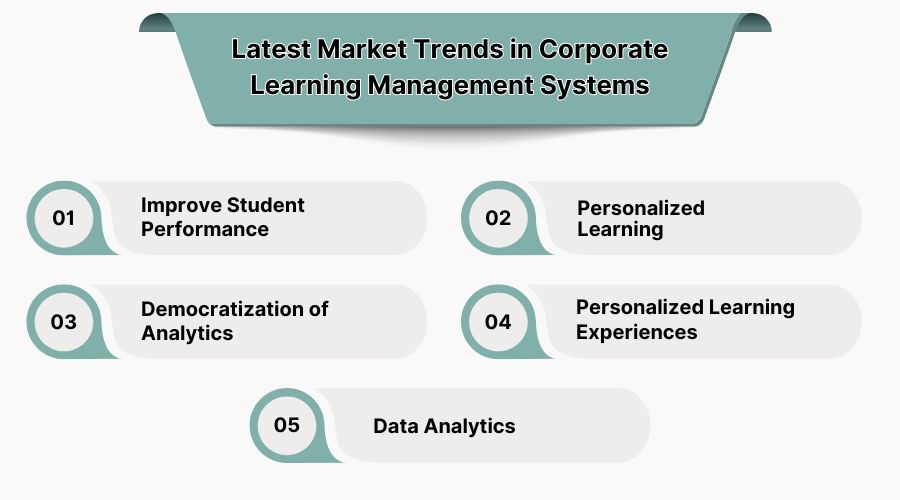
1. Improve Student Performance
Today's corporate learning management systems focus on optimizing employees' work performance through real-time monitoring, proactive adjustments, and customized evaluations. Enterprise AI LMSs utilize tracking systems to provide learners with accurate performance optimization feedback and graded assessments.
2. Personalized Learning
Customized instruction has become a focal point in the design of corporate LMS and it is facilitated by AI. Content for employees is adjusted according to individual skill sets, roles, and pace of learning, making it easier for organizations to fulfill training objectives.
3. Democratization of Analytics
The advent of corporate LMS has also provided businesses with easy-to-use analytics. It was not possible for companies to actually harness the power of modern data banks in terms of analyzing training effectiveness without data specialists.
4. Personalized Learning Experiences
Thanks to the AI integration in corporate LMS systems, training content is now tailored to each employee. Learners receive the right courses, adequate exercises, and proper feedback relevant to their progress.
5. Data Analytics
Current business LMS systems come equipped with advanced data analytics to evaluate the impact of training through enhanced engagement analytics, measuring results of assessments, and monitoring the rate of course completions.
4. Five Best Corporate Learning Management Systems in USA
1. Docebo
Docebo is one of the best corporate learning management systems that uses AI for training, compliance, and career progression activities. It offers a robust, cloud-based system to cope with the demands of large corporations that require sophisticated, analytics-driven, personalized learning paradigms.
Features:
-
Supports eLearning, instructor-led training, and blended learning for maximum flexibility.
-
Integration with third-party HR and business management applications.
Pros:
-
AI-generated learning paths that improve employee engagement.
-
Highly scalable for large enterprises, and growing businesses.
-
White-labeling and branding customization is available.
Cons:
-
Expensive pricing for some features.
-
Customization options may be limited for lower-tier plans.
Pricing:
-
Custom pricing depending on business needs.
2. Canvas LMS
Canvas LMS is an adaptable and user-friendly commercial grade proprietary LMS which is highly rated for its user-friendliness and flexibility. It provides a good design that enables companies to develop captivating online training sessions featuring videos, interactive quizzes, and forums that facilitate discussion.
Features:
-
Drag and drop customizable UI allows for intuitiveness and a tailored user experience.
-
Allows mobile learning as well as offline access meaning learning is on the go.
-
Links with HR tools, content libraries, and other third-party applications.
Pros:
-
Can incorporate videos and graphics making learning interactive.
-
Strong mobile accessibility makes the tool effective for remote learners.
-
Can adapt depending on the size of the business.
Cons:
-
Advanced customization may require some level of technical skill.
-
Not enough built-in reporting features.
-
Some features may need other programs to be integrated.
Pricing:
-
Offers tailored pricing aligned with the specific requirements of the enterprise.
3. Blackboard
Blackboard is another popular enterprise LMS which is extensively used for training, compliance, and even for managing and developing corporate talent. It enables the use of virtual classrooms, AI-powered marking, and automatic compliance checks.
Features:
-
Support for virtual classrooms includes live training with interactivity.
-
Management of compliance for certain industry regulations.
-
Multi-language support enables Training of the global workforce.
Pros:
-
Excellent attention given to compliance certification and training.
-
Live instruction can be integrated in teacher-led training sessions.
-
Helps measure how effective training is with advanced analytics.
Cons:
-
Has limited scope for newly set up businesses and start-ups.
-
New users need onboarding training for basic system functionalities.
Pricing:
-
Enterprise pricing provided upon request.
4. LearnUpon
LearnUpon is a very simple but effective business LMS with a focus on training employees and customers. The system is multi-tenant, meaning different divisions within the same organization or outside partners can all be trained on one platform.
Features:
-
Course creation is simplified and can be aided by dragging and dropping materials.
-
Learning can come in various forms such as videos and quizzes.
-
Tracking of compliance and employee progress, as well as certification, can be done.
-
HR and performance management systems can be integrated.
Pros:
-
Aids in the quick and efficient onboarding of employees.
-
Advanced tracking and reporting options are available.
-
As compared to other LMS solutions, this is economical.
Cons:
-
Some automated processes need manual setup.
-
No AI tailored adaptive learning offered.
Pricing:
-
Begins from $599 per month for small enterprises.
5. 360Learning
360Learning is a recent LMS in the corporate world that puts more focus on learning from one another. It has the traditional features of an LMS, such as content management, course outlines, and collaborative features for employees to create training materials, offer suggestions, and discuss.
Features:
-
Collaborative learning practices which incorporate sharing of knowledge among peers.
-
Real-time feedback mechanisms for trainers and learners.
-
Mobile learning, offering opportunities for training everywhere.
Pros:
-
Built-in testing and evaluation functions.
-
High engagement among employees due to participative learning.
Cons:
-
Less powerful compliance training options.
-
Some IT support for intricate training procedures is lacking.
-
Some integrations require extra work for configuration.
Pricing:
-
Based on organization’s requirements.
5. Benefits of Corporate Learning Management System
.jpg)
1. Provide Effective Preboarding
With a corporate LMS, new hires can now access training and development modules even before their first day at work. Preboarding modules introduce employees to policies, culture, and expectations, increasing productivity in administrative onboarding.
2. Enable Non-HR Hiring Managers
Most corporate learning management systems grant access to non-HR managers thereby allowing them to directly participate in training employees. Through simple interaction, team managers can allocate courses, monitor progress, and make sure team members acquire relevant skills.
3. Create a Knowledge Base of Best Practices
With a corporate LMS system, an organization can create a centralized training repository that includes training materials, best practices, and standard procedures. Every employee can access the materials at any time which ensures consistency in learning.
4. Online Learning Makes Training More Convenient
A corporate LMS system allows employees to access training programs anytime and anywhere. Whether they are working remotely or from the office, learners can participate in self-paced courses without interfering with their normal tasks.
5. It Provides Continuous and Scalable Education
Unlike traditional training methods, enterprise LMS platforms offer expanding businesses scalable education solutions. Whether training ten employees or ten thousand, a corporate learning management system accommodates business growth.
6. Challenges in Corporate Learning Management Systems
1. Delegation of Roles
To effectively manage a corporate learning management system, distinct role assignment is a requirement. Deficiencies in organizational structure may result in confusion among managers, trainers, and administrators, which in turn can slow down the course authoring, tracking, and training processes.
2. Management of Time and Resources
Organizations often struggle with finding enough time to dedicate to training owing to workload demands. To promote productivity, a corporate LMS must offer training automation, self-paced learning, and guided work scheduling. Sub-optimal planning results in low employee engagement and poor overall efficiency.
3. Management of IT Resources
A corporate LMS system requires continual support from IT for updating, integrating, and securing the system. Without sufficient IT resource allocation, a business is likely to encounter technical errors, data breaches, and poor enduring interfaces, all of which significantly impact training efficiency.
4. Personalization
Most enterprises tend to use predefined courses, which invariably results in poorly customized personalization models. Course participants require customization that is shaped according to their job descriptions, roles, skill sets, and levels of experience.
5. Assigning Roles
Managing access levels in a Learning Management System (LMS) for a business in larger organizations can be tedious. In the absence of an organized assignment of roles, administrators and instructors may have learners whom they need to add or remove access to relevant tools or features which can be detrimental to the overall experience and management of the course.
6. Measuring Learning Effectiveness
Measurement of learning effectiveness within a corporate LMS system becomes difficult if there are no advanced tools for analytics and reporting. Businesses in the modern age require clearly defined metrics such as the completion of a course, the score received during assessments, or even the level of participation by the learner.
7. Features of Corporate Learning Management System in USA
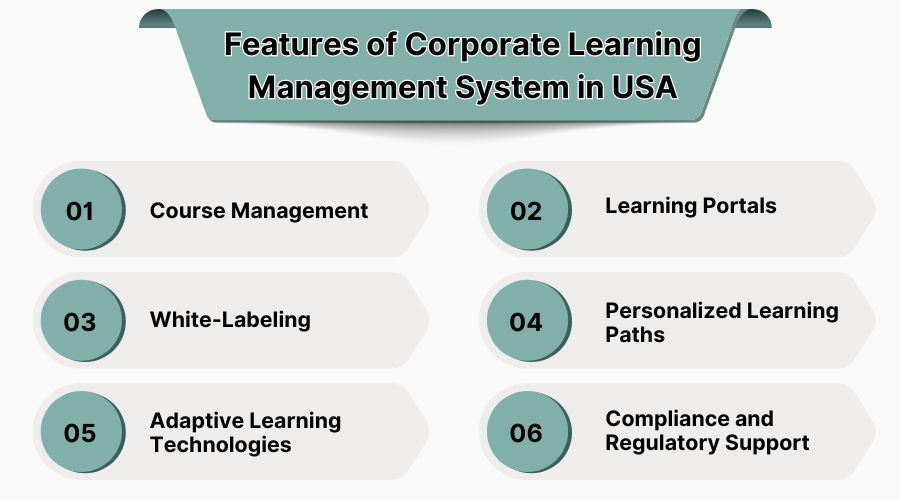
1. Course Management
Like any computer software, a corporate LMS should also include a well-defined set of tools for course management which will allow businesses to develop, maintain, and organize new and existing training materials.
2. Learning Portals
Current systems of learning management include special learning portals that serve as tools for all employees in the company or those who have access to LMS and serve as their personalized hub. They allow everyone not only to tailor a personal page, but also to get a preview of the training that follows together for the learning material which can all be done in real-time.
3. White-Labeling
The best LMS for corporate training features white-labeling as customization at the enterprise level, during which companies can implement their brand over the platform. Companies can change the logo, domain, UI design, and even training materials, and maintain branding consistency during training exercises.
4. Personalized Learning Paths
An corporate LMS system with AI personalization features tailored learning paths for every employee based on their competencies, job title, and level of advancement. Relevant adaptive training content enhances workforce engagement and assists businesses in accomplishing defined learning aims in a streamlined manner.
5. Adaptive Learning Technologies
Most sophisticated adaptive business LMS systems incorporate adaptive learning technologies that also track learner interaction with training material and adjust content based on learner behavior.
6. Compliance and Regulatory Support
An enterprise LMS assists organizations with uptime concerning compliance procedures and industry requirements by including automated certification management, proactive compliance updates, and specialized compliance training modules. This is crucial for compliance heavy sectors like medicine, finances, and manufacturing that have rigid legal boundaries.
8. Criteria for Selecting the Right Corporate Learning Management Systems
The selection of an LMS is influenced by its usability, scalability, integration options, and many more. For a corporate training LMS, multi-device access, customized learning routes, offline reporting, and access automation is essential. A quality corporate LMS must be integrable with business and HR systems; offer various recommended tools; and feature videos, interactive quizzes, live sessions, and other learning formats.