
In the modern business world, organizations are also under greater scrutiny by regulators, customers, and other stakeholders. Violations of risk and compliance manager not only result in hefty fines but also create a bad image and loss of customer loyalty. This is what makes Compliance Risk Management a very important study to any business, small or big business.
 Looking for Risk Management Software? Check out SaaS Adviser's list of the Best Risk Management Software for your Business.
 In other words, Compliance Risk Management is all about ensuring that the organizations adhere to all the laws, regulations, and in-house policies and also reduce the risks that might affect the operations, finances, and reputation. As the regulatory environment becomes more complicated, companies are no longer able to use manual processes to deal with compliance risks all by themselves.
What is Compliance Risk Management?
Compliance risk management reason can be described as the process of identification, evaluation and mitigation of non-compliance risks related to failure to comply with rules, statutes, industry regulations, and internal policies. These risks can be as a result of financial reporting errors, data risks, environmental risks, or misconduct of employees.
The ultimate goal of risk management and compliance is to do all of this not only to meet regulation requirements but also to protect the integrity of the organization, the reputation of the organization, and the long-term survival of the organization.
As an industry-neutral example, a failure to comply with legal regulations, like GDPR, HIPAA, or SOX can cost a company millions of dollars in fines. Beyond regulatory fines, the team at Alliance Risk notes that compliance failures often trigger costly lawsuits, requiring organizations to secure cyber liability, D&O, and professional liability coverage as part of comprehensive risk management. But besides fines, customer loss of confidence in the company, and even litigation may also be caused by not being able to comply.

Did You Know?
A study conducted by the Ponemon Institute revealed that the cost of non-compliance is almost thrice the cost of compliance.
What are the Challenges of Manual Compliance?
Compliance and risk management are still done using spreadsheets, emails, and manual checklists in many businesses. This can be effective with small organizations, but as a company increases in size, its inefficiencies and risks are too large to overlook. Now, we will look into the primary challenges.
As businesses integrate AI into their operations, they face new classes of threats that manual checklists cannot catch. This necessitates the use of dedicated AI security tools for red teaming, federated learning, and real-time monitoring. Below, we break down these specific challenges and why manual processes fall short.
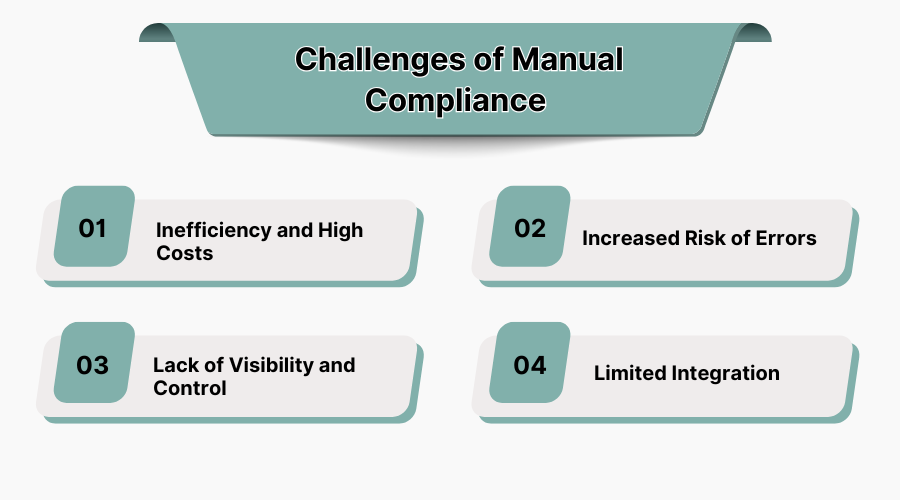
1. Inefficiency and High Costs
Compliance procedures cannot be performed manually without a lot of administration. Teams use millions of hours to write policies, monitor regulatory changes, and see controls are met. This slows down processes and also pulls resources out of line with core business objectives. Inefficiencies eventually become more costly in man-hours and the possible financial fines of missed deadlines or regulations ignored.
2. Increased Risk of Errors
Manual systems cannot avoid human error. Compliance gaps can be caused by a lack of a vital update in the rules and standards, misrepresentation of financial records, or neglect to monitor employee certification. Any minor mistakes could then become huge compliance risks.
3. Lack of Visibility and Control
Manual methods provide limited visibility into the compliance status across departments. The controllers are not always in a position to evaluate the overall risk in real-time, and therefore, to swiftly take remedial measures. Compliance managers cannot control the situation without centralized dashboards.
4. Limited Integration
Manual compliance processes are rarely aligned with other business systems, e.g., HR, finance, or IT. The consequence of such a siloed strategy is redundancy and inconsistencies and delays in risk identification.
Pro Tip:
When your organization is growing at a fast rate, an early investment in a compliance risk management program will help prevent future bottlenecks.
How Compliance Management Works?
A good compliance risk management process is organized, methodical, and technology facilitated. It works in the following steps.
1. Identifying Applicable Regulations and Policies
Each industry has certain laws and standards. The initial approach is to determine all the applicable regulations, either locally, nationally, or internationally, applicable to your organization. These are financial reporting regulations, environmental regulations, data protection regulations and labor regulations.
2. Risk Assessment
After identifying the regulations, the organization has to perform a compliance risk analysis. It is assessing the most exposed areas of the company, the most severely penalized risks and the probability of breaches occurring.
3. Developing Policies and Procedures
According to the risk evaluation, the organization must establish effective policies and procedures, which direct the actions of employees. These are documents that must be simple to comprehend and make available to every employee. They are the basis of compliance vs risk management culture.
4. Training and Communication
The staff needs to be trained consistently on the compliance policies. Training is effective in ensuring all staff members know their roles, and there will be minimal cases of non-compliance due to ignorance.
5. Monitoring and Auditing
Compliance is not a single purpose activity. Internal audits and regular checks will make sure that procedures do not go against the rules. Automated compliance tools offer dashboards and reports that assist leaders in monitoring compliance in real time and modifying strategies when necessary.
Quick Insight
Studies indicate that firms that conduct regular compliance training experience half the amount of compliance violations as compared to firms that do not have formal compliance training.
How to Choose the Best Compliance Risk Management?
The choice of an appropriate compliance risk mitigation solution is one of the keys to success over the long term. The following are the important steps to follow.
.png "Compliance Risk Management")
1. Identify Regulations
Begin with a list of all relevant laws, industry standards and internal policies. This understanding will assist you in selecting a tool that will assist in your compliance requirements.
2. Assess Current Processes
Review your existing compliance and risk management processes. Determine weaknesses, inefficiencies or spots that are likely to make a mistake. It is easier to measure the improvement after implementation because this baseline assessment is used.
3. Reporting and Dashboards
Have solutions offering real-time reporting and customizable dashboards. This will provide increased visibility of compliance risk and will aid in data-driven decision-making.
4. Pilot Testing
Pilot test with one department of the company before implementation of the software across the entire company. This gives you the ability to gauge efficacy, work out obstacles, and optimize the procedure prior to a comprehensive launch.
Why Your Organization Needs Compliance Risk Management?
Compliance Risk Management has become the foundation of organizational resiliency in a world where businesses are under both immediate and constant pressure to ensure they meet continuously changing regulations. Whether it is financial institutions trying to meet rigorous reporting requirements or health care organizations trying to keep sensitive patient information safe, all industries have compliance issues that directly impact the reputation, operations, and profitability.
Good Compliance Risk Management not only helps organizations to keep up with laws and regulations, but it also helps them to gain trust with stakeholders. According to a 2023 PwC survey, 87% of consumers say they would abandon brands that mishandle their personal information.
Enhance internal operations and better equip themselves in case of future growth. Regulatory compliance and risk management are investments that have long-term returns that are not necessarily fines. This is why companies simply cannot afford to overlook it.
1. Enhanced Operational Efficiency
Robotic compliance systems minimize the amount of work done manually and leave employees with time to focus on strategic projects. Redundancy is also minimized as a result of streamlined processes, and reporting is accelerated.
2. Improved Risk Management
Compliance gaps can be detected at an early stage and help organizations to reduce risks before they develop. Proactive monitoring will avoid expensive fines, litigation and negative publicity.
3. Increased Transparency and Accountability
Dashboards and reports provide leaders with real-time visibility into compliance status across the organization. This promotes accountability at every level and builds trust with stakeholders.
4. Competitive Advantage
Investors, customers, and regulators like good compliance programs in companies. This competitive advantage may result in the development of new markets and alliances.
5. Enhanced Security
Risk Compliance Management powered by artificial intelligence for regulatory compliance is used in sectors where data protection is significant to ensure that sensitive information is not compromised. Good compliance systems also equip organizations against cyber threats.
Conclusion
In the modern regulatory environment, the issues of risk and compliance cannot be discussed outside the context of business success. CRM is more than the ticking box strategy because it is an effort to establish a culture of responsibility, transparency, and improvement. Companies can also become lean and reduce their risk exposures and gain competitive advantage by outsourcing manual compliance to an automated compliance risk management program. Such organizations, where compliance is seen as an enabling strategy and not a liability, will be better placed to grow and survive sustainably.
The best way is a proactive, technology-based compliance program, which includes monitoring, training, and auditing.
The worst risk is the inability to abide by the rules related to the industry and can be penalized, sued, and lose your reputation.
One such example is that of a healthcare company that complies with HIPAA regulations to ensure that patient data is secured and that potential breaches are reduced.