.jpg)
Managing a school used to mean filing cabinets, scattered spreadsheets, and staff running between departments just to share basic information. A school ERP system changes all of that. It brings every critical function, admissions, attendance, grades, fee collection, and parent communication, into one connected platform. As USA schools serve increasingly diverse student populations while operating under tighter budgets.
 Looking for School ERP Software? Check out SaaS Advisor’s List of the Best School ERP Software in USA for Your Business.
The right system can make the difference between a school that runs smoothly and one that struggles to keep up. In 2026, the demand for a reliable school ERP system in the USA has never been stronger. Schools that already use a student information system report better data accuracy, faster reporting, and significantly more satisfied parents. If your institution is still relying on disconnected tools,
What Is a School ERP System?
A school ERP system, short for Enterprise Resource Planning, is an integrated software platform that connects every major administrative and academic function of a school or district. Rather than using separate tools for attendance, grading, billing, and communication, a school ERP unifies them into one dashboard.
Think of it as the operational backbone of your institution. It stores student data, tracks daily attendance, manages teacher schedules, processes fee collections, generates compliance reports, and sends notifications to parents, all from a single interface. In short, it eliminates the chaos of disconnected systems and replaces it with one clean, auditable workflow.

Do you know?
The total cost of ownership for a school ERP goes beyond licensing. Districts should also budget for implementation, training, data migration, and annual support contracts, which can add 20–40% to the base subscription cost.
Why Schools in the USA Need ERP Systems in 2026
As educational challenges evolve, school ERP systems become essential tools to meet rising demands and operational complexities.
1. US Schools Face Growing Challenges
American schools are dealing with a unique set of pressures heading into 2026. Specifically, administrators must manage:
- Rising enrollment and increasingly diverse student populations
- Stricter FERPA and COPPA data privacy compliance requirements
- Budget constraints that demand leaner, more efficient operations
- Parent expectations for real-time communication and transparency
- The need to integrate with remote learning tools post-pandemic
2. What a Modern School ERP Solves
A well-implemented school ERP software helps institutions address all of the above. Additionally, it enables staff to focus on teaching rather than paperwork. Key outcomes include faster reporting for state compliance, reduced billing errors, and significantly higher parent engagement through dedicated portals. Most importantly, it creates a single source of truth for student data, something that every department, from counselors to finance, can trust.
Core Features of School ERP Systems in 2026
A modern school ERP offers a comprehensive suite of features designed to unify and optimize school management processes.
1. Student Information System (SIS)
The student information system is the foundation of any school ERP. It stores everything from enrollment records and transcripts to health information and emergency contacts. Because data accuracy matters so much for compliance, a good SIS includes validation rules and audit trails that keep records clean and accountable.
2. Attendance Tracking
Modern attendance management software goes far beyond a paper register. Biometric check-ins, QR code scanning, and mobile teacher apps all feed into a real-time dashboard. Parents receive instant SMS or app notifications when their child is marked absent, which dramatically reduces follow-up calls for administrative staff.
3. Gradebook & Assessment
Teachers can record, weigh, and publish grades in real time. Rubrics, custom grading scales, and standards-based grading are all supported by leading platforms. Parents and students can track progress continuously, which reduces grade surprises at report card time.
4. Learning Management System (LMS) Integration
A quality school ERP software in 2026 integrates seamlessly with platforms like Google Classroom, Canvas, and Schoology. Therefore, grades entered in the LMS flow automatically into the gradebook, and assignment calendars sync without manual data entry.
5. Parent & Student Portals
These portals give families 24/7 access to attendance records, grades, fee statements, and school announcements. Consequently, parent engagement improves measurably because the information they need is always one tap away.
6. Fee & Tuition Management
Autonomous invoicing, online payment gateways, overdue alerts, and financial aid tracking are all standard in modern ERP for school platforms. This feature alone saves finance teams dozens of hours per billing cycle.
7. Analytics & Reporting
From state compliance reports to early-warning dashboards for at-risk students, built-in analytics give leadership the visibility they need. Moreover, custom report builders let districts pull exactly the data that matters to them, without calling the vendor.
8. Scheduling & Timetables
Automated timetable generation handles teacher availability, room assignments, and conflict resolution in minutes. As a result, what used to take a department head days to build manually is now done before lunch.
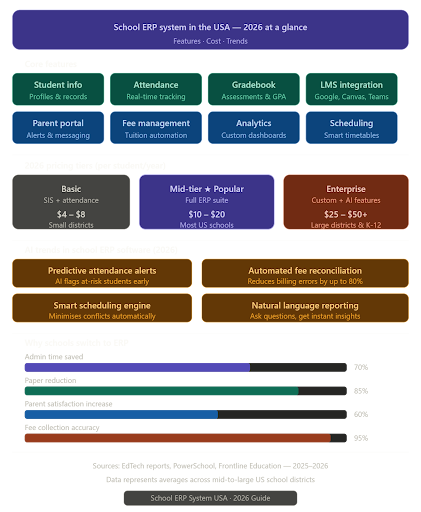
A Quick Overview of Essential School ERP Features and Benefits in 2026
Top School ERP / Management Systems in the USA (2026)
The market offers several leading platforms tailored to different school sizes and needs, each with unique strengths.
1. AFAS Software
An integrated business management solution offering HR, payroll, accounting, and project management features, designed to optimize organizational workflows, ensure compliance, and support growth for diverse enterprises.
Why it stands out in 2026
Originally a Dutch ERP provider, AFAS has expanded its US footprint with strong finance and HR modules that suit private schools and independent districts needing an all-in-one back-office and academic platform.
Pros:
- Outstanding financial management.
- Clean interface.
- Robust HR and payroll integration.
- Flexible workflows.
Cons:
- Stronger on administrative functions than purely academic ones.
- Steeper learning curve for teaching staff.
- US-specific compliance features are still maturing.
Pricing: Visit the website for detailed pricing.
Reviews: Rated 4.2/5; particularly well-reviewed for its HR integration.
Why we like it: For private schools that need tight budget control alongside academic management, AFAS delivers on both fronts.
CEO- Bas van der Veldt: AFAS is a genuinely underrated option for US private schools. The financial depth is impressive, and if your school treats HR as a core challenge, it may well be the most complete solution in this comparison.
2. Björn Lunden
A tech entrepreneur and innovator known for developing cutting-edge software solutions, focusing on digital transformation, automation, and enhancing operational efficiencies across various industries.
Why it stands out in 2026:
Björn Lunden is primarily a Scandinavian accounting and HR platform that smaller US charter schools sometimes adopt for its lean, approachable design and straightforward pricing.
Pros:
- Easy setup.
- Transparent pricing.
- Solid accounting and payroll.
- No hidden module costs.
Cons:
- Limited school-specific features.
- No dedicated parent portal.
- Not built for large-scale academic management.
- Reporting lacks depth for US compliance needs.
Pricing: Visit the website for detailed pricing.
Reviews: Rated 4.0/5. US reviews remain sparse given limited adoption.
Why we like it: Small charter schools looking primarily for clean financial management alongside basic admin tools will find it refreshingly uncomplicated.
CEO- Ulf Bokelund Svensson: Björn Lunden suits a very specific niche, the small charter or private school that simply needs clean books and basic staff management without the overhead of an enterprise ERP. Use it accordingly.
3. Viindoo
A flexible ERP platform that integrates accounting, inventory, sales, and manufacturing processes, helping businesses improve operational efficiency, data accuracy, and decision-making through centralized management.
Why it stands out in 2026
Viindoo is an open-source-based ERP platform built on Odoo that increasingly targets education institutions. Its modular structure means schools pay only for the features they actually need.
Pros:
- Highly customizable.
- Cost-effective for mid-sized schools.
- Strong module library.
- An active developer community.
- Cloud and on-premise options.
Cons:
- Requires technical expertise for full customization.
- Customer support varies.
- UI needs refinement.
- US regulatory templates require additional configuration.
Pricing: Free community edition available; enterprise plans start at $ 26.73/user/month
Reviews: Rated 4.2/5; praised for flexibility and value.
Why we like it: Schools with in-house IT staff that want maximum control over their school ERP software without enterprise-level pricing will find Viindoo genuinely compelling.
CEO- David Tran: Viindoo rewards schools willing to invest time in configuration. The value ceiling is high, but so is the setup demand. If you have strong IT support, it competes well above its price point.
4. Skyward
Skyward offers comprehensive ERP solutions tailored for educational institutions and public sector organizations, streamlining student management, finances, and operations to enhance efficiency and organizational performance.
Why it stands out:
Skyward's ERP for education is built around two connected suites, the Student Management Suite and the Business Suite, making it one of the few platforms that genuinely bridges academic and financial administration in a unified workflow.
Pros:
- Strong HR and payroll integration alongside student management.
- Solid vendor longevity.
- K-12 focused.
Cons:
- The UI has not modernized as quickly as rivals,
- The mobile app receives mixed reviews.
Pricing: Custom quotes for implementation and training are standard.
Reviews: Rated 3.8/5, with administrators noting strong value for smaller districts.
Why we like it: Skyward is the rare platform that lets you manage staff payroll and student records from the same system, a genuine operational advantage for smaller districts with lean admin teams.
CEO- Scott Glinski: If your district needs both HR and academic data under one roof without buying separate enterprise tools, Skyward earns serious consideration.
How Much Do School ERP Systems Cost in 2026?
The school ERP market is projected to grow significantly, reaching USD 84.35 billion in 2026 and USD 145.54 billion by 2031. Understanding pricing helps schools plan cost-effective investments.
- Per-student pricing is the most common model for public school districts, typically ranging from $3 to $8 per student per year. Larger districts usually negotiate lower per-student rates through multi-year contracts.
- Flat monthly subscription models, like Gradelink, are more common in private schools, ranging from under $100 to around $500 per month, depending on enrollment size.
- Custom enterprise pricing applies to very large district deployments or implementations requiring significant customization, dedicated support, and API integrations.
Pro Tip:
Always ask vendors for a total cost of ownership breakdown that includes onboarding, data migration, and the first year of support. The licensing fee is rarely the largest line item in year one.
How to Choose the Right School ERP System in the USA
Selecting the right ERP for education is not just a software decision, it is an operational strategy. Here is a straightforward process to follow:
- Start With Your Must-Haves: List the five features your school cannot function without. For most institutions, this starts with the student information system and attendance tracking. Everything else is secondary.
- Check Compliance Readiness: Ensure the platform is FERPA and COPPA compliant, and verify whether it generates state-required reports automatically for your specific US state.
- Evaluate Integration Depth: Does it connect natively with Google Classroom, Microsoft Teams, or whatever LMS your teachers already use? Switching teachers away from familiar tools creates resistance.
- Request A Live Demo, Not Just A Sales Deck: Ask to see the parent portal, the attendance workflow, and the fee management module in action, with real data.
- Think About Adoption, Not Just Features: The best school ERP software is the one that teachers, office staff, and parents will actually use. A simpler platform with 80% of the features often delivers better outcomes than a complex one that nobody engages with.
Conclusion
A well-chosen school ERP system is one of the highest-leverage investments a US school or district can make in 2026. It reduces administrative burden, improves data accuracy, increases parent engagement, and gives leadership the real-time visibility needed to make smarter decisions. Whether you are a large public district evaluating PowerSchool or Infinite Campus, or a private school looking at Gradelink, the right platform exists for your size, budget, and workflow. The key is to evaluate based on your actual operational needs, not just feature lists.
A School ERP manages the entire institution (academics, admin, finance), while an SIS focuses mainly on student data and records.
In 2026, School ERP/SIS pricing varies from budget-friendly subscriptions to premium plans based on features and school size.
Yes, most systems integrate with tools like Google Classroom, Microsoft Teams, Zoom, and online payment platforms.
Many providers offer free trials or demo access to help you evaluate the system.
Modern School ERP solutions are user-friendly and widely adopted by teachers, parents, and students.