


In the world of retail and e-commerce, online shopping has become a necessity in everyone’s life. E-commerce websites offering online shopping not only provide convenience, but also save time and the hassles that come with offline shopping. To continue offering this convenience to its customers, online shopping sites or commonly called e-commerce websites, strive to maintain their error-free, optimized platforms so that customers come back to their sites and drive sales upwards.
This can be achieved by continuously testing and maintaining the website, keeping customer information secure, and identifying any potential defects and issues before customers mention them. Thus, to keep the business thriving, it is important for e-commerce platforms to carry out thorough testing to maintain and improve their functionality.
What is E-commerce Website Testing?
The operations of SaaS businesses, which provide cloud-hosted applications to customers on a subscription basis, are critical in nature. Apart from subscription management, they also have to keep a close watch on payment processing, order management, returns management, and so on. Website navigation and product browsing are important too. Hence, e-commerce website testing becomes an essential part of SaaS business functioning.
E-commerce website testing ensures the online store functions as per the requirements in normal and adverse conditions. With e-commerce website testing, apart from functionality, the online store can be evaluated for various parameters such as website performance KPIs, usability, security, reliability, and compatibility across devices and browsers.
Online stores are tested regularly for all these aspects so that the stores function as expected, and also further improvement, if any, can be undertaken.
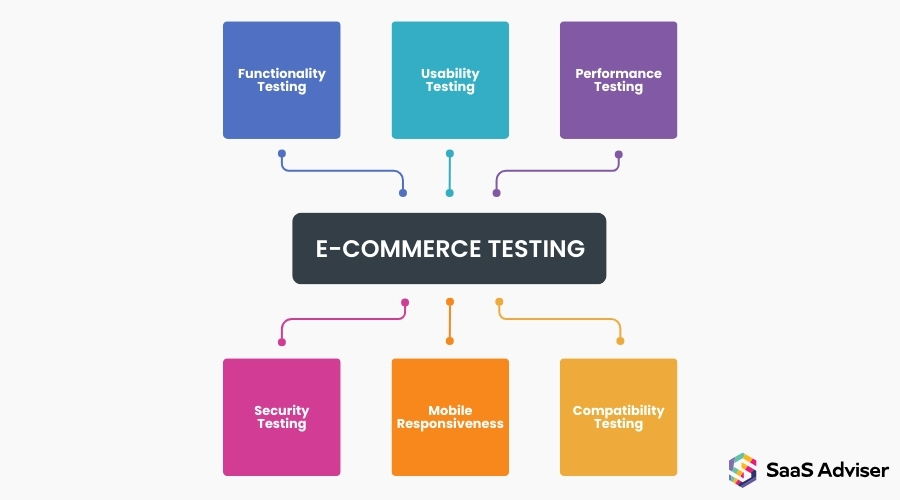
The following figure shows key areas or dimensions of e-commerce website testing.
Let us discuss each of these dimensions.
-
Functionality Testing: This is the key dimension to ensure all the features of the online website/store are working as expected. In functional testing, product filters, search capabilities, ordering and checkout process, payment gateway integration, and so on are tested thoroughly.
-
Usability Testing: Here, the online store is evaluated from the user’s perspective. Thus, aspects such as how easy the website is to navigate, its intuitiveness, overall shopping experience, including returning and refund, etc., are tested. With usability testing, any issues in website layout, ease of operations, and content clarity can be identified.
-
Performance Testing: This type of testing assesses the performance and responsiveness of website under normal and adverse conditions. Load testing is also carried out to check website’s performance under heavy traffic and stress. Conditions under which website becomes unresponsive are also identified so that further improvements can be made.
-
Security Testing: Security is a critical aspect of online websites. With customers shopping online, lots of sensitive information, including Personal Identification Information (PII), is entered into the website. It is the responsibility of the website to protect this PII and thereby the privacy of the customer. Thus, security testing is performed to identify any vulnerabilities, hacking threats, or any violations in compliance with data protection regulations such as GDPR.
-
Mobile Responsiveness: Almost every online store has its corresponding mobile app that offers same functionality as that of website. People also shop using their mobiles most of the time as it offers more convenience. They can shop on-the-go. Because of this, SaaS businesses have to ensure that the retail website is optimized for various types of mobile devices and should also be tested for mobile responsiveness.
-
Compatibility Testing: Businesses should also ensure that their e-commerce website works perfectly across various browsers, operating systems, and different types of devices. This way, retailers can be assured of maximum accessibility of the website.
Why E-commerce Website Testing Matters for SaaS Businesses
In online businesses, competition is intense and error margin is minimal. Saying e-commerce testing is important is an understatement. In fact, it is a necessity to keep businesses up and functioning.
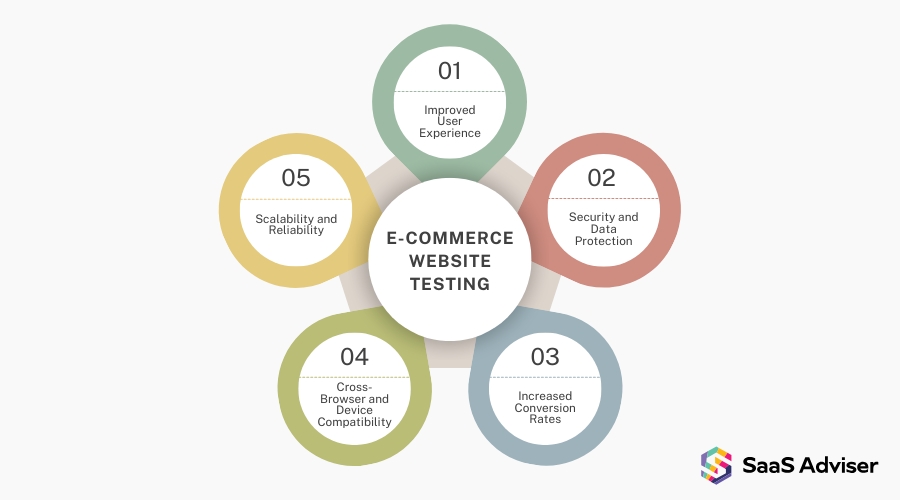
Here are some compelling reasons why e-commerce website testing is crucial to businesses.
-
Improved User Experience
Users should find the site easy to use. Customers like to come back to a site that is functioning well. Two points should be considered here for improved user experience.
- Speed and Performance: How quickly the site loads and how efficiently it performs the operations from product search to order completion is crucial to the success of online store. Any degradation in performance and speed of website functioning should be dealt with top priority so that it doesn’t affect customer view of the website.
- User Interface (UI) Testing: UI testing is part of e-commerce website testing and should be carried out regularly to ensure the website is easy to navigate, performs all the functions correctly and efficiently, design and layout is easy to follow, and customers can easily get pointers on all aspects of the website. End-to-end testing of the website also is helpful in ensuring the website functionality.
-
Security and Data Protection
As every SaaS business has a significant customer base, it is natural that the website has to handle a huge amount of sensitive data related to customers. For shopping online, customers are required to provide their credit card numbers, names, addresses, and other information for successful ordering. E-commerce testing has to ensure that this sensitive data is securely handled by the website as per the compliance guidelines. Any potential threats and security vulnerabilities should be handled promptly to ensure a seamless shopping experience.
-
Increased Conversion Rates
If a website is user-friendly and functioning flawlessly, it does not take much time for a visitor to turn into customer. This also influences conversion rates. E-commerce website testing helps test the functionality and usability of the website on various devices so that systems can be optimized to give the user a seamless shopping experience—whether they're browsing for a new phone or a premium timepiece like the Tissot PRX thereby boosting the conversion rates.
-
Cross-Browser and Device Compatibility
With variable number of devices, browsers, and operating system available for use, customers tend to use different means to access online stores. E-commerce website testing should ensure that online store works perfectly on all these devices, browsers, and operating systems. Website should be tested to ensure cross-browser and device compatibility.
-
Scalability and Reliability
E-commerce website testing is also beneficial in detecting the scalability and reliability of the website. The website’s ability to handle increase in traffic with degrading the performance is a crucial for retaining the customer base. Also, the reliability of website in unpredictable situations such as sudden network shutdown or unprecedented web traffic is also an aspect that should be considered seriously.
Challenges in E-commerce Website Testing for SaaS Businesses
Online shopping platforms are complex and dynamic in nature. Due to this, e-commerce website testing comes with challenges that are important to address to ensure the performance, security, and reliability of the website. Some of the key challenges are explained in the table below.
|
Challenge |
Description |
|
Ensuring Good User Experience across Devices and Platforms |
Customers access e-commerce websites on variety of devices, browsers, and operating systems. It becomes a challenge to ensure a seamless and consistent experience when using websites. A comprehensive compatibility test has to be performed, which is time-consuming. |
|
Handling High Traffic and Scalability |
Sudden increase in traffic during holidays and sales promotions can becomes a challenge to handle. Also performance during these times may be a bottleneck. |
|
Security Concerns |
As customer’s personal and financial information is uploaded to website, security becomes critical. Vulnerabilities have to be identified and compliance with security standards like GDPR should be ensured. |
|
Testing Complex Integrations |
E-commerce platforms integrate with many entities, such as payment gateways, inventory management systems, Customer relationship management (CRM) tools, subscription management tools and so on. These integrations pose a significant challenge if there is any issue. Extensive API and integration testing are required. |
|
Real-world testing with a Wide Range of Testing Types |
It is challenging to simulate real-world shopping scenarios to test the functionality, performance, and usability of a website. Testing also involves various types of tests as well as test mediums to ensure all aspects work perfectly. This process is quite time-consuming and laborious. |
Checklist for Testing an E-Commerce Website
Here is a comprehensive checklist for testing an e-commerce site. A tester should go through this checklist before beginning the e-commerce website testing or consider hiring specialists to outsource testing if in-house resources are limited.-
Homepage and Navigation: First of all, ensure the website homepage loads completely and correctly. Also ensure that the navigation links are displayed and takes you to expected pages.
-
Product Pages: Product information should be accurate, images loaded properly, and product prices and currency displayed correctly. A tester should verify all these details related to product pages.
-
Search Functionality: Verify that the search functionality of website is working accurately. Also test that it works efficiently and is not slow.
-
Shopping Cart: Verify the shopping cart functionality to ensure items can be added, removed, or updated from the cart.
-
Checkout Process: Verify the entire checkout process once the product is added to the cart. Test all the steps from checking out, entering shipping details, to completing payment.
-
Payment Gateway: Test various payment methods available to ensure each one works fine and completes a successful transaction.
-
Account Creation and Management: Test all the steps related to the account, such as registration, login, password recovery, and profile update.
-
Responsiveness: Test the website behavior on various devices and screen sizes to ensure that the site functions properly and all items displayed.
-
Security: Test the website thoroughly from security point of view such as SSL certificate implementation, secure payment processing, and data encryption.
Tools for E-commerce Website Testing
Here we have listed some of the tools used for e-commerce website testing.
-
testRigor
When the tests are repetitive and time-consuming, they can be automated to speed up feedback and reduce human error. Generative AI-based test automation tools such as testRigor offer this automation of tests. The testRigor tool allows you to create AI-driven scripts and compose end-to-end scenarios in plain English. Most of the website functionality can be automated using this tool, which saves considerable time and effort.
-
Selenium
Selenium is a web application testing automation tool that supports all the major browsers. It also enables test script writing in multiple languages. Selenium is a perfect cross-browser tool for e-commerce websites.
-
JMeter
This is an open-source tool, mostly used for load testing and performance measurement. It simulates heavy loads to test e-commerce website behaviour and measure its site strength and performance during heavy traffic.
-
BrowserStack
BrowserStack is a cloud-based testing tool. This is a tool that is mainly used for testing functionality across various browsers and devices. The tool can help in e-commerce testing as these websites also function across devices and browsers.
-
BugBug.io
Bugbug.io is a user-friendly no-code automation tool. Repetitive tasks like the checkout process can be effectively tested using this tool. Tool also supports cloud execution across various browsers and devices.
-
OWASP ZAP
This is an open-source security tool that helps to identify vulnerabilities in web applications. By testing e-commerce websites using this tool, sites can be protected against potential security threats.
Conclusion
E-commerce website testing ensures that the online shopping website is secure, robust, and provides a seamless user experience. It is a continuous process and requires attention to detail and a clear understanding of the user’s expectations. SaaS businesses should seriously invest in e-commerce website testing to safeguard their website operations, enhance customer satisfaction, provide secure website operations, and establish themselves competitively in the online marketplace.


.jpg "Cloud Payroll Solutions: The Future of Payroll Management in USA")