
What we'll cover
Share with your community!


Get Free Consultation


Graphic Design: Understanding Its Types and Why It Matters
-min.jpg) Ankit Patel
Ankit Patel
Visual communication is the heartbeat of modern branding. Graphic design involves more than just picking colors; it is a strategic process that combines art and technology to communicate ideas. By using a mix of typography, imagery, and layout, a professional graphic designer transforms a simple concept into a powerful message.

Looking for Graphic Design Software ? Check out SaaS Adviser’s Best Graphic Design Software in USA for your business.
Effective graphic designing is not a luxury but a necessity for any business aiming to establish authority. When you look at graphic design examples like the iconic Nike swoosh or the clean interface of a SaaS platform, you see how different forms of design work together to create a lasting impression.
What Is Graphic Design?
At its core, graphic design is about visual communication. It is a discipline where professionals create visuals to convey ideas clearly and effectively. By using structure, layout, typography, and imagery, designers organize information in a way that helps users understand and interact with content more easily.
Many people assume it is only about making things look attractive, but graphic designing is primarily about solving communication challenges. A graphic designer evaluates the audience, the platform (print or digital), and the purpose of the design. Whether it is a billboard, a mobile interface, or even content enhanced through video editing, graphics in design connect a brand with its audience in a clear and purposeful way.
Do You Know?
High-quality graphic artwork can increase a viewer's desire to read content by 80%. This is why good graphic design is considered a high-ROI investment for any marketing strategy.
Types of Graphic Design
Understanding the different types of graphic design helps you identify which type of graphic designer you need to hire or which discipline you want to specialize in.
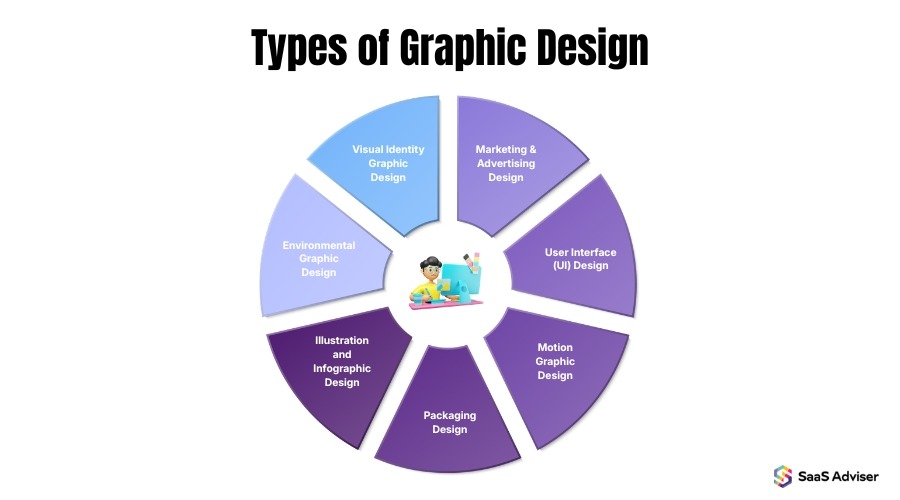
1. Visual Identity Graphic Design
This niche serves as the foundational face of a brand, focusing on the visual elements that communicate a company’s personality and values. A graphic designer in this field creates essential assets like logos, specific color palettes, and unique typography to ensure brand recognition.
2. Marketing & Advertising Design
Marketing design is the most visible branch, specifically crafted to influence the audience's purchasing decisions and drive high conversion rates. This category includes social media graphics, digital banner ads, email templates, traditional print posters, magazine spreads, and even content created for video marketing campaigns.
3. User Interface (UI) Design
UI design focuses on the interactive and visual experience of a user within a digital product, such as a mobile app or a SaaS platform. A graphic designer specializing in UI creates the look of buttons, menus, and layout grids to ensure the software is both beautiful and easy to navigate. These types of designers often collaborate with UX experts to bridge the gap between technical functionality and visual delight.
4. Motion Graphic Design
Motion design is a rapidly growing field that brings graphic artwork to life through animation, video editing, and cinematic effects. This includes everything from animated logos and social media reels to title sequences in films and complex data visualizations. By adding the element of time and movement, different types of graphic designers can tell more complex stories that capture attention longer than static images.
5. Packaging Design
Packaging design is a unique discipline that sits at the intersection of graphic design and physical product engineering. Every bottle, box, or bag on a shelf is carefully designed to protect the product while simultaneously acting as a silent salesman to the consumer. This design type requires a deep understanding of print processes, materials, and 3D space to ensure the brand looks as good in person as it does online.
6. Illustration and Infographic Design
Custom illustration and infographic design falls into its own distinct and highly versatile category within graphic designing. This includes original graphic artwork created for editorial content, explainer graphics, data visualizations, icon systems, and branded storytelling. A strong infographic, for example, can increase web traffic by up to 12% compared to text-only content, according to HubSpot data. Illustrations also give brands a unique visual personality that stock photography simply cannot replicate.
7. Environmental Graphic Design
Environmental graphic design connects people to physical spaces through signage, wayfinding systems, murals, exhibitions, and branded retail interiors. You encounter it in airport directories, museum displays, hospital corridors, and office environments designed to reflect a company's culture.
How Graphic Design Impacts Social Media Marketing
In 2026, social media marketing is purely visual. If your graphic designing isn't up to par, users will simply scroll past. Research shows that posts with high-quality graphics in design receive 2.3 times more engagement than those without.
-
Brand Recognition
Maintaining consistent types of design across platforms like Instagram, LinkedIn, and X allows your audience to identify your business instantly in a crowded feed. When a graphic designer uses a unified color palette and font set, it reinforces your brand identity every time a user scrolls past your content.
-
Trust and Credibility
In the digital space, users instinctively judge a company's professionalism by the quality of its graphic artwork. Investing in good graphic design signals that your business is established and pays attention to details. By showcasing high-quality graphics in design, you create a sense of reliability that encourages potential customers to engage with your services and trust your expertise.
-
Viral Potential
Creative graphic design examples, such as well-researched infographics or striking visual data, are shared significantly more often than plain text or stock photos. These different forms of design, along with video management strategies, are designed to be snackable and highly shareable, which naturally expands your organic reach without requiring extra advertising spend.

Pro-tip
On LinkedIn, posts with custom-designed images receive 98% more comments than text-only posts. If you are not investing in social media graphic design, you are leaving engagement on the table.
5 Key Graphic Design Elements
To create effective visuals, you must understand what to design as a graphic designer. These five elements are the foundational building blocks of every great piece of graphic artwork. Mastery of these elements allows different types of graphic designers to manipulate how a viewer feels and where they look.
1. Line
As the most basic element of graphic designing, lines serve multiple functional purposes. They can be straight, curved, thick, or thin, acting as dividers or connectors within a layout. A skilled graphic designer uses lines to lead the viewer’s eye toward important information, such as a Call to Action button or a headline. In different forms of design, lines also convey mood horizontal lines suggest calmness, while diagonal lines imply movement and energy.
2. Color
Color is perhaps the most influential tool in graphics in design because it triggers immediate emotional responses. For example, blue often represents trust and stability, while red can signify urgency, passion, or danger. Understanding color theory allows types of designers to create high-contrast visuals that stand out.
3. Shape
Every design type relies on shapes geometric or organic to create areas of interest or to organize complex information. Circles are often perceived as friendly and inclusive, while squares represent strength and efficiency. By combining various shapes, a graphic designer can create a visual hierarchy that makes a piece of graphic artwork easy to navigate at a glance.
4. Texture
Even in digital graphic design, texture adds a sense of physical touch and depth, making the visual experience more immersive. It can make a flat digital ad appear as though it has a glossy, metallic, or paper-like finish. By using texture strategically, different types of graphic design can evoke specific sensations, such as the ruggedness of outdoor gear or the smoothness of high-end skincare packaging.
5. Typography
This is the art of arranging text to make the message both legible and visually appealing. A graphic designer must choose fonts that reflect the brand's voice serif fonts for a traditional look or sans-serif for a modern, tech-focused feel.
How Graphic Design Benefits Your Business and Why It Matters
Investing in professional graphic designing is not just an aesthetic choice; it is a calculated business strategy that yields high returns. Here is how good graphic design impacts your bottom line:
It Saves Money in the Long Run
Poorly designed files can be incredibly expensive to fix, especially if they are sent to print with low resolution or incorrect dimensions. Hiring a professional graphic designer from the start ensures that your files are in the correct format for every medium. For instance, if you spend $500 on a professional logo now, you won't have to spend $2,500 rebranding in a few months because your initial graphic artwork was unscalable or off-trend.
High Conversion Rates
Whether it’s a landing page for a new software or a physical flyer, good graphic design serves as a roadmap that guides the user toward the button. High-quality graphic design examples consistently show that clear visual hierarchies and strong calls-to-action lead to significantly better sales results. Professional types of designers know how to eliminate visual clutter, making the decision-making process easier for your customers.
Improved Market Position
In a sea of competitors, unique different types of graphic design help your business secure a premium market position. If your competitors rely on generic, free templates and you invest in custom-tailored graphic artwork, you immediately appear more established and trustworthy. This perceived value allows you to justify higher pricing and attracts a more loyal customer base that values quality and professionalism.
8 Key Principles of Graphic Design
Every piece of great visual work whether it is a logo, a landing page, or a product label is built on a set of proven principles. These principles are what separate professional graphic design from guesswork.
1. Alignment
Alignment is the principle that ensures every element on a page has a visual connection to something else. Nothing should be placed randomly every line of text, every image, and every shape should line up with a clear intention. When alignment is strong, a design feels organized, clean, and easy to trust. When it is missing, even beautifully crafted individual elements can make a layout feel chaotic and unprofessional. Good graphic designers treat alignment not as a minor detail but as the invisible grid that holds an entire composition together.
2. Balance
Balance refers to the distribution of visual weight across a design. A composition feels balanced when no single area dominates the layout in a way that feels unintentional or uncomfortable to look at. Symmetrical balance where elements mirror each other creates a sense of formality and stability, which is why you often see it in legal, financial, and luxury brand graphic design. Asymmetrical balance, on the other hand, feels dynamic and modern, distributing weight unevenly but still creating harmony.
3. Contrast
Contrast is one of the most powerful tools in graphic designing because it is what makes things stand out. It works by placing opposing elements side by side light against dark, large against small, bold against thin, warm color against cool color. Strong contrast directs the viewer's eye immediately to the most important part of the design. Without contrast, everything competes equally for attention, and the result is a flat, forgettable layout.
4. Repetition
Repetition is the principle that creates consistency and visual cohesion across a design or a broader brand system. When you repeat colors, fonts, shapes, or patterns intentionally, you build a visual rhythm that makes your brand instantly recognizable. Think of how a well-designed brand uses the same typeface across its website, packaging, and social media that repetition is what makes the brand feel unified rather than scattered.
5. Proximity
Proximity is about using physical closeness to communicate relationships between elements. When items are grouped together, the viewer naturally assumes they are related and when they are spaced apart, the viewer reads them as separate ideas. This principle is especially important in layouts with a lot of information, such as brochures, dashboards, or infographics.
6. Hierarchy
Visual hierarchy determines the order in which a viewer processes information what they see first, what they notice second, and what they read last. It is controlled through size, color, weight, placement, and contrast. In any strong piece of graphic designing, the most critical message is the most visually dominant element on the page.
7. Color Theory
Color theory is the study of how colors interact with each other and how they affect human perception and emotion. It covers concepts like complementary colors, analogous colors and triadic color schemes. Beyond aesthetics, color carries powerful psychological associations blue builds trust and calm, red drives urgency and energy, green signals growth and health, and yellow conveys optimism.
8. White Space
White space also called negative space is the empty area around and between design elements, and it is just as important as any element that is actually placed on the page. Far from being wasted space, white space gives a design room to breathe, making it feel premium, modern, and easy to absorb. A graphic designer who understands white space knows that restraint is often the boldest creative choice you can make.
Conclusion
Graphic design is far more than making things look attractive. It is a discipline that communicates, persuades, and builds trust at scale. From the foundational principles of line and color to the diverse types of graphic design visual identity, UI, packaging, motion, and beyond each specialization plays a critical role in how brands connect with their audiences. For businesses, good graphic design is not an optional luxury. It is a core part of how you compete, convert, and grow.
The core elements are line, color, shape, typography, texture, and space each working together to create a cohesive visual composition.
Most graphic designers work with Adobe Creative Suite (Illustrator, Photoshop, InDesign), Figma for UI work, and tools like Canva or Affinity Designer for faster production needs.
The main branches include visual identity, marketing and advertising design, UI design, publication design, packaging design, motion graphics, environmental design, and illustration.
Graphic design solves communication problems visually using layout, typography, and images; illustration creates original custom artwork, often as one element within a broader graphic designing project.
The scope is enormous spanning print, digital, motion, environmental, and product design across virtually every industry worldwide, with demand growing steadily as visual content consumption increases.
Common paths include brand identity designer, UI/UX designer, motion graphics artist, art director, packaging designer, publication designer, and freelance graphic designer each requiring a different mix of skills and tools.
.jpg)
In a time when online platforms are just as important as physical stores, small-business entrepreneurs must navigate a terrain that is equal parts opp [...]

Niraj

Even in the digital economy of today, where money flows in smartphone apps and direct deposits, paystubs are still an important bit of documentation. [...]
Foram Khant

Modern business workflows look organized on the surface. CRMs track deals, contacts, and pipelines. Calendars stay full, and dashboards refresh on sch [...]