.jpg)
Every business, whether a growing startup or a large enterprise, owns physical assets that drive its operations. Machinery, vehicles, buildings, computers, and equipment all represent significant capital investment. Without a structured approach to tracking and controlling these resources, businesses lose money, miss compliance deadlines, and make poor financial decisions. Fixed asset management is the discipline that solves this problem.

Looking for Fixed Asset Accounting Software? Check out SaaS Advisor’s List of the Best Fixed Asset Accounting Software in USA for Your Business.
Furthermore, Fixed asset management is not just about record-keeping. It directly influences your balance sheet, tax liability, insurance coverage, and operational efficiency. When you manage fixed assets well, you reduce unnecessary spending, improve audit readiness, and gain real-time visibility into your asset portfolio.
What Is Fixed Asset Management?
Fixed assets management refers to the end-to-end process of acquiring, recording, depreciating, maintaining, and disposing of a company's long-term tangible assets. These are assets that a business holds for more than one financial year and uses to generate revenue, rather than selling them as part of daily trade. Think of a manufacturing plant's conveyor belt, a logistics company's fleet of trucks, or an IT firm's server infrastructure.
Essentially, the fixed asset management process covers everything: setting a capitalisation policy, building an asset register, calculating depreciation, conducting physical audits, and recording disposals. Consequently, it bridges the gap between physical operations and financial reporting, ensuring both sides stay aligned and accurate.
Key Concepts in Fixed Asset Management
1. The Fixed Asset Lifecycle
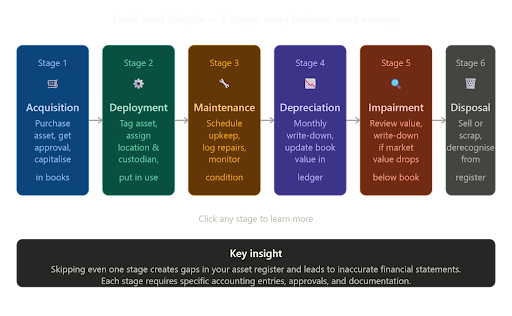
The fixed asset lifecycle describes every stage an asset passes through, from purchase to retirement. Understanding this lifecycle helps you assign the right processes, people, and controls at each stage. Below is a visual breakdown of all six phases.
2. Depreciation Methods
Depreciation spreads the cost of an asset across its useful life. Choosing the right method for fixed asset accounting affects both your profit and tax calculations. Here are the three most common approaches, with a practical example for a machine purchased at $10565.42 with a 5-year life:
|
Method |
How It Works |
Year 1 Charge (10565.42$ Asset) |
Best For... |
|
Straight-Line (SLM) |
The asset's value is reduced by the same fixed amount every year until it reaches its salvage value. |
$2113.08 / year (Assuming a 5-year life) |
Assets with consistent utility, such as buildings, office furniture, and simple fixtures. |
|
Written Down Value (WDV) |
Depreciation is calculated as a fixed percentage of the remaining book value each year. Charges are highest in Year 1. |
$2641.36 (Using a 25% rate) |
Assets that lose value quickly or become obsolete, such as vehicles, heavy machinery, and technology. |
|
Units of Production |
Expenses are based on the actual physical wear and tear (hours used or units produced) rather than time. |
Varies (Based on actual output) |
Specialised manufacturing equipment, construction plant, and mining assets. |
3. Capitalisation vs. Expensing
Capitalisation means recording a purchase as an asset on the balance sheet rather than as an immediate expense in the income statement. Your capitalization policy defines the threshold—often called the capitalization limit. For example, many mid-sized businesses set this at $ 52.83 or $105.65. Anything above the limit is capitalized and depreciated; anything below is expensed immediately. Moreover, a clearly written capitalisation policy prevents inconsistencies and audit queries.
4. Asset Register / Centralized Database
An asset register is your single source of truth. It stores every asset's details, purchase date, cost, location, assigned user, depreciation schedule, book value, and maintenance history. Furthermore, a centralized, real-time asset register is the foundation of effective fixed asset tracking. Without it, managing fixed assets across multiple locations becomes guesswork.
5. Compliance & Reporting
Government agencies and tax authorities require specific reports on your asset holdings. Accurate fixed asset accounting ensures you comply with standards like IFRS or GAAP, avoiding heavy fines during audits.
6. Physical vs. Financial Tracking
Physical tracking confirms that an asset actually exists at its recorded location, through barcodes, RFID tags, or QR codes. Financial tracking records the asset's value, depreciation, and book balance in accounting systems. Both must stay in sync. Consequently, a mismatch between physical inventory and financial records is one of the most common audit findings across businesses of all sizes.

Do You Know?
Up to 15% of assets on a typical company's balance sheet are actually ghost assets—items that no longer exist or are unusable, yet the company is still paying insurance and taxes on them.
Best Practices for Fixed Asset Management in 2026
As technology evolves, the way we handle fixed assets management must also change. Here are ten strategies to keep your system modern and efficient.
1. Establish a Clear Capitalization Policy
You should define exactly what constitutes a fixed asset for your company. By setting a specific dollar amount and a minimum useful life, you ensure that your fixed asset accounting remains consistent across all departments.
2. Maintain a Centralised, Real-Time Asset Register
Avoid storing assets in multiple spreadsheets. Instead, use a centralised database where updates happen in real-time. This is the cornerstone of managing fixed assets effectively, as it prevents duplicate entries and data gaps.
3. Implement Regular Physical Inventories & Audits
Even with the best software, you must physically verify your assets. Conduct annual or bi-annual floor-to-sheet audits to ensure that the items listed in your fixed asset software actually exist in your facility.
4. Automate Depreciation & Reporting
Many calculations are prone to human error. By automating your depreciation schedules, you ensure that your fixed asset accounting software handles the math perfectly every month, saving your finance team dozens of hours.
5. Adopt Fixed Asset Management Software
In 2026, using a dedicated fixed asset software is no longer optional for growing businesses. These platforms offer specialized features like barcode scanning and automated alerts that a general ERP might lack.
6. Standardize Procedures for Acquisitions, Transfers, and Disposals
Create a paper trail for every asset movement. If a laptop moves from the Marketing department to Sales, your fixed asset tracking system must reflect that change immediately to maintain accountability.
7. Incorporate Predictive Maintenance & AI
Modern fixed asset management tools now use AI to predict when a machine might fail. By performing maintenance before a breakdown occurs, you save money and extend the asset's lifespan.
8. Focus on ESG & Sustainability
Investors now look at how you dispose of assets. Ensure your fixed assets management strategy includes sustainable disposal methods, such as recycling electronics or donating old furniture, to boost your ESG scores.
9. Train Staff & Assign Accountability
Software is only as good as the people using it. You should train your team on the importance of managing fixed assets so they understand why precise data entry matters for the company’s bottom line.
10. Perform Regular Impairment Reviews
Don't wait until you sell an asset to check its value. If a piece of technology becomes obsolete early, record an improvement. This keeps your fixed asset accounting conservative and accurate.
Why Fixed Asset Management Matters in 2026
In 2026, the fixed asset management market remains crucial as global markets grow, with the software market expected to rise USD 2.23 billion at a 9.8% CAGR, driven by compliance and financial transparency needs. Here's why it matters:
- Financial Accuracy: Accurate asset values produce reliable balance sheets and prevent costly restatements.
- Tax Optimization: Correct depreciation claims, especially under the WDV method, to reduce taxable income legally. A $10 lakh asset miscalculated over five years can result in lakhs of rupees in excess tax paid or penalties imposed.
- Audit Readiness: Complete, documented asset records cut audit preparation time significantly and build auditor confidence.
- Insurance Coverage: Accurate valuations ensure you carry the right level of insurance, neither underinsured nor paying excess premiums.
- Capital Planning: Lifecycle data and predictive maintenance insights help leaders plan asset replacements and capital budgets proactively, rather than reacting to failures.
Pro Tip:
Tag every new asset with a rugged QR code or RFID tag the moment it arrives at your loading dock. Immediate tagging is the best way to prevent an asset from disappearing before it ever makes it onto your digital register.
Conclusion
Fixed asset management is one of the most financially significant and most overlooked disciplines in business accounting. When you build a solid fixed asset management process, you protect your balance sheet, control costs, stay compliant, and extend the productive life of every asset you own. For the record, with AI-powered tools and purpose-built fixed asset software available today, there is no reason to rely on manual spreadsheets or disconnected systems. Start by auditing your current asset register, establishing a capitalization policy, and evaluating software that fits your scale. The result is a leaner, more accurate, and audit-ready finance operation, built to grow with your business.
It ensures accurate financial reporting, tax compliance, optimal asset utilisation, and audit readiness, directly protecting your business's bottom line.
Any tangible asset held for more than one accounting year and used to generate revenue, such as land, buildings, machinery, vehicles, and computers, qualifies as a fixed asset.
The three primary methods are Straight-Line Method (SLM), Written Down Value (WDV), and Units of Production, each suited to different asset types and usage patterns.
It is the six-stage journey of an asset: Acquisition → Deployment → Maintenance → Depreciation → Impairment Review → Disposal.
Depreciation systematically allocates an asset's cost over its useful life, reducing its book value each period while recording the corresponding expense in the income statement.