Best Leave Management System in
Are you looking for Leave Management System for your Business in ? SaaS Adviser brings you the best Leave Management System to ease your worries. In order to make your work smooth and swift, SaaS Adviser has compiled a list of the best software available. Compare the Best software features, pricing, free demo, and trial to select the best Leave Management System for your organization.
 Researched and Written by Akash Patel
Top 3 Featured Softwares


List of Top Leave Management System
.jpg "Category Image")
Get Free Consultation

ShiftBase

Solve today's chaos, grow tomorrow.
What is ShiftBase? ShiftBase is a cloud-based workforce management and employee scheduling solution designed to help businesse...
View Profile

Hooray HR
Save time on HR and create a happy team.
Hooray HR is an all-in-one HR management software designed to simplify the day-to-day tasks of small and medium-sized businesses. It streamlines HR operations like onboardi...
View Profile
Buddy Punch
By Buddy Punch
Buddy Punch is an employee time clock management software that makes it easier for business owners and team leaders to track the working hours of their employees. The software trac...
View Profile

Tellent
Make better people decisions
Tellent is a cloud-based people-management and HR platform that unifies recruiting, employee data management, performance reviews, and engagement workflows into a single system. It...
View Profile

Leave Dates
Staff Holiday Planner
Leave Dates offers a comprehensive solution for tracking, scheduling, and approving staff leave requests. Seamlessly integrated with Google and Outlook calendars, it allows emp...
View Profile

Calamari.io is an HR software that mainly deals with tracking and planning all types of time off, vacation and sick leave. The setup and use of this software are very easy so your ...
View Profile

Deel is a cloud-based global payroll and compliance platform designed to help businesses hire, manage, and pay remote employees and contractors across 150+ countries. By provid...
View Profile
WebHR is a cloud-based social HR software that handles all employee functions from the time of hire until they leave the company. The software seamlessly combines aspects of human ...
View Profile

Connecteam
Powerful Hubs, Flexible Pricing
What is Connecteam?Connecteam is a mobile-first employee management software designed to simplify and centralize daily operations for deskless and remote teams. It offers tools...
View Profile

absence.io
By absence.ioCheck How absence.io can help to automate Indian Business. SaaSAdviser provide their list of features, pricing, Free demo and Comparison with the best alternative
View Profile

greytHR is a centralized platform that helps you manage payroll processing, attendance, employee lifecycle management, and compliance in one place. With greytHR, you can process pa...
View Profile

Timetastic is a staff leave planner that is designed for modern companies. The application offers a paperless way to record staff leaves and manage their attendance. Users can swit...
View Profile
Vacation Tracker
By Vacation Tracker
The Vacation Tracker app simplifies the process of requesting and booking leaves for your organization. Team members can use the app to book any type of leave or paid/unpaid day of...
View Profile

BambooHR is a cloud-based Human Resources (HR) software designed to help small and medium-sized businesses (SMBs) streamline HR processes. It provides tools for managing employee i...
View Profile

LeaveBoard is a cloud-based, integrated HR software platform with intuitive time-off management features, such as automated leave tracking, to help simplify employee time-off booki...
View Profile
PurelyHR
By Ironflow TechnologiesCheck How PurelyHR can help to automate Indian Business. SaaSAdviser provide their list of features, pricing, Free demo and Comparison with the best alternative
View Profile

What is Factorial?Factorial is an all-in-one human resources (HR) software designed to simplify and automate HR processes for small and medium-sized businesses. The platform of...
View Profile
actiPLANS
By ActimindCheck How actiPLANS can help to automate Indian Business. SaaSAdviser provide their list of features, pricing, Free demo and Comparison with the best alternative
View Profile

isolved
Have HR Headaches?
What is isolved?isolved is a comprehensive human capital management (HCM) platform designed to streamline HR, payroll, talent, and workforce management processes. Built for modern ...
View Profile

Sage HR
For every stage of business
Sage HR is a cloud-based human resource management software designed to streamline HR processes for small to mid-sized businesses. It helps organizations manage core HR functio...
View Profile

Table of Content
What Is Leave Management Software?
Leave management software is a comprehensive solution that automates the entire process of employee time-off requests and approvals, tracking, and reporting. This software helps organizations streamline their employee time-off processes. It also helps in reducing errors and paperwork and works for organizations of all sizes, especially those using payroll software in the USA. It brings fluidity to business operations by syncing the leave records with time tracking and workforce management software. As part of the employee leave management system, it helps in providing consistency in employee records by ensuring the company policy is implemented regularly while also ensuring legal compliance when operating across multiple locations or employee roles.
1. Five Best Leave Management Tools in the USA
Here are five well-regarded options offering various features and pricing tiers to suit businesses of all sizes.
1. Vacation Tracker
Employees may request time off easily using the interface with Slack, Google Workspace, and Microsoft Teams, so it does not interrupt their regular routines. If your startup or remote team is seeking a simple, easy leave management tool, this platform is a fantastic choice. The absence of performance analytics and full HR integration features doesn't detract from its appeal to small to medium teams who benefit from its straightforward interface and rapid onboarding process.
Features:
-
Automates tracking all types of employee paid time off.
-
Shows current and upcoming absences, preventing scheduling issues.
-
Integrates with Slack/Microsoft Teams
-
Enables tailoring leave rules, accruals, and approvals to fit company needs.
-
Provides insights into leave usage and trends for informed decision-making
Pros:
-
Easy setup and user-friendly interface
-
Seamless integration with popular tools like Slack.
Cons:
-
Mobile app may have occasional glitches
-
Some users desire more reporting customization.
Pricing: The pricing starts at $1 per user/month
2. Gusto
Gusto is a widely used HR and payroll software in the USA, offering built-in time-off tracking, payroll processing, and benefits management in a unified dashboard. It is perfect for small teams or startups that want a one-stop system instead of juggling multiple tools. Gusto’s HR leave management software is easy to set up, even for businesses without a dedicated HR department, and works well for handling everything from direct deposits to paid leave policies. While it is more focused on U.S.-based compliance, it is a solid pick for those wanting a reliable, all-in-one solution.
Features:
-
Connects payroll data with other systems seamlessly.
-
Manages health insurance, retirement plans, and other employee perks easily.
-
Automates tracking and management of employee time off.
-
Records employee work hours and supports accurate payroll calculations.
-
Keeps businesses compliant with labor laws and tax regulations.
Pros:
-
User-friendly interface
-
Great customer service.
Cons:
-
Pricing can be higher, particularly for growing businesses.
-
Reporting features may be limited.
Pricing: The pricing starts at $49/mo + $6/mo per person
3. Buddy Punch
This tool started as a time tracking SaaS platform but evolved to support leave tracking, overtime, and scheduling. Its simple UI calendar makes it easy for managers to view who is in or out. While it lacks broader HR features, it works well as a leave addition to the best employee scheduling software.
Features:
-
Records employee work hours accurately via web or mobile apps.
-
Allows managers to create, edit, and distribute employee work schedules easily.
-
Restricts clocking in/out to specific, predefined geographic locations.
-
Uses Face ID on iOS devices to verify employee identity during clock-in/out, preventing buddy punching.
-
Manages and tracks all types of employee time off, including accruals and requests.
Pros:
-
Easy to use
-
Offers multiple clock-in/out options.
Cons:
-
Lacks client billing functionalities.
-
Some users experienced occasional mobile app glitches.
Pricing: Monthly pricing for the starter pack begins at $5.49per user/month + $19 base fee per month, and yearly pricing starts at $4.49per user/month + $19 base fee per month
4. Replicon
Replicon is built for larger teams that need detailed, flexible leave tracking, especially when managing compliance across different regions. It lets you track time off by project, which is helpful if your team is spread out or tied to billable work. The platform’s reports are deep and useful, but for smaller companies without a full HR setup, it might feel a bit much to manage.
Features:
-
Helps businesses adhere to diverse international labor laws and regulations.
-
Accurately tracks time spent on projects for billing and cost analysis.
-
Automates and streamlines the approval process for submitted timesheets.
-
Provides instant insights into time, expenses, and other workforce metrics.
-
Facilitates recording and processing employee expenses, often linked to projects.
Pros:
-
Strong technology and integration with other vendors
-
Highly efficient in tracking time and managing projects.
Cons:
-
Can be more expensive
-
Customer service can be inconsistent.
Pricing: The pricing starts at $6/month
5. Zoho People
Zoho People is part of the Zoho suite and includes everything from onboarding to employee absence management software. Its leave module supports custom workflows, geographic policies, and calendar integrations. It’s a strong pick for growing businesses looking for a budget-friendly, scalable system.
Features:
-
Allows tailoring leave types, accruals, and rules to specific company needs.
-
Supports creating tiered approval processes for leave requests.
-
Provides a visual overview of employee leave, aiding in resource planning.
-
Automatically updates leave balances, reducing manual effort and errors.
-
Helps manage and track various holidays, considering different regions and policies.
Pros:
-
Cost-effective solution with flexible pricing
-
Strong integration with other Zoho products.
Cons:
-
User interface can be complex for new users
-
Mobile app has limited functionality.
Pricing: The pricing starts at ₹48/user/month, billed annually
2. Latest Market Trends in Automated Leave Management Systems
As HR tech evolves, automated leave management systems are adopting AI, mobile-first design, and wellness-focused innovations. According to the insights given by Verified Market Reports, the leave management system market, valued at USD 1.5 billion in 2024, is expected to climb to USD 3.2 billion by 2033, growing at a CAGR of 9.2% from 2026 to 2033
1. Employee Wellbeing Integration
Leave tools are increasingly incorporating mental health tracking, leave fatigue alerts, and wellness leave categories. When combined with HR leave management software, these tools allow HR to create targeted wellbeing programs that encourage healthy time-off habits and reduce burnout.
2. Real-Time Notifications and Alerts
From Slack alerts to mobile push notifications, today’s tools ensure instant communication on approvals, overlaps, and leave policy changes. These real-time features reduce confusion and help maintain smooth workflows across departments—even more valuable when synced with the best time clock software.
3. AI-Driven Employee Insights
AI is now being used to detect patterns in absenteeism and suggest interventions. For instance, if one team is overusing sick leave, the system may recommend redistributing workload or reviewing leave policies. When integrated with absence management software, such insights can prevent productivity dips.
4. Integration with Other HR Systems
Modern tools focus on seamless connections with payroll, performance, recruitment, and customer onboarding software. The goal is a unified experience across the entire employee lifecycle. This also eliminates redundancy and allows HR to manage all processes from a central hub.
5. Mobile-First Design
With the rise of remote and frontline workers, leave tools are now built with mobile usability at their core. Employees can apply for leave, view calendars, and check policies on the go. Apps that combine leave tracking with workforce management software are particularly helpful for distributed teams.
3. Conclusion
Adopting a robust leave management software for businesses is essential for organizations seeking to reduce administrative friction, improve compliance, and create a transparent work culture. Whether you're using a dedicated HR leave management software or exploring options for free leave management software, the right tool will help you align employee needs with organizational goals. Look for platforms that integrate with your existing stack, from payroll software USA to workforce management tools, and prioritize ease of use, scalability, and data accuracy. With the right system in place, your HR team can focus less on paperwork and more on building a healthier, more engaged workforce.
4. Features of Absence Management Software in the USA
Today’s U.S.-based companies need tools that adapt to diverse work environments and regulations. Here’s what to expect from high-quality absence management software.
1. All-in-One Dashboard
A central dashboard might show you at a glance who is off, who has been approved, and how much time you have left. Human resources and managers benefit from this since it aids with organization. It is most effective when used in conjunction with time tracking SaaS platforms or employee scheduling in order to provide visibility in real-time.
2. Configurable Fields
You can set up several forms of leave, make holiday calendars, and put up guidelines for how different groups of employees can earn time off. This adaptability ensures that your absence management software stays up to date and compliant if you are in charge of hybrid teams or several geographies.
3. Cloud-Based Accessibility
You can access cloud-hosted platforms from any device at any time. Accessibility is a must today as remote work is the norm. Cloud tools also make it easy to connect with other HR systems and make changes quickly.
4. Auto-Update Leave Balances
With every approved leave, balances update instantly—eliminating manual updates or payroll errors. Tools that double as employee absence management software often offer alerts when balances are low or unused leave builds up.
5. Customizable Approval Workflow
You can define workflows based on hierarchy, department, or employee type. This is crucial for businesses with matrixed structures. Flexible rules reduce approval delays and improve accountability.
6. Seamless Integration
Top solutions integrate with payroll software, HRIS, and best time clock software to ensure consistent data. This saves time and makes sure that paychecks and time logs indicate time off correctly.
7. At-a-Glance Reporting
Visual charts and exportable reports show trends like frequent absenteeism or unused leave. When combined with broader employee absence management software, they help HR make data-driven staffing and wellness decisions.
5. How Does a Leave Tracking Tool Work?
Modern employee leave management systems are designed to optimize time efficiency for both staff members and human resources personnel. The chaotic nature of emails and paperwork disappears as employees access a portal or app to submit their time off requests. The request navigates through an automated approval pathway defined by organizational hierarchy structures or customized regulations. Upon approval, the system modifies leave balances without delay and integrates with your payroll or time tracking tool. Certain platforms display collective team availability, which helps prevent scheduling conflicts and resource shortages. The tool enables HR departments to develop customized reports, keep compliance logs, and easily integrate with time tracking tools.
6. Steps to Choose the Best Leave Management System for Your Business
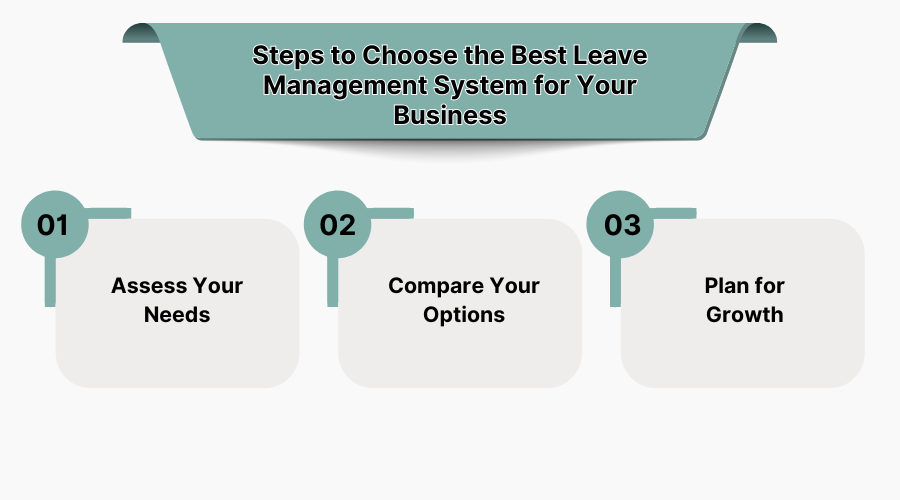
Selecting a leave tracking tool involves more than just choosing a software, you also need to consider your team's size, organizational structure, and future goals.. An intricate evaluation process guarantees that your leave management system addresses existing issues while remaining scalable for future company expansion.
1. Assess Your Needs
If you are running a business that maintains both internal staff and remote employees, it might be advantageous to link a company's leave management program to other HR software, such as employee scheduling software or workforce management software. New or small businesses will be able to take advantage of free trials of HR leave management software, so they can see if the system works for them and if they want to spend money on it.
2. Compare Your Options
Check vendor reputation, user reviews, support services, and feature lists. Tools offering integration with customer onboarding software or best employee scheduling software often provide additional value. Demos and trial versions can help you evaluate usability and fit.
3. Plan for Growth
Try to find a service that can grow with your business as it adds more locations, employees, or regulations. Your leave management platform needs to be able to adapt to your changing needs, regardless of whether you are onboarding 20 or 2000 employees. If you're planning long-term, going with a cloud-based setup that has open APIs can really help. It not only cuts down integration headaches but also saves costs over time. Plus, it makes your system easier to scale when your needs grow.
7. Challenges in Leave Management Programs
Even though it is crucial, leave management is often treated as an afterthought until problems arise. Some of the common issues companies face without the right tools are:
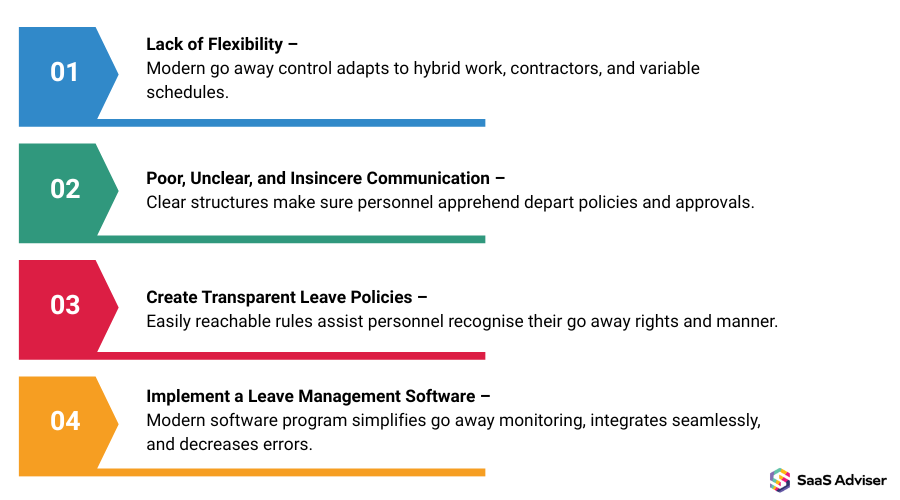
1. Lack of Flexibility
Older systems usually aren’t built for today’s hybrid setups. Legacy solutions don't make it easy to handle exceptions for contractors, remote workers, or team members who work variable hours. HR personnel have to handle leave requests by hand when they don't have a contemporary, scalable leave management platform. This might cause delays, mistakes, or unhappy employees. The lack of flexibility can also make it harder to integrate with tools like time tracking SaaS or labour management software, which makes things worse.
2. Poor, Unclear, and Insincere Communication
Without a clear set of policies and systems to work with, there is hesitation in requesting or taking leave by employees. This might lead people to miss work or cause conflicts. An efficient leave management system makes sure that there is no space for doubt by clearly stating the rules and the steps needed to get approval. Managers don't have to say the same thing over and over, which saves them time, and staff know what is expected of them.
3. Create Transparent Leave Policies
Workers might be confused about their leave periods, the process for requesting it, and any applicable exclusions if company regulations are difficult to understand or locate. These guidelines are laid forth clearly and consistently in good employee absence management software. It also helps HR teams include rules for different regions, which is great for teams that work in different places or countries. This clarity helps create a fair and respectful workplace.
4. Implement a Leave Management Software
Companies sometimes put off updating their leave management systems because they are afraid of the high learning curve that comes with doing so. On the other hand, sticking with inefficient practices that have seen better days usually ends up costing more in the long run, not to mention making workers unhappy. The good news? Most modern HR leave management software providers offer step-by-step migration, onboarding help, and even free leave management software trials. Plus, many tools today are built to plug right into your existing stack, whether it is workforce management software, customer onboarding software, or employee scheduling tools.
8. Criteria for Selecting the Right Leave Management Platform
Selecting the right leave management platform really comes down to what your business needs right now—and where you are headed next. It is not just about features on paper. A good leave management tool should update you without delays, work well with what your team already uses, and give you room to scale when things start getting busy
1. Customisation & Configurability
If you are managing employees across different regions or remote locations, flexibility in your leave system is not optional, rather, it is essential. The best absence management software will let you define custom leave types, set location-based holidays, and adjust approval rules as needed. This flexibility also helps you align your policies with your company’s processes, like employee scheduling or whatever best time clock software you are using to track attendance.
2. User Experience & Accessibility
Your team should have a system that is not only powerful but is also easy to use. They should have the ability to use the software regardless of whether it is through a desktop or a mobile device. Employees should also find it as easy to request leave as they do checking shift schedules in the best employee scheduling software that is perfectly suited for the business needs. A self-service portal reduces HR queries and increases adoption across departments.
3. Integration with Other Tools
A good automated leave management system should work with other HR technologies, such as payroll, onboarding, and performance systems. Platforms that can additionally integrate with customer onboarding software are even more useful for firms that deal with customers. The idea is to have one HR system that doesn't let you enter the same information twice and makes it easy to make changes right away when you need to.
4. Real-Time Reporting & Dashboards
HR teams using live dashboards can spot issues without delay. No more waiting around—they can notice trends, run quick reports, and react in the moment. This kind of quick insight helps with staffing plans, budgeting, and real decisions. When it is paired with absence management software, it also becomes easier to flag recurring time-off patterns or unusual PTO habits before they start affecting team performance.
5. Customer Support & Onboarding
Good onboarding and support are very important, whether you're using a free HR leave management software or paying for an enterprise platform. The best providers have dedicated account managers, knowledge bases, and training webinars. This is helpful for small HR teams that require a quick and easy way to set things up.
9. Benefits of a Leave Management System
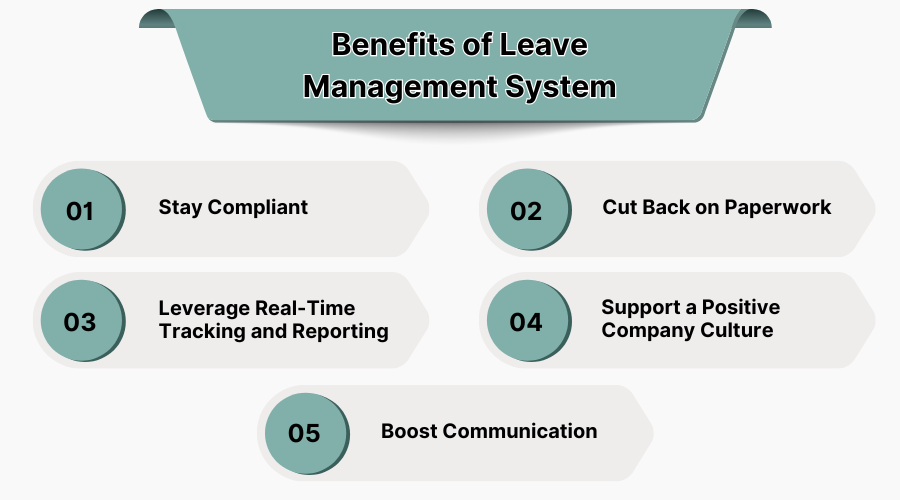
A good leave management software makes your time-off rules more organised, clear, and equitable. It makes administrative work easier and helps businesses stay within the law.
1. Stay Compliant
A robust system helps enforce local and global leave laws, from PTO accruals to FMLA compliance. This is very important in other countries like the U.S. because employment laws are different in each state. HR leave management software that works with other systems has built-in notifications and rule-based controls that lower the risk of violations or lawsuits.
2. Cut Back on Paperwork
HR teams can save time and eliminate errors by swapping out manual tracking with an automated leave management system. Employees also gain visibility into their balances without waiting for updates. This is especially helpful in globalized environments where time tracking is done using a time tracking SaaS tool.
3. Leverage Real-Time Tracking & Reporting
Live dashboards can help managers to monitor employee leave balances, understand absence visibility, and optimize their workload scheduling. There are integrated systems that include employee absence management software, which can allow managers to better inform the staff about their projects. Reports like these simply provide you with the tools to assist with workforce planning, with the added costs to your business as well.
4. Support a Positive Company Culture
A clear, transparent leave management program builds trust among employees. It ensures fairness in approvals and allows people to take well-earned breaks without administrative hurdles. When tied to broader workforce management software, it encourages balance, engagement, and productivity.
5. Boost Communication
With built-in notifications, calendar syncing, and employee self-service dashboards, modern automated leave management systems eliminate the guesswork. Everyone knows who is off and when, without endless emails. Managers get alerts in real time, and team members can plan workloads better. This kind of collaboration is even more important in hybrid workplaces or worldwide teams that have to deal with varied time zones and rules.