

You snap a photo of the new shoes you have and upload it. Friends comment, like, and inquire on where they came from. That is what works with customer photos. In 2025, this energy will become a form of marketing used by businesses. Such user-generated content (UGC) as photos creates credibility and triggers interest. When customers are ready to be sold to by means of authenticity, it is good to use their images. This article discusses the eight best practices in utilizing the photos of your customers in marketing.
Customer photos just give what marketing flourishes on and that is a real relationship. They present products in our day-to-day life and this makes the brands familiar. With the declining popularity of traditional ads, UGC becomes noticeable. Such photos are easy to get and show with tools such as Yotpo. By 2025, any business that neglects to pay attention to the photos of a customer will have a problem with its credibility. This tutorial plunges into the technical plans to tap their power properly.
What Are Customer Photos in Marketing?
The customer photos constitute samples posted by clients to display products. They are either on social, review sites or brand websites. These are real life photos, which serve as testimonials to its products. They are natural unlike the brandished brand images that enhance consumer faith. They are easier to collect and display using tools such as Yotpo, which they include into marketing campaigns.
They increase their popularity since they bring conversions. Research indicates that UGC helps to increase click through by 40%. Photos are powerful since patrons believe advert placement on peers more than they do on advertisements. In their absence, social proof is lost to the brands putting at risk reduced engagement. The AI tools provided by Yotpo support companies in selecting and presenting such images so that they will be relevant and effective in the competitive world in 2025.
8 Best Ways to Use Customer Photos in Your Marketing:
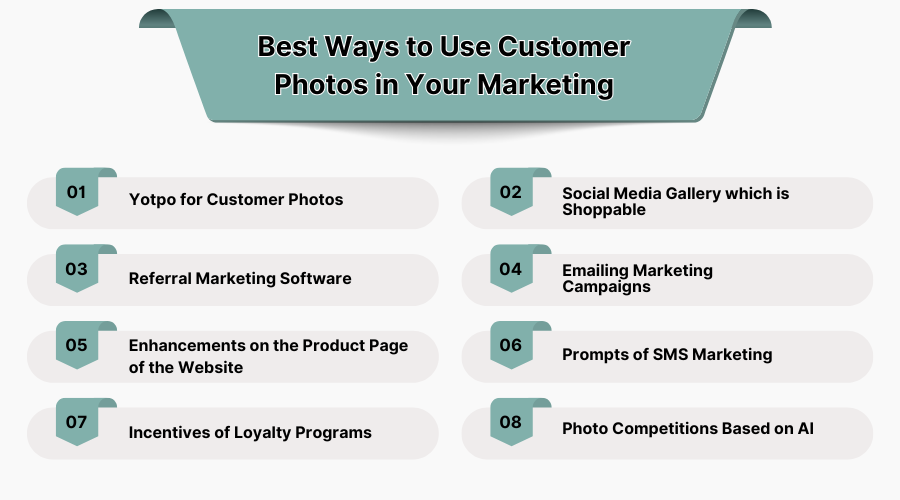
1. Yotpo for Customer Photos
Yotpo is the best at utilizing customer images to market. It uses UGC on its site that is gathered through automated post-purchase prompts. These requests can be sent in SMS or email and they require photos of reviews. Yotpo has an AI that checks the submissions, resulting in excellent photos. This stimulates the creation of a rich depot of genuine imagery of campaigns. Yotpo for customer photos boosts trust with AI-driven, personalized UGC collection. Many brands also collaborate with UGC creators to source authentic visuals that align with their community’s voice and strengthen brand trust.
The tool is compatible with eCommerce systems such as Shopify and Magento. It plugs in shoppable galleries into product pages and associates photos with an option to buy. Yotpo API also gives an opportunity to create custom widgets and show images during checkouts. This raises a 24% conversion rate. Engagement is followed in real-time analytics and photo placement is optimised to the best extent.
The capability of Yotpo is scalability. It has thousands of submissions every day which it manages on cloud. Companies get access to deep-ended statistics, such as selection of photos based ads. Yotpo enables conversations without wasting time and possibly performing inconsistently with manual curation. It is the most favored photo marketing of 2025 as it is extruded and reiterated.
2. Social Media Gallery Which is Shoppable
Using shoppable galleries, photos on social media can become a selling factor. Applications such as Instagram enable one to tag photos using product links. These galleries are stocked with the images of the customers who shared them with hashtags. JavaScript files download photos into branded sites, forming interactive screens.
It is done using OAuth authentication to retrieve user posts. With AI filters, it only streams the best and pertinent photos. The friction involved in purchasing is minimized by the use of click-to-buy links whereby an image is embedded with a purchase link. Analytics monitor the activity in photos showing which photos convert. This strategy boosts the sales by an average of 15 percent.
3. Referral Marketing Software
Referral marketing software amplifies customer photos through advocacy. It also calls upon users to share photos using distinctive linking behaviour. Photo-driven referrals are traced by such links placed in social postings. Apps such as ReferralCandy automatically give rewards, with a discount on profitable sharing.
Technologically, these applications utilise APIs to keep in sync with social media. They create links to the viewable photos that are traceable. Referral traffic and conversions are monitored with the help of analytics dashboards. JavaScript widgets place photo-sharing invitations on the web pages and make participation rise. This system increases organic reach by 30 percent as it uses trusted networks of users.
4. Email Marketing Campaigns
The use of customer photos increases engagement during email campaigns. There are photos in customized emails, demographic images of actual users. UGC pulls APIs on marketing platforms through review systems. The dynamic content blocks show photos, depending on the behavior of the users, such as historic purchases.
Embedded images are sent using SMTP servers. CSS guarantees flexibility with regard to the devices utilized. A/B testing tools help to optimize subject lines and placement of the photos. The click-throughs and open rates are tracked through analytics and campaigns are refined. According to the industry statistics, the addition of a customer photo to the email will raise the conversion by 20 percent.
5. Enhancements on the Product Page of the Website
Customer photos polish the product pages. They have UGC and also stock photos which they show together, giving it authenticity. Review websites provide API to access photos, which are embedded in an HTML widget. Lazy-loading means a quick page speed, which is beneficial to the SEO.
AI algorithms sort out photos in terms of relevance and quality. JavaScript can provide zoomable galleries which increase user experience. Photo interactions are tracked by heatmap analytics and layout is optimized. Research indicates that the display of customer photos on the pages selling goods increases conversion by 30%. This technical installation creates confidence in the sales.
6. Prompts of SMS Marketing
The SMS campaigns encourage customers to post the photos. There are upload links placed in post-purchase texts. Using the Twilio API allows sending SMS in bulk and providing them with trackable URLs. AI checks the quality of submissions and gives usable content. This is a way of gathering photos in large amounts.
Analytics measure the SMS-open rates, and the number of submissions of photos. Truncated are able to decrease the number of characters leaving more room to develop the message. Legal compliance is guaranteed using Opt-in compliance. Photography campaigns facilitated by SMS get an open rate of 98 percent as very high compared with email.
7. Incentives of Loyalty Programs
Photo sharing is rewarded by means of loyalty programs. The points can be achieved by posting or uploading an image on a social media or a review site. APIs match synchronization points with online retailers. Blockchain allows the process of reward tracking to be transparent which creates trust.
JavaScript widgets show balances of the points used on the user dashboards. The push notifications prompt customers to post photos. Analytics report on rewards redemption and photos engagement. Photo incentive programs have a 25 percent higher retention rate. This technical structure makes users become active proponents.
The day loyalty incentives are lacking, photo sharing steps into the ruts. Keeping rewards manually is full of errors. There is smooth execution of automated systems. When brands reward the photos of customers, they encourage them to be loyal and produce UGC which is essential to success in marketing in 2025.
8. Photo Competitions Based on AI
Photo-related photo contests supported through AI make users active. Brands often run contests online to encourage customers to submit photos and engage with their products. AI rates the entries using quality and relevance. Social media and APIs combine to increase the contest's reach.
HTML 5 forms capture metadata photos. Machine learning prioritizes, eliminating manual work. Leaderboards are developed using JavaScript and present real-time top entries. Tracking the engagement of contests and conversion is done through analytics. According to the trends in the industry, the photo collection increases by 40% in contests.
Manual contests are inefficient regarding time and prejudiced. AI guarantees justice and productivity. Hosting photo contests, the brands collect the UGC of high quality. The campaign will be used to spur action and power up the marketing campaign in 2125.
Conclusion
They will be the marketing gold 2025 customer photos. They develop trust, increase conversions and achieve genuine relationships. With tools such as Yotpo, photo-incentive collection and displaying become automated. These methods include shoppable galleries, SMS reminders, and other ways of using UGC. There is technical precision such as AI filtering and API integrations that guarantee scalability. Neglecting customer schemes is equivalent to irrelevance in a market with a high sense of trust.
Brands should move fast in order to remain competitive. Photo effect is enhanced with the use of referral software, loyalty programs, and AI contests. Analytics can track ROI and it has its worthiness. The eight approaches create advocates of customers since they lead to growth when the business embraces them. Customer photos are no longer welcome in 2025, but are a key to success.