
.jpg "What is Video Screening Interview and How it Works for HR?")
In today's aggressive recruitment environment, U.S. companies are increasingly using digital solutions, such as video screening interview, which have acquired a lot of traction and provide recruiting executives and HR professionals with a modern, adaptive, and efficient approach to evaluating job candidates. Understanding how a video screening interview operates is fairly beneficial for any company that feels it has an advantage in its recruiting game, whether they are slightly ahead, on par, or can quickly catch up.

Looking for the Video Interview Software? Check out SaasAdviser’s List of the Video Interview Software
In this blog, we find out how video screening interviews work, why they are modern work, and how the HR team can use them effectively.
What is a Video Screening Interview?
A video screening interview is front-loaded with questions that candidates answer on video, either live or recorded, to be conducted as an initial exploratory dialogue preceding the more penetrating conversations. Unlike the conventional phone screens, it provides the visual context of the body and face and expressions of the individual to add one more dimension to the assessment of the candidate.
This online-first method matches changing staff models and helps virtual check-ins that are used in today’s remote work setting. For HR heads who do not know terms like what is pre-screening interview or what is screening interview, this way shows the next change in how to look at candidates.

Pro Tip:
When using one-way video interviews, keep the questions clear and concise. This helps candidates stay focused and gives you better-quality responses to evaluate.
How Video Screening Interviews Work For HR Teams?
For Human Resource Departments throughout the nation, video screening interviews offer a time-efficient and scalable alternative to traditional interviews. Typically it works thus:
1. Job Posting and Application Review
The HR teams initiate the process by posting job openings on the company’s website, job boards, or even on social media channels. These listings generally comprise details about the role, the qualifications required for that role, and also a small note indicating that the candidates would go through a video screening interview process. As applications start coming in, the recruiters review resumes to filter out the unqualified candidates before moving forward.
2. Candidate Invitations
Applicants selected will have to complete a video interview using a platform chosen by the employer. Shortlisted applications are followed by an invitation from the HR team, who use a video interview screening application/ App to record video answers. It includes a link to the platform, how to go about it, and sometimes even the questions. This lets the candidates complete the interview at their timing; there is no need to coordinate live calls.
3. Candidate Response Recording
Candidates log into the Video Interview Screening App and are shown pre-set questions. They answer by recording themselves with the help of a webcam or mobile camera. Most systems have things like time limits, retry restrictions, or guided prompts to make the process fair and the same for all applicants.
4. Recruiter Review and Evaluation
Once the video&a have been uploaded, the recruiters log into the Video Interview Screening Application and begin watching the candidate, pausing, and if need be watching them again to assess their communication skills, body language, confidence levels, and job-specific knowledge. Some tools may also have AI-based analytics or scoring features to help give an objective view.
5. Shortlisting Candidates
HR teams watch the video interviews and review the initial application to be able to then assign scores or notes against each candidate, after which they collaborate to shortlist the top promising candidates for the next phase. The rest are kept in the pipeline. These candidates are then scheduled for live interviews or any other assessment that may be deemed necessary.
Fun Fact:
Companies that use video screening tools reduce their time-to-hire by up to 50%—saving both time and hiring costs.
Benefits of Using Video Interview in 2025
The video screening interview stands out as a vital tool for U.S.-based human resources departments looking to streamline their hiring procedures as the requirement for the best candidates keeps on increasing in 2025.
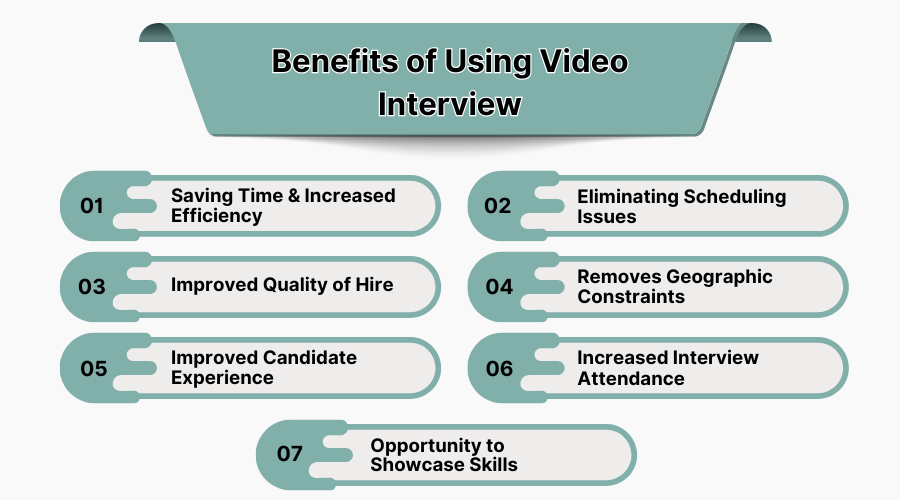
1. Saving Time & Increased Efficiency
Logistics often pose a great challenge for setting up traditional interviews. With the video screening interview, more candidates can be assessed in less time, which reduces the process of the interview. This, in turn, enables HR to quickly evaluate many candidates, tighten the hiring funnel, and consider only the most qualified applicants, potentially saving hours of manual effort.
2. Eliminating Scheduling Issues
One-way video interview screening removes the back-and-forth scheduling. Candidates can do this at their own pace, and reviewers can do it at their convenience. Conventional interviews take a lot of back-and-forth to figure out a suitable time. In video interview screening, candidates can record their answers at their convenience, and then recruiters can review them at their convenience.
3. Improved Quality of Hire
A video screening interview should be based on visual and verbal cues that would provide a better understanding of the candidate’s communication skills and professionalism, which are strong determinants of potential performance. The global market size for video interview software was $ 0.41 billion in 2024 and is estimated to increase to $ 0.83 billion by 2033, performing CAGR of 8.1% during the forecast period. The use of both verbal and non-verbal cues gives the recruiter a better insight to make an informed decision, which, in turn, leads to making a higher quality hire who is more likely to meet the expectations and needs of the company.
4. Removes Geographic Constraints
Companies can widen their talent base outside of local applicants. The virtual screening interview enables firms to assess candidates from other regions—of the world—without bearing travel expenses. Video interview screening removes the travel or relocation imperative in the first steps, allowing companies to attract a larger talent pool. Whether the candidate is from the same locality or some distance away, they can take part equally in the hiring process.
5. Improved Candidate Experience
Applicants of today desire flexibility. The ease of video screening makes for a more candidate-friendly experience, and it also betters employer branding. Easy video screening reflects well on the brand and shows commitment to the style of recruitment practices that is modern today.
6. Increased Interview Attendance
This will widen the window through which HR can peer at responses. As a result, there will be a higher show-up rate of candidates due to the fact that they have the liberty to pick the time and mode of the interview. This will generate a broader set of responses for HR to consider. There is no need for work time off or personal schedule adjustments. This makes a fuller evaluation pool and prevents missing out on potential top performers.
7. Opportunity to Showcase Skills
A video assessment provides employers with deep insight into the personality and communication ability of a candidate, which helps evaluate the characteristics that go beyond the originally written resume. This makes it easier for the bosses to understand a person’s real potential. Some of these websites let a person upload their work and even do a screen share to show good work.
Looking for the HR Software USA ? Check out SaasAdviser’s List of the HR Software USA
What are the Types of Video Screening Interviews?
The choice between the two common types of video screening interviews depends on the goals of your organization, as well as its timeline and the nature of the role.
1. Real-time Video Interview
A real-time video interview, or live video interview, takes place between the interviewer and the interviewee using a video conferencing tool. This particular modality most closely approximates the dynamics of a face-to-face interview in real-time interaction. Spontaneous follow-up questions can be asked immediately based on the responses of the candidate. It also gives an opportunity to assess the 'soft skills' of the candidate, for example, communication and confidence. The real-time interviews should be used through the middle to end stages where more interaction and assessment are required.
2. One-way Video Interview
This type does not require all candidates to log in at the same time. Instead, it lets them record answers to questions already set. It can be very useful for hiring in large numbers since it gives recruiters the choice to review answers when they can best do so. In the one-way video interview, candidates are able to record answers to a set of predefined questions at any time suitable for them, without a live interviewer, and the HR team can then watch these responses whenever they like.
You May Also Read How HR Software Can Boost Employee Engagement in USA Firms
List of Best Video Screening Tools & Applications
Discover the best video screening tools that interview the HR team and change the shortlist candidates.
1. Hireflix
Hireflix is a one-way video interviewing platform designed to streamline the candidate screening process with asynchronous video interviews.
Key Features:
- One-way video interviews
- No app installation for candidates
- Custom branding and white-labeling
- Question timer and retake limits
- Shareable candidate responses with stakeholders
Pros:
- Simplifies the screening process for high-volume hiring
- Excellent user experience for both recruiters and candidates
Cons:
- No live video interview option
- Limited integrations compared to larger platforms
Pricing: Starts at $75/month for up to 30 interviews. Custom pricing for the enterprise.
2. MyInterview
MyInterview offers smart video interview tools powered by AI to help you hire the right candidate faster and more efficiently.
Key Features:
- AI-powered candidate insights and ranking
- One-way and live video interviews
- ATS integrations (e.g., Greenhouse, JobAdder)
- Custom branding
- Collaborative evaluation tools
Pros:
- Free plan available for startups and small businesses
- AI analysis improves candidate shortlisting
Cons:
- Limited advanced features in the free plan
- AI recommendations might need manual review
Pricing: Visit the website and get a quote for custom pricing.
3. HireVue
Hirevue is a video interview and corporate-class AI assessment platform used by fortune companies for high-level hires.
Key Features:
- On-demand and live video interviews
- AI-driven candidate assessments
- Coding challenges and game-based assessments
- ATS & CRM integrations
- Enterprise-grade compliance and security
Pros:
- Robust analytics and AI tools for large-scale hiring
- Strong global support and compliance
Cons:
- Can be expensive for small to mid-sized businesses
- Some concerns around AI transparency and bias
Pricing: Visit the website and get a quote for custom pricing.
4. VidCruiter
Vidcruiter is an adaptable video interview solution designed for structured recruitment and conformity industries such as health and authorities.
Key Features:
- Live and asynchronous interviews
- Structured interview guides
- Automated scheduling
- ATS & CRM integration
- Multi-language and accessibility support
Pros:
- Highly customizable and scalable
- Designed for structured and compliant hiring
Cons:
- Complex setup may require training
- Premium pricing for advanced features
Pricing: Visit the website and get a quote for custom pricing.
5. Willo
Willo offers a flexible and user-friendly video interview platform perfect for remote-first and global hiring teams.
Key Features:
- One-way video interviews
- GDPR and CCPA compliance
- Integration with 5,000+ apps via Zapier
- Mobile- and desktop-friendly interface
- Multi-language support
Pros:
- Simple, clean interface for easy onboarding
- Scales well for growing teams
Cons:
- No live interview capabilities
- Basic analytics compared to competitors
Pricing: Starts at $249/month.
Conclusion
The workplace continues to evolve, and the video screening interview has increasingly become modern recruitment. It not only enhances decision-making and saves time but also opens the doors to a broader and more diverse talent pool. Whether a Best video interview screening solution or a Free video interview screening option is available, adoption of this technology can significantly evolve the approach to finding the right fit for the job - for making the right hiring decision.