
.jpg "ERP-Driven Commerce: How to Integrate SAP with Your eCommerce & SaaS Stack (PIM, CRM, CPQ)")
In a world where online sales grow year after year, businesses face the challenge of connecting fragmented systems for seamless operations. ERP integration turns data chaos into a unified stream that accelerates growth. SAP serves as a reliable anchor, linking e-commerce with SaaS solutions like PIM, CRM, and CPQ. This isn’t just a technical task — it’s the foundation for a scalable business, where every integration drives real sales. Let’s break down how it works in practice.
What Is ERP Integration?
The company can Hybris developers to ensure seamless integration of SAP Commerce Cloud with systems like PIM, CRM, and CPQ. The goal is to build reliable bridges between your ERP and other enterprise platforms, enabling real-time data exchange without delays or duplication. ERP integration meaning, in this context, refers to the creation of a unified digital environment where business processes — from product management to customer engagement — are synchronized across departments. That’s why many businesses turn to experienced Hybris developers to unlock the full potential of SAP Commerce Cloud.
The difference between integrated ERP and disconnected setups is huge. In a disconnected setup, teams spend hours on manual entry, risking mistakes. The integrated approach creates a single source of truth: everyone sees real-time data, which simplifies reporting — marketing can see how PIM data impacts CRM campaigns without version conflicts. As a result, businesses grow faster: companies with integrated ERP systems increase revenue by ~15% annually because ERP data integration directly impacts scalability.
The Role of SAP in Modern Commerce
SAP has long held its position as a leader in enterprise resource planning integration. Adidas uses SAP Commerce Cloud with PIM and CRM for seamless omnichannel operations, processing millions of orders daily. Siemens integrated CPQ with SAP ERP, cutting quote time by 50%. And Unilever? Their cloud ERP integration with SaaS enables demand forecasting using ML, minimizing waste.
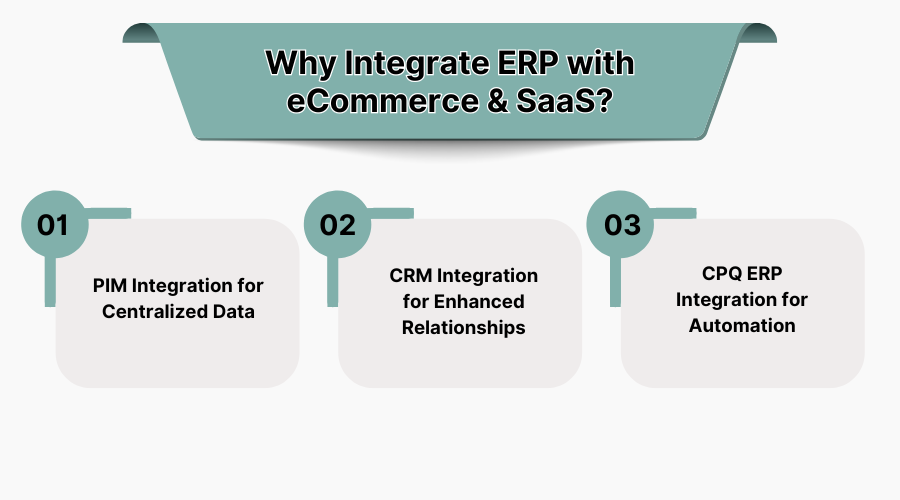
Why Integrate ERP with ECommerce & SaaS?
Businesses without centralized management risk falling behind. Cloud ERP integration with PIM ensures uniform product data, reducing errors.
PIM Integration for Centralized Data
ERP integration creates a golden record: all attributes from PIM flow into SAP, updating eCommerce in real time.
Benefits of PIM-ERP integration:
-
Consistent catalogs across channels;
-
Automated enrichment workflows;
-
Reduced time-to-market for new products.
After implementation, clients report up to 40% improvement in data accuracy, with no duplicates in the database.
CRM Integration for Enhanced Relationships
CRM with ERP merges customer profiles: purchase history from eCommerce enriches CRM, while SAP adds financial insights.
Key advantages:
-
360-degree view of customers;
-
Automated lead scoring from ERP data;
-
Seamless support across touchpoints.
Without this, data remains fragmented, like in old systems where sales can't see inventory.
CPQ ERP Integration for Automation
CPQ automates configure-price-quote, pulling data from ERP for accurate pricing.
Comparison table without/with integration:
|
Aspect |
Without Integration |
With CPQ-ERP Integration |
|
Quote generation time |
2-3 days manual |
Under 1 hour automated |
|
Error rate |
~15-20% due to mismatches |
Below 2% with real-time validation |
|
Revenue impact |
Lost opportunities from delays |
Faster deal closure |
|
Scalability |
Limited by team size |
Handles high-volume B2B sales |
For manufacturing clients in the US, this became a game-changer: quotes are generated instantly, with compliance checks.
ERP Integration Methods
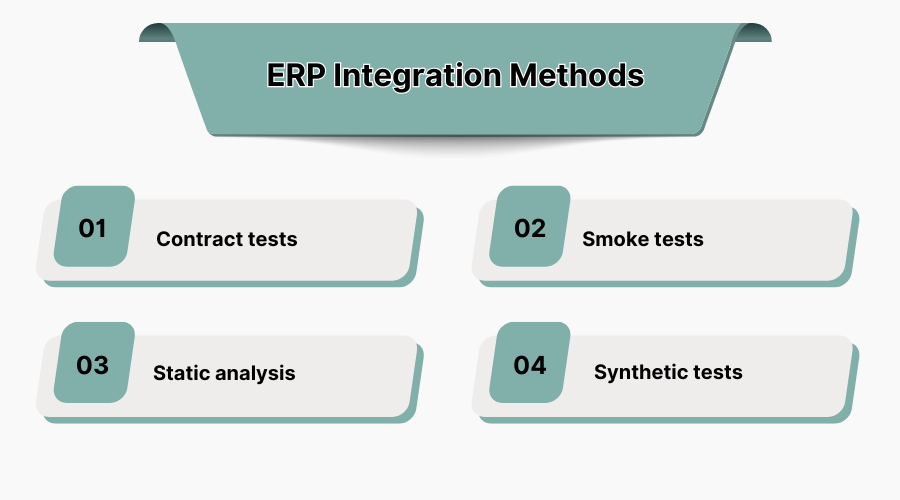
Approaches to ERP integration have evolved from manual to automated: Contract tests validate service interfaces: the consumer and provider agree on a schema without full integration. In SAP, they are used for APIs between PIM and ERP, shortening the feedback loop.
Smoke tests during deployment are a quick sanity check: the app starts, basic flows work. Ideal post-deployment, like in our CI/CD for Hybris. Static analysis scans code for vulnerabilities and dependencies. In CI, it's a must-have for ERP security. Synthetic tests simulate user journeys from cart to payment. They reveal bottlenecks in omnichannel.
|
Method |
Pros |
Cons |
|
Contract tests |
Fast execution; promotes API discipline |
Doesn't test actual data flow |
|
Smoke tests |
Quick deploy validation; low overhead |
Limited depth; misses edge cases |
|
Static analysis |
Early bug detection; security focus |
High false positives; needs tuning |
|
Synthetic tests |
Realistic user simulation; proactive |
Maintenance-heavy; resource-intensive |
Challenges of ERP Integration
Integrating SAP with SaaS isn't without pitfalls. Legacy systems are the main barrier: outdated formats aren't compatible with modern APIs, causing delays. Data silos isolate information, leading to inconsistent views. Security concerns are growing: breaches in integrations hit around 82 percent due to human error, and custom setups can consume 20-30 percent of the IT budget. Every modern integrated ERP system addresses this through iPaaS, like SAP Integration Suite: pre-built connectors minimize custom code, reducing costs. For legacy systems, phased migration with archiving is key.
Best Practices for SAP ERP Integration with PIM, CRM, and CPQ
Smooth integration starts with assessment: map business processes, and study gaps in the PIM-to-ERP process. Choose tools like SAP Suite for low-code adapters — this will accelerate your endeavors. Use phased rollouts: start with a pilot (e.g., CRM synchronization), followed by the full stack. Don't forget continuous monitoring by dashboards and fine-tuning by ML for predictive fine-tuning.
The Future of ERP-Driven Commerce
Cloud ERP integration is taking center stage: market estimates show the market hitting $130 billion in 2027, with an eye on hybrid cloud models. Artificial intelligence and machine learning are increasingly applied for predictive analytics: ERP models forecast demand based on PIM data, automating CPQ processes.
Wrapping Up: Unlock Growth with SAP ERP
ERP integration is the glue for eCommerce and SaaS, where SAP is critical for scalable commerce. From a single source of truth to AI-driven flows, it transforms operations, boosting revenue. Don't wait: analyze your stack today, integrate tomorrow.
ERP-driven commerce integration connects your SAP system with eCommerce and SaaS tools, streamlining workflows, automating data exchange, and enhancing overall business efficiency. This ensures real-time inventory, pricing, and order management across platforms.
SAP integration centralizes data from your eCommerce platform, improving order accuracy, inventory tracking, and customer experience. It reduces manual errors, speeds up processes, and allows businesses to scale operations efficiently.
Yes, SAP seamlessly integrates with PIM, CRM, and CPQ tools, creating a unified tech stack. This enables consistent product data, smooth customer interactions, and accurate quoting for complex sales processes.
SaaS businesses benefit from SAP’s robust ERP capabilities, ensuring real-time data synchronization, scalable operations, and efficient management of orders, inventory, and subscriptions—all in one connected system.