
.jpg "What to Look For in a Sales CRM For Your SaaS Startup (Insights From Founders)")
If you’re a SaaS startup founder exploring sales CRM options, chances are you’ve Googled “best CRM for startups” and ended up drowning in feature lists, pricing tables, and tools that all blur together. On paper, they seem similar. But once you’re inside, the gaps start to show. And by then, you’re already deep into onboarding.
Choosing your first CRM is a major decision—one that shapes how quickly you move, how clearly you see your pipeline, and how much time your team wastes (or saves) every day.
That’s why I spoke to real SaaS founders who’ve made these decisions. They’ve tested the platforms, made the wrong calls, and learned what actually matters.
This guide isn’t sponsored. It’s not another feature roundup. It’s what to look for in a sales CRM—based on lived experience.
Here’s what you’ll learn:
-
Why the best CRM isn’t about features—it’s about fit
-
The mistakes founders wish they had avoided
-
The non-negotiables that really matter
-
Practical questions to ask before you commit
Let’s get into it.
The CRM Decision is First About Fit, Not Features
In the early days of building a SaaS company, it’s tempting to pick the CRM that looks most impressive—something packed with features, dashboards, and integrations you think you’ll need later.
But here’s the reality: the best sales CRM for your startup isn’t the one with the most features. It’s the one your team will actually use consistently and without friction.
At this stage, you’re not managing a hundred-person sales team. You likely have a small, scrappy team juggling multiple roles. So if your CRM slows them down, feels overwhelming, or doesn’t align with how your sales process works right now, it’ll get ignored. Data won’t be updated, pipelines will go stale, and you’ll end up back where you started.
That’s why fit—not feature count—should guide your decision. A well-fitting CRM should also support buyer enablement by helping reps understand buyer intent and deliver the right information at the right time, not just track deals. Fit means asking:
-
Does this tool make it easy to log activity easily without extra training?
-
Can I see our pipeline clearly, without digging?
-
Does it work with the tools we already rely on?
Too often, founders choose CRM software based on what they might need someday, not what they need right now. But adoption matters more than capability.That’s a lesson Chris Sorensen, CEO at PhoneBurner, learned the hard way:
“A big lesson I’ve learned is to not just evaluate features—you need to evaluate adoption. I’ve picked robust CRMs on paper, only to find the team avoided using them. A tool must align with daily workflows.”
In short, choose a CRM that fits where you are, not where you think you’ll be.
Common CRM Mistakes SaaS Founders Make When Choosing
Once you understand that choosing a CRM is more about fit than features, the next question becomes: what does the wrong fit actually look like?
The answer? It’s not always obvious at first.
Many SaaS founders don’t realize they’ve made a bad CRM decision until months later when deals slip through the cracks, the sales team works outside the system, or reporting turns into a manual mess. or reporting turns into a manual mess. To avoid these issues, you can explore the most common CRM mistakes businesses make before committing to a platform. And the missteps that lead there often start early.
Here are the biggest mistakes founders wish they could undo—so you don’t make them too.
Mistake #1: Buying for Scale You Haven’t Reached Yet
It’s easy to get ahead of yourself, especially when every podcast, investor, or LinkedIn post is preaching scale.
So you start looking at CRMs with lead scoring, multi-team permissions, enterprise-level automation, and integrations you won’t need for months. The pitch sounds great: "Buy now so you won’t have to switch later."
But what actually happens? You’re paying for complexity your team doesn’t need yet, and won’t use. And the result? Your sales reps build spreadsheets on the side, you lose visibility, and the system quietly becomes shelfware.
This particular founder & CEO has seen that pattern play out too many times:
“Many SaaS founders make the mistake of selecting overly complex CRMs and justify their decision because they think they'll ‘grow into it. That’s just not a good idea, he said. “Start with something that solves your immediate needs and can scale progressively. That way your sales team will use it and get into the habit of logging data—creating that culture of accountability.”
Think of it this way: if you’re a five-person team closing 20 deals a month, you don’t need the same CRM as a 100-person org running outbound at scale. Choosing tools for a version of your company that doesn’t exist yet only slows down the one you’re trying to build.
Mistake #2: Choosing Before You’ve Mapped Your Sales Process
Another easy way to get stuck with the wrong CRM is to pick one before you've nailed how your sales process actually works.
Maybe a friend recommends a tool, or a sales rep gives you a smooth demo. But if you haven’t clearly mapped how leads move from first contact to close, you’re choosing blind.
And without that upfront clarity, you end up customizing fields on the fly. Reps aren’t sure what to enter or when. Pipeline stages mean different things to different people. Soon, you’re spending more time fixing the tool than closing deals.
That’s exactly what Paul DeMott, CTO at Helium SEO, experienced:
"If I could rewind and do one thing differently, I would have spent more time mapping out the full lifecycle from first touch to close before choosing the CRM. At the time, we were still defining stages on the fly, which meant we had to constantly tweak our workflows and reporting rules after launch. That burned way more time than expected."
It’s like trying to buy shelves before you know what you’re storing. You either overbuild or fall short and end up constantly rearranging.
Here’s a better approach: Sketch out your current sales flow first. Define what a qualified lead looks like. List out the handoffs, follow-ups, and approval steps. Only after that should you start exploring CRM options. And only pick one that fits the way you already work.
Mistake #3: Believing the Demo Tells the Whole Story
It’s easy to get swept up in a good demo. The dashboards are polished, the pipelines are clean, and everything clicks together effortlessly. But here’s what most founders learn too late: demos are designed to sell you, not support your actual workflow.
In real life, your data isn’t that clean. Your team isn’t that uniform. And your process certainly isn’t that predictable.
That gap can be costly. Maybe your team struggles to pull a report that isn’t pre-built. Or the CRM feels smooth until you try logging 40 leads from three different sources. Suddenly, what looked sleek now becomes clunky and hard to manage.
Sheraz Ali, founder of HARO Agency, has seen it firsthand:
“The CRM that looks so good at a 30-minute demo can be your operations nightmare six months later. I always tell fellow SaaS founders: talk to real users, not the sales reps, before you commit.”
So go beyond the pitch. Ask for a trial where you can test your actual workflow—your lead data, your sales process, your reporting needs. Even better, talk to founders using the tool at your stage.
Because if you’re only testing the best-case scenario, you’re not really evaluating the CRM—you’re evaluating their marketing.
Mistake #4: Underestimating the True Cost of Switching
It’s tempting to pick a CRM that fits your current needs. But many don’t fully consider the hidden costs of switching when that tool no longer fits as you grow.
Sure, you shouldn’t overbuy from day one (see Mistake #1). But it’s equally important to think about how easily your CRM can evolve with you—because switching later brings real friction.
Data migration, team retraining, rebuilding automation, reconnecting integrations… these all take time, money, and momentum. Switching CRMs during a growth phase can seriously slow you down.
That kind of disruption caught Sheraz off guard:
“I would have preferred to have determined the actual cost of implementation—data migration, training of team members, and the inevitable loss of productivity during the transition phase,” he said.
That’s why it’s critical to balance simplicity now with flexibility later. Start lean, but not so lean that the CRM breaks the moment you scale.
Joran Hofman, founder of Reditus, puts it plainly:
“Check for pricing & features you need now, and in the future. Don’t go for the cheap solution as you might end up with a 'broken system' later down the line. You don't want to spend your time migrating CRMs when it is time to grow.”
In short: don’t just optimize for today. Choose a CRM that can grow with you, so you’re not forced into an expensive, momentum-killing switch down the road. A clear CRM strategy is only half the story. Complement it with an impactful sales presentation design that brings your data and deals to life.
Must-Have Sales CRM Features for SaaS Startups
Every startup sells differently—different cycles, different stacks, different styles. But when it comes to choosing a CRM, there’s a core set of features SaaS founders and pros consistently agree on.
These aren’t just “nice to haves.” They’re the non-negotiables that make the difference between a tool your team ignores and one that drives real growth.
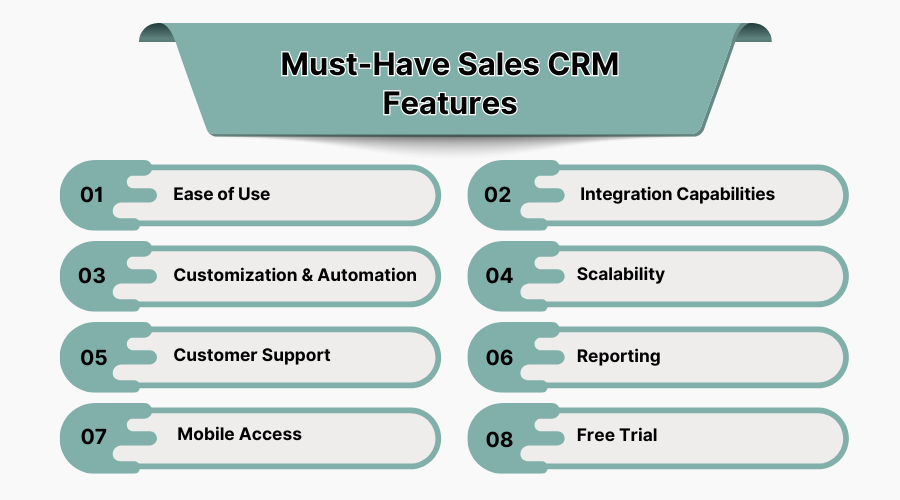
Here’s what to look for in a CRM that works now—and keeps working as you scale:
1. Ease of Use
Your CRM is only useful if your team actually uses it. Founders repeatedly point to simplicity as a deal-breaker. A cluttered UI or steep learning curve will lead to low adoption. Look for a CRM where reps can hit the ground running—drag-and-drop pipelines, easy data entry, AI-native features, and no 3-hour onboarding video required.
2. Integration Capabilities
Since your team will likely rely on a suite of different tools, like Gmail, Slack, Stripe, Zoom, Calendly, Notion, etc., integration options should be at the top of your CRM checklist. Your sales system must connect seamlessly with your marketing tools, customer success platform, and billing systems so that there is a single source of truth for what's happening across your business.
3. Customization & Automation
Off-the-shelf CRMs can feel rigid. You want one that bends to your process, not the other way around. Custom deal stages, fields, filters—plus automation for repetitive tasks like follow-up emails or lead assignments. This flexibility matters even more as your team grows and workflows evolve.
4. Scalability
Your CRM should grow with you. That doesn’t mean buying enterprise software on day one. But it does mean checking how well the tool handles more users, more leads, or deeper reporting down the line. As Joran puts it:
“Don’t go for the cheap solution—you might end up with a ‘broken system’ when it’s time to grow.”
5. Customer Support
Things will break. Questions will come up. Good support saves time, stress, and momentum. Test their response time during your trial—ideally through live chat or email. One founder shared how a fast support team saved their setup after a botched data import.
6. Reporting
You don’t just want dashboards; you want clarity. The best CRMs for SaaS founders offer reporting that highlights what’s working: conversion rates, sales cycle length, and top-performing reps.
7. Mobile Access
Sales don’t stop at the office. Whether your reps are traveling, in back-to-back Zooms, or responding on the fly, your CRM should work from their phone without a hitch. Logging calls, checking pipeline status, or updating notes should be just as smooth on mobile.
8. Free Trial
Finally, always take the CRM for a spin. A free CRM trial lets you test with your real team, real data, and real workflows, not a cherry-picked demo. It’s the best way to spot dealbreakers early before they slow you down later.
Practical Questions to Ask Before You Commit
You don’t find the right CRM by comparing feature tables; you find it by asking smarter questions.
To make a confident decision, ask the questions that get beneath the surface. Here’s a practical checklist to guide your evaluation:
-
Does this CRM truly fit our unique sales process and workflows?
-
Is the user experience simple enough for everyone to adopt quickly?
-
Does it integrate seamlessly with our existing stack?
-
Can I customize fields, pipelines, and automate repetitive tasks easily?
-
What’s the real cost and effort if we need to switch later?
-
Will it scale with our growth without forcing expensive upgrades?
-
How responsive and helpful is the customer support when issues arise?
-
Does the CRM offer reporting that goes beyond vanity metrics?
-
Is mobile access reliable for the team on the go?
-
Is the CRM GDPR compliant and secure enough for our data?
-
Does it offer a free trial or sandbox environment to test thoroughly?
Keep this list handy during demos and trials. These questions help you move beyond shiny features and get to what really matters for your SaaS startup’s success.
Conclusion
Choosing the right sales CRM for your SaaS startup isn’t just a software decision; it’s a growth decision. The best CRM fits your workflow, scales with your business, and helps your team close more deals with less friction.
There’s no perfect tool, but there is a right fit for where you are and where you're headed. Use the questions, insights, and founder lessons in this guide to move beyond guesswork—and choose with clarity. Because in the early stages of building, the right CRM isn’t just helpful. It’s foundational.
Author Bio:
Adedoyin Ogunmola is a B2B SaaS and tech writer with over three years of experience working with different brands. His writing stands out for its authenticity and quality, guided by his core philosophy: Show, don’t just tell. Adedoyin simplifies even the most complex ideas by using relatable examples and clear illustrations, ensuring readers not only understand but also engage with the content

.jpg "How Employee Recognition Software Elevates Employee Engagement in the USA")