
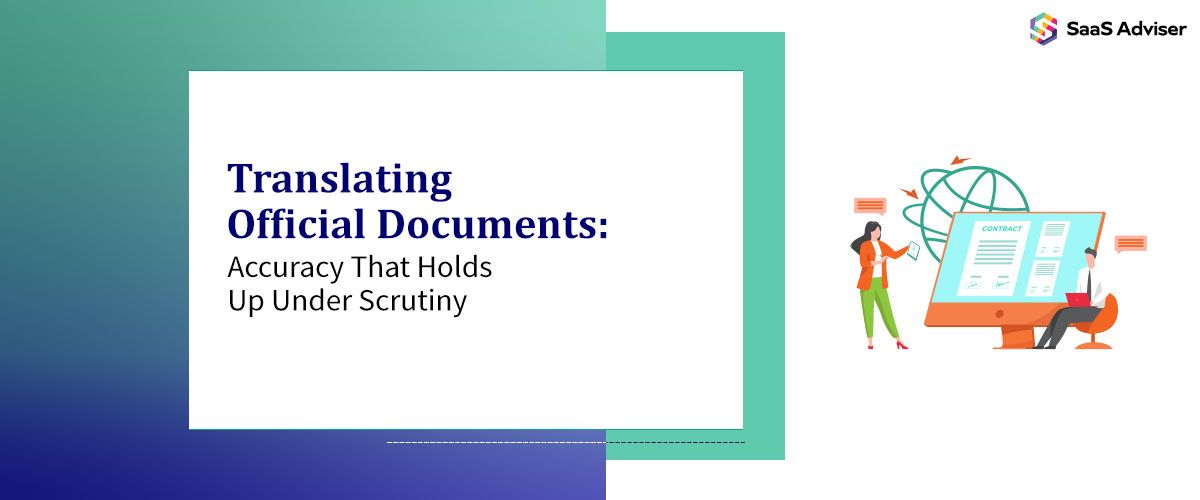
Official documents don’t leave room for interpretation. They define identity, confirm rights, establish eligibility, and carry legal weight across borders. When these documents move from one language to another, precision isn’t a preference—it’s a requirement. That’s why translating official documents is a spe32cialized discipline, not a general language task.
Whether the document is destined for a government authority, a court, a university, or a regulatory body, the expectations are exacting. Formatting must remain intact. Terminology must align with legal and institutional standards. And every word must reflect the original meaning without dilution or assumption. Miss one detail, and the entire document can be rejected.
So what does it actually take to translate official documents correctly—and consistently?
Why Official Document Translation Is Different
Unlike marketing copy or casual correspondence, official documents function as evidence. They confirm facts. They trigger decisions. They influence outcomes.
This distinction matters because translating official documents requires a controlled, methodical approach. Translators must preserve:
-
Legal intent, not just vocabulary
-
Structural accuracy, including stamps, seals, and signatures
-
Institutional terminology is often governed by country-specific systems
-
Compliance standards, especially for international submission
A birth certificate, for example, is not just a record of birth. It is proof of identity. A marriage certificate may impact immigration status. An academic transcript influences admissions and licensing decisions. The translation must stand up to institutional review without explanation or clarification.
That’s the benchmark.
Precision Over Interpretation
A common misconception is that translation allows for stylistic flexibility. Official documents allow none. Every date format, title, designation, and legal phrase must reflect the original content exactly. If a document contains inconsistencies, those inconsistencies must appear in the translation. If a section is unclear or illegible, that fact must be noted—never guessed.
When professionals handle translating official documents, they avoid “fixing” language or smoothing phrasing. Their responsibility is accuracy, not improvement. This approach protects the integrity of the original record and ensures the translated version is treated as a true and complete representation.
The Role of Certification and Accountability
Most official translations require certification. This is not a decorative stamp—it’s a declaration of responsibility.
A certified translation confirms that:
-
The translation is complete
-
The content is accurate to the original
-
No information has been added or removed
Certification ties the translator or translation provider to the work. It creates accountability. Institutions rely on this assurance because they do not evaluate translations line by line. They evaluate trust. That’s why uncertified translations, even if linguistically correct, are often rejected outright.
Formatting: The Silent Requirement
Formatting errors are one of the most common reasons official translations are denied.
Authorities expect the translated document to mirror the structure of the original. Headings, tables, margins, and spacing matter. So do annotations.
For example:
-
Seals are noted, not recreated
-
Signatures are identified, not interpreted
-
Handwritten text is labeled if unclear
When translating official documents, layout accuracy reinforces credibility. It signals professionalism. More importantly, it allows reviewers to cross-reference documents quickly without confusion.
Language Knowledge Is Not Enough
Bilingual ability alone does not qualify someone to translate official documents.
Professional translators working in this space understand:
-
Legal and administrative systems in both source and target countries
-
Terminology conventions used by courts, universities, and government agencies
-
Submission standards for international institutions
This knowledge prevents subtle but damaging errors. A term that seems interchangeable in everyday language may carry a specific legal meaning in official records. Translators must recognize and respect that distinction. That’s where training, specialization, and experience matter.
Confidentiality and Data Protection
Official documents often contain sensitive personal information—names, addresses, identification numbers, medical history, and financial details. Handling this data responsibly is part of the translation process.
Professional translation providers operate under strict confidentiality protocols. Secure file transfer, controlled access, and data protection compliance are not optional extras. They’re built into the workflow.
For clients, this matters. Trust is not just about accuracy. It’s about knowing your documents are protected at every stage.
Technology’s Role—And Its Limits
Translation technology has improved dramatically, but it still has boundaries.
Machine translation tools can assist with reference or terminology consistency, but they lack contextual judgment. They cannot certify translations. They cannot evaluate legal nuance. And they cannot assume responsibility for accuracy.
Professional translators may use technology to support efficiency, but the final output is human-reviewed, human-verified, and human-certified. That human layer is what makes translating official documents reliable rather than risky.
Common Mistakes That Lead to Rejection
Even small oversights can derail an official submission. Common issues include:
-
Missing certification statements
-
Inconsistent formatting
-
Incorrect rendering of official titles
-
Omitted marginal notes or stamps
-
Altered date or number formats
These errors are avoidable—but only when translation is treated as a compliance process, not a language shortcut.
Choosing the Right Translation Partner
If you’re submitting documents for legal, academic, or governmental use, the translation provider you choose matters as much as the document itself.
Look for:
-
Proven experience with official records
-
Certified translators, not generalists
-
Clear quality control processes
-
Transparent turnaround timelines
-
Secure document handling
The goal is simple: a translated document that is accepted the first time, without questions or delays.
Translating Official Documents with Connected Translation
Translating official documents requires more than linguistic ability. It demands technical accuracy, procedural discipline, and a deep understanding of how institutions evaluate translated records. When done correctly, the translation becomes invisible—it works, it’s accepted, and it supports the purpose it was created for.
Connected Translation approaches official document translation with this responsibility in mind, delivering certified, compliant translations that meet institutional standards and withstand scrutiny across borders.