
Choosing the right CRM software is one of the most important decisions a business can make in 2026. A powerful CRM system helps companies manage leads, close more deals, improve customer relationships, and scale operations efficiently. Among all available options, HubSpot CRM and Salesforce CRM continue to dominate the market.
Both platforms are widely trusted and offer advanced tools for sales, marketing, customer support, and automation. However, when it comes to usability, pricing, customization, and scalability, they serve very different types of businesses. In this CRM software comparison, we’ll clearly explain the difference between HubSpot vs Salesforce , who should use which platform, and why one may be a better choice for your business in 2026.
What are HubSpot CRM and Salesforce CRM?
HubSpot CRM and Salesforce CRM are powerful CRM software that help businesses organize customer data, streamline sales processes, and improve communication across marketing and sales teams.
HubSpot CRM
HubSpot CRM is an all-in-one CRM software solution designed with simplicity and usability in mind. When it comes to HubSpot vs Salesforce ease of use, HubSpot stands out due to its clean interface and quick setup.It helps businesses manage contacts, track deals, automate follow-ups, and centralize customer interactions in a single platform. HubSpot is especially popular among startups, small businesses, and service-based companies because of its clean interface, quick setup process, and generous free plan that includes core sales and marketing tools.
HubSpot focuses on:
-
Ease of use
-
Fast setup
-
Built-in marketing, sales, and support tools
-
Minimal technical expertise required
Many small business owners say HubSpot feels ready to use right out of the box, making it ideal for teams without a dedicated CRM administrator.
Salesforce CRM
Salesforce CRM is a highly powerful and customizable CRM software designed for businesses with complex sales processes and large-scale operations.In the HubSpot vs Salesforce customization comparison, Salesforce clearly offers deeper flexibility and control. It enables organizations to manage leads, accounts, opportunities, and customer data while supporting advanced workflows, automation rules, and detailed reporting. Salesforce CRM is built for growing and enterprise-level businesses that require deep customization, robust analytics, AI-driven insights, and the ability to scale across teams, regions, and business units without limitations.
Salesforce is known for:
-
Extreme customization
-
Advanced reporting and analytics
-
Large app marketplace
-
Strong enterprise and B2B focus
Salesforce is often described as extremely powerful, but best suited for companies that have the resources to manage complexity.
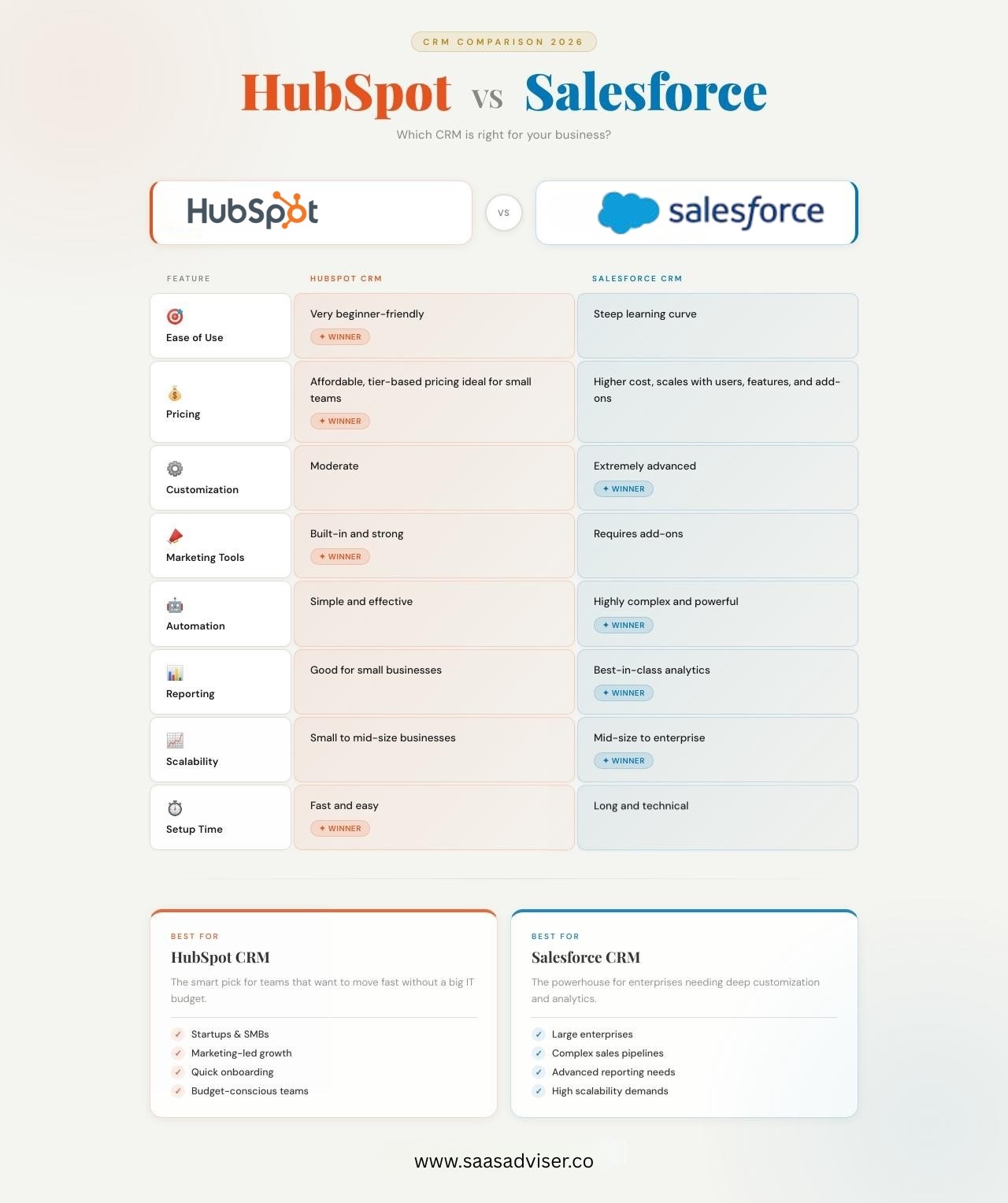
HubSpot vs Salesforce: Features And Key CRM Software Differences
HubSpot - Key features
-
Free Smart CRM (permanent free tier): Contacts, deals, tasks, activity timeline, email tracking, meeting scheduling, and basic reporting usable for small teams at no cost.
-
Marketing Hub (native inbound stack): Landing pages, forms, email marketing, workflows, lead nurturing, A/B testing, SEO recommendations and marketing analytics all in one UI.
-
CMS Hub (marketer-first CMS): Drag-and-drop pages, blogging, contact-aware content, and SEO tools integrated directly with the CRM. Good for content teams that want low-friction publishing.
-
Conversational tools built in: Live chat widget, chatbots, and a meeting scheduler tightly connected to contact records and quick to deploy for SMB sites.
-
Sales tools for SMBs: Email templates/sequences, deal pipelines, basic quoting, playbooks, and simple salesforce automation for sales reps.
-
No/low-code automation & unified UX: One workflow builder that connects marketing → sales → service actions with templates geared to non-technical teams.
-
Marketplace & APIs for extensibility: Integrations and custom objects available, but intentionally less developer-centric than enterprise platforms.
Where HubSpot Has the Edge Over Salesforce
-
A permanently free, full CRM tier with marketing + chat + meeting scheduling ready for SMBs.
-
A single, marketer-friendly CMS bundled/connected to the CRM for easy inbound content workflows.
-
Simple plug-and-play live chat + meeting scheduling + marketer UX aimed at fast time-to-value for small teams.
Salesforce - Key features
-
Enterprise platform & deep customization: Apex (code), Flow (complex automation), custom objects, advanced admin controls model nearly any business process.
-
AI + analytics at scale: Einstein AI across clouds (scoring, recommendations, agents) plus Tableau / Data Cloud for enterprise BI and visualization.
-
Enterprise integration & middleware: MuleSoft for large-scale integrations and an extensive AppExchange + SI partner ecosystem.
-
Industry & vertical clouds: Prebuilt data models and features for Financial Services, Health, Manufacturing, etc., to shorten enterprise implementations.
-
Advanced Service & Field Service: Omni-channel routing, CTI, field scheduling, work orders, and enterprise contact center capabilities.
-
CPQ & Commerce at enterprise scale: Native/first-class CPQ (Revenue Cloud) and Commerce Cloud for complex quoting, pricing rules, and large B2B/B2C commerce needs.
-
Regular platform releases (Hyperforce / Spring ’26): Ongoing platform updates for global regions, developer tooling and large-org governance.
Where Salesforce Has the Advantage Over HubSpot
-
Apex-level programmable platform and enterprise governance for highly customized, large-scale workflows.
-
Enterprise BI & broad AI agents (Tableau + Einstein) for large predictive models and cross-cloud analytics.
-
Built-in enterprise integration (MuleSoft) and mature industry clouds, CPQ and field-service suites suited to regulated/complex verticals.
HubSpot CRM vs Salesforce CRM Pricing Comparison
This HubSpot vs Salesforce pricing comparison shows how costs scale differently based on features and team size.
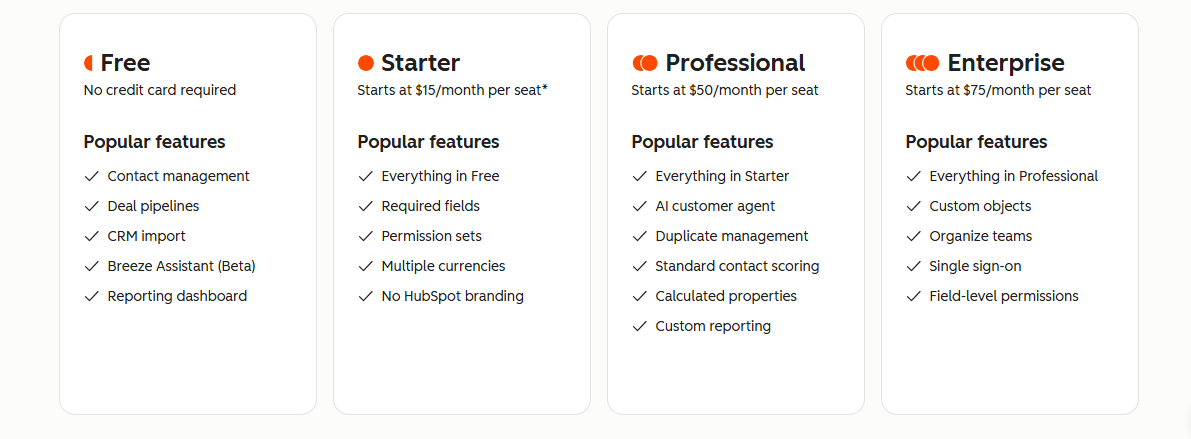
HubSpot CRM Pricing
HubSpot offers a free CRM plan with core features, making it accessible to startups and small businesses. Paid plans are competitively priced and scale based on features and team size.
-
Free ($0):
Best for startups and very small teams that need basic CRM features such as contact management, deal pipelines, CRM import, basic reporting dashboards, and limited AI assistance (Breeze Assistant beta) at no cost.
-
Starter (starts at $15/month per seat):
Ideal for growing businesses that need everything in Free plus required fields, permission sets, multiple currencies, and removal of HubSpot branding for a more professional CRM setup.
-
Professional (starts at $50/month per seat):
Designed for scaling teams that need advanced tools including AI customer agent, duplicate management, standard contact scoring, calculated properties, and custom reporting capabilities.
-
Enterprise (starts at $75/month per seat):
Built for large organizations that require advanced CRM control such as custom objects, organized team structures, single sign-on (SSO), and field-level permissions for enterprise-grade security and governance.
Salesforce CRM Pricing
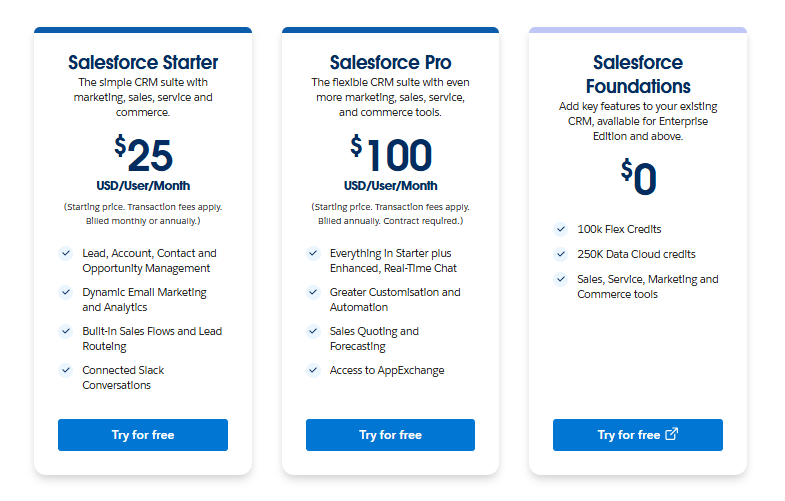
Salesforce no longer offers a true free CRM for small businesses. The platform now starts at $25/user/month with Salesforce Starter, while its $0 Foundations offering is reserved for Enterprise customers only. This reinforces Salesforce’s strength as a scalable, future-ready CRM—but requires careful budgeting as business complexity grows.
-
Starter Suite ($25/user/month):
Best for small and growing businesses that need core CRM features such as lead management, contact, and opportunity management, basic automation, email marketing, analytics, and Slack integration in one simple setup.
-
Pro Suite ($100/user/month):
Designed for scaling teams that require advanced customization, stronger automation, real-time chat, sales quoting and forecasting, and full access to the Salesforce AppExchange ecosystem.
-
Salesforce Foundations ($0 add-on):
Available only to Enterprise Edition and above customers. Foundations is not a standalone CRM and includes limited AI (Flex Credits), Data Cloud credits, and access to Sales, Service, Marketing, and Commerce tools for existing Salesforce customers.
Best CRM for Small Business sales Which Should You Choose?
The CRM market size is valued to increase by USD 75.4 billion, growing at a CAGR of 11.5% from 2024 to 2029, driven largely by the increasing adoption of CRM systems by small and medium-sized enterprises (SMEs). As competition intensifies, small businesses need a CRM that not only fits their budget but also aligns with their sales processes, growth goals, and technical capabilities.
Choose HubSpot CRM If:
-
You are a startup or small business
-
You want quick setup and easy adoption
-
You need marketing and sales tools in one CRM system
-
You are looking for the best CRM for small service businesses
HubSpot is often considered the best CRM for small business sales due to its affordability and ease of use.
Choose Salesforce CRM If:
-
You manage a large or growing sales team
-
You need advanced reporting and automation
-
You have complex sales workflows
-
You can invest in training and customization
Salesforce is ideal for companies planning long-term growth and enterprise-level operations.
Which CRM Will Drive Your Success in 2026?
There is no single winner in the HubSpot vs Salesforce debate because the best CRM software depends on your business size, growth strategy, sales complexity, and internal resources. In 2026, success with a CRM is less about having the most features and more about choosing a system that aligns with how your team works, how quickly it can be adopted, and how well it supports long-term business goals.
HubSpot CRM is ideal for small to mid-size businesses that value fast setup, ease of use, and built-in marketing and sales tools in one platform. It works especially well for teams focused on inbound marketing, lead nurturing, and quick adoption without heavy technical overhead or dedicated CRM administrators.
Salesforce CRM is better suited for enterprises and fast-growing companies that require advanced customization, automation, and deep reporting capabilities. When comparing HubSpot vs Salesforce scalability, Salesforce is ideal for large organizations, while HubSpot is better for growing teams.It is a strong choice for organizations with complex workflows, large sales teams, multiple integrations, and the technical resources needed to manage and scale a highly customized CRM environment effectively.
Conclusion
In 2026, choosing the right CRM software comes down to how well it fits your business size, goals, and internal capabilities. HubSpot CRM is an excellent choice for startups and small to mid-size businesses that want an easy-to-use CRM system with built-in marketing tools, fast setup, and predictable pricing. Salesforce CRM, on the other hand, is better suited for growing and enterprise-level organizations that need advanced customization, powerful automation, AI-driven analytics, and the ability to scale complex operations. Ultimately, the best CRM is the one your team can adopt easily, use consistently, and grow with—because long-term success depe
Salesforce leads in enterprise AI with Einstein AI, Agentforce, and Data Cloud capabilities. HubSpot offers AI tools like Breeze AI for content, insights, and productivity, but with fewer enterprise-grade options.
For many mid-size companies, HubSpot deal pipelines are better because they’re easier to use, quicker to adopt, and require less admin effort. Salesforce opportunities are stronger when sales processes are complex and need advanced customization, forecasting, and reporting.
HubSpot Marketing Hub is usually better for small businesses due to its all-in-one tools, lower setup complexity, and faster results. Salesforce Marketing Cloud is more powerful but suits larger teams with advanced personalization needs and higher budgets.

.jpg "Best CRM System for Recruitment: Features, Benefits & Tools")