

Why Emails Go Unread?
Email communication is a hard nut to crack, for sure. Nearly one in five companies spend up to 10% of their marketing budgets on emails, only to see those emails sent to the trash in many cases. If you don’t w1ant this to happen to you, you have choices. Invest the time to understand why your emails sit unopened or unread. Follow these tips to make your emails rise to the top, and you’ll get more than just the satisfaction of knowing that people read them.
Reasons People Don’t Open Emails
If you’re agonizing over the read rate of your business’s communications, evaluate the open rate first. People avoid opening emails that they find irrelevant, inappropriate, or poorly timed. Consider these possibilities while you work on improving your email strategy.
-
Overfull Inboxes
For some people, sifting through emails is like looking for a needle in a haystack. The average person has more than 1,000 unread emails in their inboxes. It’s an average, which means that some people have many more. Only about a third of people keep their boxes at zero. So if your emails are getting buried, it’s not surprising. You have to compete with work emails, personal messages, and lots of spam. If you want to get ahead of the pack, you need to refine your strategy.
-
Emails Come Too Frequently
Big business knows that people’s inboxes are full of garbage. Their email frequency adjusts accordingly. Ever been surprised by a company sending you five emails a day about a particular sale? Keep in mind that everyone gets those emails. Frequency can be an advantage in that people really can’t miss the messages that you send. But if you constantly bury them in overlapping content, they’ll reach for the unsubscribe button faster than you can imagine. Consider frequency as a major part of your strategy. It’s better than shooting in the dark and hoping you hit the target.
-
Spam Filters Reclassify Emails
Although spam filters aren’t perfect, they are getting better at removing irrelevant content from the primary inbox. Of course, that might mean that your messages get lost in the sorting. Researchers estimate that at least half of emails sent each day are spam. Spam filters look for a variety of things. Is your email address authenticated? Do you write engaging content that your audience actually cares about?Do you avoid using language that sounds spammy? Building sender reputation gradually with the help of an email warmup tool can also reduce the risk of your messages being flagged. Pay attention to the rate at which your subscribers mark your content as spam, as it may be pretty enlightening.
Why People Don’t Read Emails
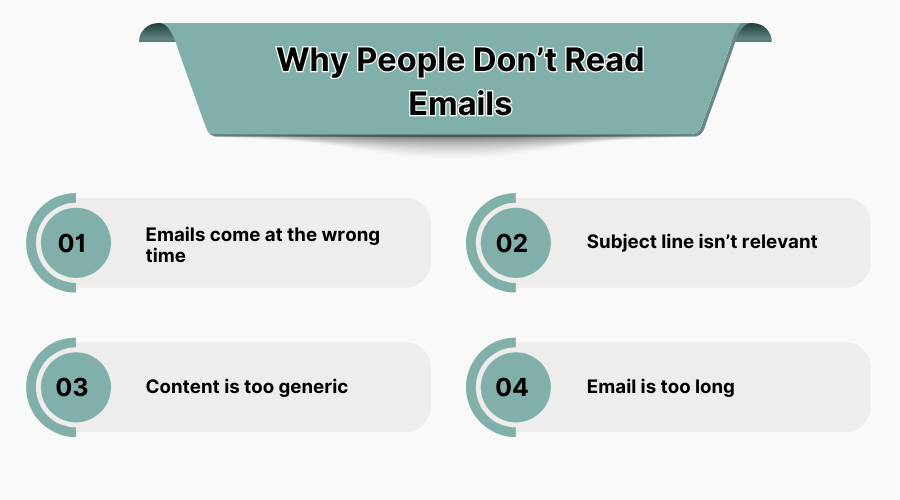
Picture it: You sit down to look at your inbox, and it seems jam-packed with sludge. You click on the first message, and it doesn’t relate to you at all. You’ve just discovered how people can open an email and still not read it. Think about these factors that affect read rates.
-
Emails Come At the Wrong Time
In many cases, emails can’t compete with everything else. We live in a world where people are expected to engage with everything in real time. Trying to stay on top of work, home, and social life can make it hard for people to focus. The research reflects this reality. The American Psychological Association noted that in the last couple of decades, attention span has shrunk significantly. If your email gets lost because you sent it at night or on the weekend, it’s on you. You can find the right time to send an email, based on content type and other factors.
-
Subject Line isn’t Relevant
You’re probably familiar with email subject lines that don’t tell you anything useful. Were you more likely to click to learn more? If you clicked, did you scroll to get more context? Or did you just delete and move on? To get people to read the message, the subject line is what matters most. It must be engaging, simple, and easy to understand. If you can’t meet those requirements, your readers are unlikely to dig into the content for more information.
-
Content is Too Generic
People spend a lot of time each day checking their email. They look for relevance. Most of the time spent on the inbox goes to quick checks for emails to delete. This means that someone who opens your email and briefly reads it is unlikely to come back to it, unless they felt it was important. Generic, impersonal content is a communication killer. You’re not establishing your primary goal with the reader, which is to convince them you have useful information, tips, or help they need. Instead, they click unsubscribe or report spam and delete.
-
Email is Too Long
Remember when people started saying, “This meeting could have been an email.” The latest adage says, “This email could have been a text message.” In the broad acceptance of SMS communication and short-form social media sites like X/Twitter and BlueSky, people express a clear preference for brevity. There’s a case for storytelling and other communication styles that take longer to express, but they should be the exception. In general, emails should be short, clear, and require little scrolling. You only have about 10 seconds to get their attention. Make sure you get out your important message first.
How to Improve Email Readership

Trends are shifting more to other types of communication. And yet, email is still king in the business world. If you want your emails to be opened, read, and understood, you should follow these effective email marketing ideas and tips to improve your stats.
-
Choose the Right Time for Delivery
To get maximum readership, aim for early morning or late afternoon. Early morning gets the people who check their email before they head to work. The late afternoon mail call catches the readers who take a look during or after the commute. Research indicates that Tuesday is an ideal day for email openings, while Friday tends to drive higher conversions. If you have an international readership, consider dividing subscribers into regional groups. That way, you can send the emails at the right time, no matter where the readers are.
-
Personalize Each Message
Personal messages automatically feel more relevant to readers. An email with correct, appropriate levels of personalization is about 25 percent more likely to be opened and read, according to the American Marketing Association. People like to feel that they are important. They value organizations that speak to them directly, instead of treating them like one of the crowd. Knowing how to write an email outreach that puts the reader first is what transforms personalization from a tactic into a genuine connection. Just remember to personalize correctly. Get the name right. Add other factors that personalize the content. Along with this, a well-designed html email signature can reinforce that personal touch by making each message feel more tailored and consistent. Mentioning the reader’s expressed preferences or linking to products that are consistent with their shopping habits can further customize the message.
-
Limit Content Length
Emails that drag on forever are unlikely to be read at all, much less in total. Best practices suggest creating content that runs about 75–100 words. That’s a handful of sentences, not multiple paragraphs. You may be tempted to provide a lot of context, but you need to check that impulse. It’s an email, not a firehose of words to drown the reader. Think about how you’d make an elevator pitch and adjust accordingly. Just make sure not to turn that spray into a drip. Spend enough time to get your message across.
-
Select an Appropriate Frequency
The best email frequency depends on the reason for the content. For newsletters, once a week or once a month is appropriate. For retail sales, a few times a week may be acceptable. The goal is to avoid overwhelming your readers. Research suggests that you can effectively increase frequency in certain situations, including:
-
Right after a new subscription
-
Shortly after a recent purchase or signup
-
During major promotional campaigns
Don’t abuse these exceptions. If you use a weekly sale as an excuse to start sending emails twice a day, you’ll probably increase unsubscribes and spam reports.
-
Consider Multiple Messaging Formats
If you’re struggling to relate to your email subscribers, you can try multiple messaging formats as a way to get around some of the limitations of email. Research indicates that people are more likely to engage with content that comes in a format that works for them. For some, that’s email. For others, it’s texting or even snail mail. For example, using an employee text messaging system can help you get out short messages, directing readers to an email for additional information.
-
Use Metrics to Measure Progress
If you want to know how your email communications strategy is working, you should set some metrics to assess it. Use tools to track rates of engagement with your emails, including:
-
Open rates
-
Time spent reading the message
-
Clicks and other interactions
-
Signups, purchases, or other conversions
-
Unsubscribe requests
-
Spam reports
Pay close attention to negative responses, as they can tank your success. Unsubscribes at more than 2% or spam reports at more than .02% indicate that you need to pivot quickly.
Does getting people to read your emails feel like a Herculean effort? It doesn’t have to be. By implementing these tips to streamline your email strategy, you can yield the benefits of higher readership and fewer spam reports.

.jpg "How Digitized Warranty Workflows Improve Turnaround Time")
.jpg "Biometric Authentication Through Facial Recognition Software")