
What we'll cover
Share with your community!


Get Free Consultation
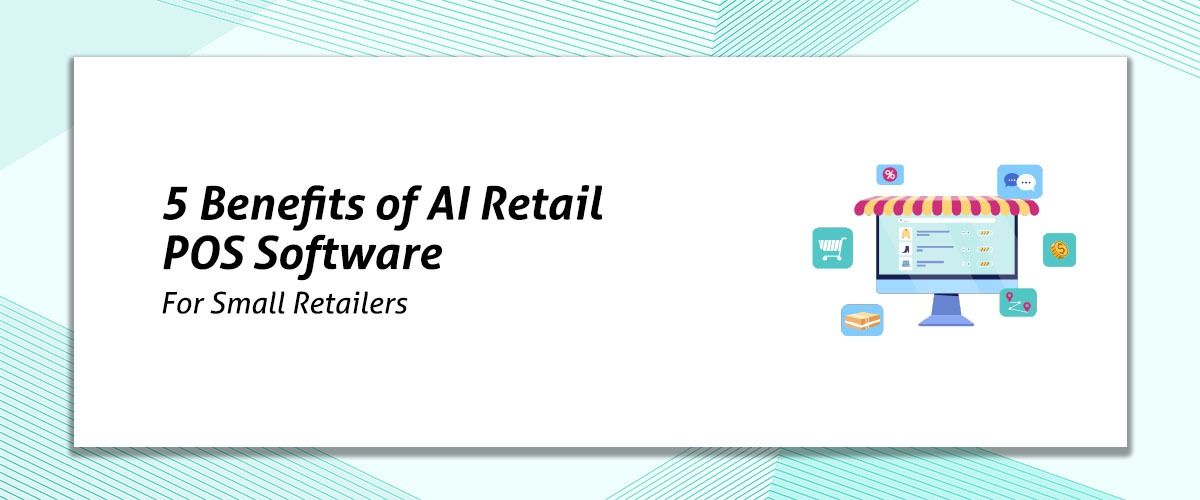
5 Benefits of AI Retail POS Software for Small Retailers
 David N. Wilks
Small, brick-and-mortar retailers in an increasingly competitive US retail marketplace struggle to maintain their profit margins while competing with large, big box retailers. Additionally, traditional legacy Point of Sale (POS) hardware is limited to handling sales transactions and storing receipt records. As your business continues to grow, you need a new approach to protect and grow your operation. Enter the AI-based POS system. A true paradigm shift where traditional register hardware has transitioned from being a basic cash register into a source of actionable insights through the creation of smart, analytics-based workflows that connect all functional areas of retail with your supplier partners. By utilizing cloud technology combined with advanced Machine Learning algorithms at the point of sale, businesses of all sizes can now realize significant operational improvements that have traditionally only been available to Fortune 500 companies.
What is AI Retail POS Software, and why does it matter for Small Retailers?
Point-of-sale (POS) systems in retail are cloud-based checkout solutions that have become smarter and utilize machine learning along with predictive analytics to run the day-to-day operations of stores. Compared to traditional legacy cash registers only recording sales and processing payments, an AI retail POS software is the thinking hub of a physical store's inventory, how to schedule staff members, and how to interact with customers. Because of the extremely competitive nature of the US retail market, AI-powered POS solutions connect a store's traditional checkout process to the real-time marketplace; reading consumer shopping trends automatically at years, tracking local supply chain activity, and organizing financial data right at the transaction point.
For small independent retailers throughout the US, using AI-powered POS systems can provide them with not only a competitive edge over retail giants (Wal-Mart) but also help them survive against large e-commerce businesses (Amazon). Typically, small business owners have very low profit margins to work with, and they do not have large data teams, so using AI-based POS systems allow them to be competitive, as they automate some of the most critical components of running a business such as predictive ordering, mitigate fraud in real-time, and personalize marketing to their customers. With the ability to convert previous sales data into instant usable information, main-street retailers can protect their cash flow and reduce unnecessary overhead, thus increasing profitability.
How does AI Retail POS Software benefit small retailers?
1. Predictive Demand Forecasting Automation: The system uses machine learning algorithms to predict customer purchase behavior by automating vendor purchase orders, allowing customers to have access to the right amount of inventory at all times without tying up too much money in excess stock.
2. Smart Checkout Upselling: The program analyzes items within the customer's current shopping basket in near real-time in order to provide the cashier with product suggestions that are relevant to that customer's current purchase. This will increase the average transaction value.
3. Monitoring Fraud and Shrink in Real-time: The software tracks the checkout lanes to understand and identify fraudulent activity such as voids or discount activity, ensuring that the business's profitability remains intact and is protected from internal and external loss.
4. Loyalty Marketing, Customized for Each Customer: The software tracks each customer's buying habits and provides automated, personalized, data-driven promotions via SMS or email to each individual customer, thus providing a reason for the customer to return to the store again in the future.
5. Financial Reconciliation Without Errors, and No Delay: The system tracks all payment types in real-time and provides accurate and timely reporting so that the business can eliminate manual reconciliation between payment types and business accounting systems.
How does AI Retail POS Software improve Inventory Management?
With the use of AI retail point-of-sale tools, inventory management has become significantly easier and much more accurate than it ever has been before. Historically, most tracking of inventory was done via a manual process that depended on historic spreadsheets depicting items that had been sold. Because of this, retailers experienced a lot of stockouts (running out of a product and not being able to sell it), and backrooms filled with dead inventory (not being able to sell a product). Now, with AI technology that combines real-time checkout speed with external US market data (such as changes in local weather patterns, local community social events, as well as macroeconomic news about supply chain issues), retailers are able to track inventory in real-time.
Identification of hidden buying patterns is made possible through machine learning algorithms. They provide retailers with the prediction of the items that a particular customer wants, as well as how much to spend on the item, weeks prior to that customer coming into the store.
Retailers no longer have to deal with managing the amount of inventory they have on hand by automating their daily inventory replenishment cycles. AI technology provides them with the calculations needed to predict safety stocks of each product (how many of each product should be kept on hand), and generates purchase orders to their suppliers (vendors) before the product runs out on the shelf. AI technology allows a retailer to continuously sell their products without ever having to worry about the cash being tied up on the shelf.
How does AI Retail POS Software Boost Sales for Small Retailers?
Maximizing average transaction value with real-time intelligent upselling at checkout based on the data-driven product recommendations provided to cashiers that make the baskets being purchased while the customer is paying for their purchase. The system uses artificial intelligence to instantaneously analyze the shopping basket and all of the historical transactions of millions of customers to display complementary items and current bundle deals on the register screen as they check out, enabling the cashier to make high-margin sales effortlessly.
Automated hyper-personalized loyalty marketing to increase CLV and the number of times a customer returns to make a purchase from you by keeping them engaged with your store when it’s closed. The system captures the buying habits of shoppers and the frequency with which they visit your stores and then triggers automatic SMS/text messages and email promotions that are targeted to each individual shopper instead of generic/spammy text messages or emails that offer that customer discounts on their favorite brands when they are statistically due to buy again which brings dormant customers back into your stores to make purchases.
Dynamic Pricing and Predictive Discount Optimization. Maximizes revenue on popular items and speeds up the process of getting rid of items that have not sold quickly enough. A store’s POS will always monitor the prices competitors are charging in the local area, how much of that product is available, how fast it has sold relative to past sales, and how much of that product should be available based on last year’s demand. The POS will then make a determination of the maximum amount of discount required to clear inventory of slow-selling products off of your shelf as quickly as possible, so that the gross profit margin for each sale can be maximized without using arbitrary “store-wide” clearance tickets.
How does AI Retail POS Software Enhance Customer Experience?
AI-powered POS systems improve the Checkout experience for customers by transforming a standard checkout process to one that is quick, customized and easy. Customers can now expect the conveniences of online-shopping in a physical store, thanks to an AI-POS.
An AI-POS addresses this expectations by providing 4 major points of benefits:
1. Significantly Reduced Checkout Time (Lines & Waits)
Customers can get through the payment process quickly without going through tons of frustration waiting in line at the register. The AI-POS uses predictions for your locations traffic to predict when to staff your store when your location will experience the most traffic in person, and uses predictive barcode scanning (with the items being purchased), and instant mobile processing to reduce the time required to process each item from 30% down to no time (a long wait time), and therefore allowing customers to checkout quickly.
2. Seamless Omnichannel Shopping and Product Returns
AI sales engagement with a business through both physical and virtual commerce channels without any break in the user's experience. The AI creates a uniform profile for each customer from their in-store purchase history, as well as their online search history. As a result of having a unified file, the potential for using BOPIS (buy on-line, pick up in-store), and returning an on-line purchase at the brick-and-mortar store, is seamlessly integrated into the experience, and the system will process the return without requiring a paper receipt for tracking purposes.
How does AI Retail POS Software Save Time and Reduce Errors?
1. Automated Inventory Receiving with AI Visual Recognition
Translation of hours spent verifying SKU quantities typed in manually by each supplier's packing slip to quick verification/confirmation with a single scan eliminates mistakes associated with data entry. When staff receive a shipment containing packing slips, they scan them as if they were using a POS system or take a photo of them with their tablet's camera. The software then uses Optical Character AI employee recognition from the scanned image and AI processing to read the text from the packing slip, extract line items as well as quantities and pricing ways, and generate a digital purchase order that is compared against an existing product catalog to identify duplicates or error in price before live inventory is updated.
2. Instant Daily Financial Reconciliation
Translation from a stressful task to a few minutes can be done via an automated process with no manually visiting computations involved. Rather than counting the paper receipts and tallying the cash drawer totals with another count, cashiers simply log the transactions that they make using the cloud-based POS system in real-time regardless of format (cash, mobile wallet, EMV card), and all of these transaction records are matched to each other by the software. After verification has been completed, the software automatically creates a completed version of the entire cash register with the cash amount subtracted, all of the cash drawn as cash equivalent, and all of your cash balance entered as a total of all of these receipts. An entirely perfect, error-free summary of your entire daily cash register will be sent electronically via email to your integrated business accounting system like QuickBooks or Xero removing the opportunity for duplicate entry errors or missing transaction records.
3. Price Synchronization in Real Time and Automation of Promotion Policies
This eliminates lengthy checkouts due to having to manually adjust prices during the checkout process, and also alleviates any cash register errors when accepting cash. By using artificial intelligence (AI), when a retailer launches some type of complex promotional bundle, flash sale, or markdown due to changes in the marketplace caused by seasonality; the central database is instantly updated and synchronised across all check-out lanes and online shopping channels. Therefore, cashiers will never have to remember what promotional codes are currently active or do any calculations manually while at the register. By scanning the item(s) the cashier will have the correct promotion applied to it at the point of sale, thus ensuring full compliance with current corporate margin strategies.
How can small US Retailers get Started with AI Retail POS Software?
For smaller retailers that are based within the United States, the most important step in getting started with an AI retail POS software solution involves auditing your current sales technology and identifying where your business has the strongest pain points. Most modern AI-based POS systems will run on cloud-native infrastructure so that you do not need to have to spend excessive amounts of money on a proprietary register. Many of the leading platforms can be installed directly onto a regular iPad, a tablet, or a compatible card reader all hardware that you may already own. When you start to decide which vendor you would like to use, look specifically for vendors who have developed their platform for the same specific retail vertical as your business, whether high volume boutique, specialty grocery store, or apparel store, and are able to offer native or plug-and-play integrations between their platform and your existing accounting and eCommerce platforms.
Onboarding for a new platform relies on migrating legacy clean data into the new system. You will need to export your existing product catalog, supplier information, and customer loyalty lists into a flat, standardized format (commonly in CSV format) in order to load that data into the new cloud-based app. The optimal time to launch will be during your historical sales lull, rather than over the biggest holiday weekend, in order to give your staff time to acclimate to using features such as AI suggested cross-sells and electronic purchase orders. Remember that all of the models built from machine learning will need to be updated.
Conclusion
When you utilize an AI based retail POS system, small retailers can fully remove back-office uncertainty from their operation and rival the operational capability of large corporate competition. An intelligent approach automates inventory tracking, provides personalized consumer incentives at time of sale, and prevents fraud to successfully convert transaction data into sustainable, year over year growth for their business. When the small retailer is ready to update their store front they can use softwareadviser.ai which serves as a leading digital SaaS marketplace to easily find, evaluate, compare and purchase any type of business applications. It increases the effectiveness of a business' software search by compiling multiple live metrics for the various business application providers, assembling customized feature check lists and publishing user reviews. The result is greater success for the business acquiring the best technology to support their retail operation.
Corporate content teams have moved beyond treating artificial intelligence as a simple novelty. Today, AI writing tools are practical, regular propert [...]
David N. Wilks
Scale matters, but smart marketing teams refuse to sacrifice quality to get there. The old way, losing half your week to writer's block or babysitting [...]
David N. Wilks
The social media world is changing. As experienced by many agencies, managing multiple brand handles involves a lot of manual management of content ca [...]