
What we'll cover
Share with your community!


Get Free Consultation

Automotive Software Guide 2026: Platforms, Solutions, and Use Cases
 Foram Khant
Why 2026 Will Be a Turning Point for Automotive Software
The automotive industry is changing faster than ever before in recent decades. What's happening right now? Connected cars are becoming the norm, not a novelty. Over-the-air (OTA) updates work just like on your smartphone – the car improves even after purchase. Artificial intelligence analyzes driving style, predicts breakdowns, and optimizes all systems. SaaS platforms allow manufacturers to rapidly scale new features to millions of cars simultaneously.
Why will 2026 specifically be a turning point when the niche is constantly changing anyway? First, new EU regulations are forcing manufacturers to implement more advanced safety and environmental monitoring systems. Second, Level 4 autonomous driving is gaining popularity for production models (due to demand and expectations), which requires enormous computing power and complex software. Third, the market has simply matured – consumers want their cars to be smart and constantly updated like a phone or smartwatch, and they're willing to pay for it.
According to analyst forecasts, the SDV market could grow to $1.19 trillion by 2036. That's a 7% annual growth rate – three times faster than traditional automotive. So, one way or another, the era of classic automobiles is ending, and the age of computers on wheels is beginning.
From Hardware to Software: How Car Manufacturing Logic Has Changed
If you look at Henry Ford's first automobiles, there wasn't a single line of code. The Model T, which came out in 1908, was a purely mechanical device. Engine, transmission, brakes – everything worked through levers, gears, and linkages. No electronics except a simple ignition system. The car was a product of iron engineering, and this approach dominated for decades.
The first software elements appeared in cars only in the 1970s when electronic engine management systems began to be implemented. These were simple controllers that regulated fuel delivery. In the 1980s, ABS and diagnostic systems were added. In the 1990s – cruise control and the first multimedia systems. But software still played a supporting role.
The real turning point came in the 2010s when Tesla showed that a car could operate on a "software first" principle. The car became a platform that constantly improves through updates. Features that didn't exist at the time of purchase appeared later. This was a completely different philosophy that the market hadn't seen before and hadn't thought in this direction.
A software-defined vehicle is a car where most functions are controlled by software running on powerful central computers. One or several computing platforms that manage everything: from steering to climate control. This architecture allows for quickly adding new capabilities, fixing bugs, and personalizing the driving experience.
BMW, for example, introduced an approach where the car is "born" with all hardware capabilities, but some functions can be activated later through subscription. Stellantis is investing billions in its own software platforms to reduce dependence on suppliers. Mercedes-Benz created the MB.OS operating system, which unites all digital functions of the car into a single ecosystem.
The SaaS approach makes all this possible, like buying an Apple Music subscription. Instead of developing monolithic systems, manufacturers create modular solutions that scale easily. A new feature is developed once and deployed across the entire vehicle fleet within hours.
5 Companies Shaping the Future of Automotive Software
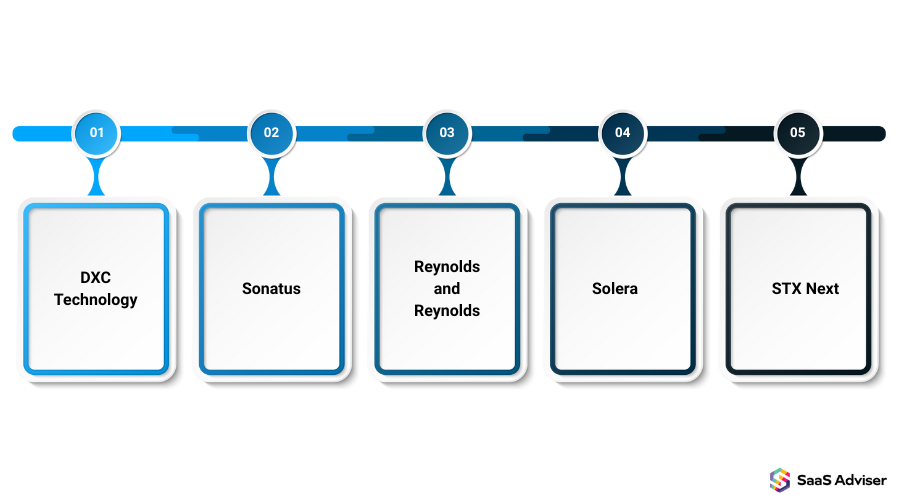
1. DXC Technology
DXC Technology works with automakers worldwide, helping them transition to the digital era. The company specializes in autonomous systems, connected mobility, digital cabins, and solution testing. What makes DXC special is its comprehensive approach. They don't just develop software but help manufacturers completely rethink business processes.
DXC developed, together with Snowflake, an analytical solution for connected mobility that combines data from connected vehicles with internal and external information sources. This helps analyze product quality, detect system anomalies, plan parts supply, and optimize warranty operations. The platform unifies disparate data and even allows for information monetization.
2. Sonatus
Sonatus is a company that creates technology building blocks for automotive manufacturers, accelerating software innovation. Their platforms and products serve as a foundation on which automakers and their partners can create new solutions faster. Sonatus focuses on zonal architecture and creating operating systems for software-defined vehicles. This is an American company from Silicon Valley that brings experience working with high-tech startups to the auto industry. Their solutions are used for in-vehicle data management, workload orchestration, and ensuring secure OTA updates.
3. Reynolds and Reynolds
Reynolds and Reynolds occupies a separate niche – they create solutions for car dealers, not manufacturers. Their comprehensive software package covers sales management, financing, service operations, document management, and regulatory compliance. This is an American company that understands the specifics of the US retail market. Reynolds helps dealers optimize operations, improve customer service, and minimize risks. Their solutions integrate with manufacturer systems and create a unified ecosystem from factory to end customer.
4. Solera
Solera specializes in software for vehicle management and service. Their solutions cover the entire vehicle lifecycle: from valuation to claims management, repair, and used car sales. The company works with insurance companies, repair shops, fleets, and dealers. Solera has one of the world's largest automotive databases, allowing for accurate repair cost estimation, expense forecasting, and process optimization. Their solutions help reduce claim processing time and improve customer experience.
5. STX Next
STX Next is a Polish company with over 20 years of experience developing custom software for global enterprises. They work with the automotive industry, creating customized solutions for specific client needs. STX Next specializes in Python development and creating web applications that integrate with automotive systems. The company represents the Eastern European development school – high quality at competitive prices. Their experience includes creating fleet management portals, analytical dashboards, and platforms for processing data from connected vehicles.
Key Automotive Software Platforms for 2026
While "what's under the hood" used to be paramount, now what matters more is "what software is inside." The market is seeing more and more platforms that determine how smart your car will be.
DXC Automotive Platform stands out as a flexible enterprise solution. It combines data analytics, cybersecurity, and UX optimization tools – all in one environment. In short, it's like a "central brain" for automotive data.
BlackBerry IVY is no longer just a brand from the nostalgia of button phones. It's a large-scale platform for collecting and processing data from car sensors. It helps manufacturers create personalized experiences for drivers – from route optimization to predictive maintenance.
Bosch Vehicle Cloud focuses on security and connectivity. Its solutions enable remote software updates (OTA updates) and fleet management, which is especially useful for businesses with large fleets.
AWS Automotive Cloud offers unlimited scalability and AI-powered analytics. Manufacturers can track vehicle behavior in real time, optimize energy usage, and even predict accidents.
And of course, Google Android Automotive OS – a platform loved for its convenience and familiar interface. It allows you to integrate your favorite apps directly into infotainment systems. As fans say, "it's Android, but with wheels."
What unites these platforms? They all support open architecture and APIs for integration. This is an important trend – "open platform ecosystems," where different solutions can work together.
How the SaaS Business Model Is Changing Automotive Development
The automotive industry is borrowing successful practices from the IT sector, and the SaaS model is becoming one of the most important. Traditionally, automakers sold a car once and earned from service maintenance. Now there's an opportunity to receive regular income from software features.
BMW launched a subscription service for heated seats. The hardware is already installed in the car but activates only after payment. Mercedes offers subscriptions for electric vehicle performance enhancement.
Why are manufacturers switching to this model? First, it's predictable revenue. Instead of a one-time sale – regular payments throughout the vehicle's life. Second, scalability. A new feature can be deployed to millions of vehicles within hours through OTA updates. Third, faster releases. In software, you can release updates every month, test hypotheses, and quickly respond to feedback.
The SaaS model also changes the development approach. Instead of major releases every few years – constant iterations and improvements. Teams work using Agile and DevOps methodologies. Testing is conducted on real data from the vehicle fleet. Bugs are fixed much faster than in the classic automotive industry.
For consumers, this means the car doesn't become obsolete as quickly. A car you bought three years ago can receive features that didn't exist at the time of purchase. The interface improves, new services are added, system performance is optimized. This is a completely different ownership experience.
Real Use Cases for Automotive Software
-
Driver Behavior Tracking for Insurance Companies
Insurance companies offer discounts to drivers who install apps or devices for driving style monitoring. The system records speed, braking intensity, rule compliance, and other parameters. Careful drivers receive discounts up to 30-40% on policies. This is a fairer approach than traditional insurance, where everyone pays the same price regardless of actual risks. For young drivers, it's a chance to prove their responsibility and pay less. Some insurers are fully switching to a pay-as-you-drive model, where insurance cost depends on actual mileage and driving quality.
-
OTA Updates as a New Safety Standard
When a vulnerability is discovered in a vehicle's software, the manufacturer can fix it within hours through over-the-air updates. Previously, this meant recalling millions of vehicles to dealers – enormous costs and inconvenience for owners. Now the update downloads automatically when the vehicle is connected to Wi-Fi and installs overnight. Tesla constantly improves its autopilot system through OTA. Volvo released an update that improved the collision prevention system in already sold vehicles. This isn't just convenient – it's critically important for safety in an era when vehicles are becoming increasingly software-dependent.
The Role of SaaS Consulting in Automotive Industry Transformation
The transition to the SaaS model isn't just software replacement. It's a fundamental change in all company processes: from development to sales. This is where SaaS consulting services come in – specialists who help automakers make this transformation.
-
Consultants begin with auditing existing processes and architecture. They determine which systems can be moved to the cloud, which need reworking, and which are better replaced with ready-made solutions. This saves years of experimentation and millions on mistakes. For example, DXC consultants help manufacturers integrate data from various sources – from factories to cars on the road – into a single analytical platform.
-
Security is one of the critical aspects. A vehicle connected to the internet becomes a potential target for hackers. SaaS consultants develop security architecture, implement encryption, set up threat monitoring, and train teams to handle incidents. This isn't optional – it's a mandatory requirement from regulators in the EU and USA.
-
Time-to-market is critically important in modern automotive. If a competitor launches a new feature a year earlier, they can capture a significant market share. SaaS consulting helps shorten development cycles through implementing CI/CD practices, test automation, and process optimization. Companies working with experienced consultants reach the market 30-40% faster.
-
Scaling strategy also requires expertise. How to ensure the system handles millions of simultaneous connections? How to manage infrastructure costs during rapid growth? How to organize teams for effective development? These are questions where consultant experience makes the difference between project success and failure.
Conclusions
2026 will be the year when software-defined vehicles transition from innovation to industry standard. Automakers who invest in the right SaaS scaling strategy, open platforms, and reliable partners will gain a competitive advantage for the next decade.
If your company is planning digital transformation or developing new software services for vehicles, it's worth contacting experienced automotive software consulting services. They'll help avoid common mistakes, accelerate market entry, and build scalable architecture that will work for years. Investing in consulting today means saving millions and preserving years of development tomorrow.
The business world is more competitive in tougher conditions and some companies do not want to think of having quality to reduce the cost. It plays a [...]

Ankit Patel
.jpg)
A key component of a successful firm is employee engagement software. Creative expression flourishes, production rises, and job satisfaction reaches n [...]
Manav Pandya
Businesses must use Client Onboarding Software correctly. Too many businesses still rely only on luck when it comes to their new workers' perform [...]