
Healthy teams rarely happen by accident. They thrive when leaders keep a constant pulse on morale, clarity, and collaboration, then act on the signals before small issues snowball. That’s why “team assessment tools” have exploded from one-off personality quizzes into always-on platforms that nudge managers in Slack, surface burnout risk, and benchmark your squad against thousands of peers.
If you purchased these tools in 2023, get ready for a changed environment. AI currently guides managers during their work activities, Microsoft Viva Glint has integrated Copilot summaries into its dashboards, and traditional survey providers are competing to consolidate engagement, performance, and capability information into one comprehensive view. At the same time, per-assessment classics like CliftonStrengths and EverythingDiSC still dominate headline searches, confusing buyers who need more than a feel-good workshop.
We wrote this guide to clear the fog. You’ll see where each tool truly fits, what it really costs, and how to roll out a pilot that sticks. Let’s dive in.
What Team Assessment Tools Actually Cover
Continuous team-health platforms
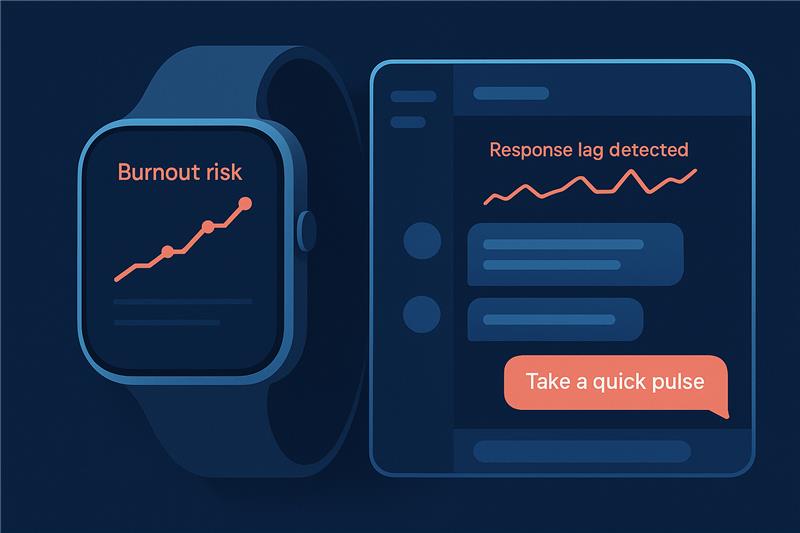
Think of these tools as a Fitbit for teamwork. They send lightweight pulses every week or two, pull engagement signals from Slack or Microsoft Teams, and flag burnout risk before it spreads. Culture Amp’s 2025 update added AI heat maps that surface patterns in seconds, while 15Five’s Kona coach, launched May 21, 2025, joins 1-on-1s, creates follow-up actions, and delivers private tips to managers inside the same chat thread (according to 15Five release notes).
Tools like these, along with always-on newcomers such as TeamDynamics, spot delayed replies, uneven airtime, or meeting overload, then prompt managers with next steps inside their workflow. Choose them when you need quick feedback loops, embedded action tracking, and benchmarks that show exactly where your team stands against thousands of peer squads. In short, they replace the annual engagement survey with a live feed you can’t ignore.
Strengths and behavior frameworks
Pulse data shows how the team feels today; strengths and behavior assessments explain why they show up that way. CliftonStrengths has reached 30 million completed assessments and is used by more than 90 percent of Fortune 500 companies (per Gallup). EverythingDiSC reports over 10 million learners in 150,000 organizations across 70 countries (per Wiley), while the MBTI remains a staple for 88 percent of Fortune 500 employers (according to The Myers-Briggs Company). Working Genius rounds out the list with an energy-focused model that maps each person’s two “geniuses,” two competencies, and two frustrations (per The Table Group).
These frameworks give teams a neutral language that keeps feedback from feeling personal. Instead of saying “Sam never speaks up,” we can say, “Sam leads with Analytical, so she wants data before weighing in.” That shift matters when new squads form or roles shuffle after a reorg: a team map might reveal, for instance, that no one covers the “Relationship Builder” slice, prompting a hiring or rotation call.
The catch? The benefit fades if the assessment stays a one-off. Companies that weave the language into daily rituals-agenda check-ins, project kick-offs, even Slack status emojis-turn personality data into a living playbook instead of a workshop souvenir.
Leadership and critical-team diagnostics
When the stakes get high, especially when a new C-suite is brought in, a high-risk product is launched, or after a merger, you need more than just pulse averages to understand team dynamics. Research validated surveys like the Team Diagnostic Survey (TDS), the Five Dysfunctions Online Team Assessment, and Belbin Team Roles assess cohesion, clarity, and decision-making norms in one sitting.
-
Team Diagnostic Survey (TDS). Used by more than 3,000 teams worldwide, the TDS costs certified practitioners about $650 per team and produces a heat map against the six conditions for team effectiveness (per 6teamconditions.com).
-
Five Dysfunctions assessment. The Table Group prices the online team test at $56.50 per person and pairs results with a facilitated workshop that sparks candid debate on trust, conflict, commitment, accountability, and results (per Table Group).
-
Belbin Team Roles. Analysis of 60,000 responses across 150 countries shows how Belbin maps nine contribution styles to reveal coverage gaps before they derail execution (per Belbin).
Because the audience is small and senior, sessions run deep. Executives tackle tougher questions, challenge assumptions, and leave with explicit commitments instead of a one-size-fits-all action list. Diagnostics do cost more than a standard survey, but one misaligned leadership team can stall an entire company, so the extra spend isn’t significant compared with the risk.
Think of these tools as a CT scan before surgery: they expose hidden fractures so we can set them before scaling new processes or strategy bets.
2025–2026 Trend Scan
AI coaching in the flow of work
The newest wave of team-assessment tech skips the dashboard and lands inside Slack or Microsoft Teams. Culture Amp released its generative-AI Coach on July 7, 2025; the assistant suggests language for tough conversations and will soon pull in Engage survey data (according to Culture Amp product updates). 15Five followed on May 21, 2025 with Kona, an add-on that joins 1-on-1s as a silent participant, takes notes, and sends private leadership nudges after each meeting (per 15Five release notes).
Why does that matter? Speed separates high-trust squads from groups still debating last quarter’s survey. When an AI spots a workload spike and offers a one-click pulse or talking-point script in the same chat thread, managers act within hours, not weeks. The gap between signal and response shrinks to a single workday.
Early users already see tighter loops from “problem spotted” to “action taken,” higher psychological safety scores, and fewer skipped check-ins. As these copilots mature, we expect retention numbers to climb wherever real-time coaching replaces static reports.
Listening and analytics consolidation
After years of bolt-on modules, vendors are folding surveys, action plans, and performance data into one hub. 15Five fired the starter pistol on February 5, 2025, announcing that its standalone Engage portal would close on October 31, 2025 and that “all engagement tools will live inside the core 15Five platform,” according to the company.
Why should you care? A single dataset shortens the relay between HR, managers, and executives. When engagement scores, 1-on-1 notes, and OKR progress sit side by side, root causes surface in minutes instead of spreadsheets.
We see the same playbook elsewhere. Culture Amp now pipes survey results into its Perform and Develop modules so managers can link morale dips to goal slippage or missed learning milestones. Workleap bundles Officevibe surveys, recognition, and micro-learning in one login for $5 per user per month, trimming the cost of running three separate tools (per Workleap).
The lesson is simple: data creates value only when it lives where daily work already happens. Expect more suites to fold standalone tools into one view over the next 12 months.
Assessment help from online assignment expert provides students with reliable academic support. The platform delivers well researched answers, timely submissions, and plagiarism free work. Expert writers assist across subjects, ensuring clarity, accuracy, and improved grades while reducing stress and helping learners meet demanding academic deadlines with confidence and professional guidance.
How to Choose: Problem → Fit Matrix
Start with the problem
Before you compare feature grids, name the pain in plain language:
-
Morale slipped 12 points on your last eNPS pulse after a reorg.
-
Remote squads miss 1 in 5 Slack messages inside project channels.
-
A brand-new leadership pod must gel in 60 days to approve the next product launch.
Each scenario trims the field right away. Chronic engagement dips and burnout call for always-on pulse platforms that surface workload spikes in real time. Role confusion or communication friction points to strengths frameworks such as CliftonStrengths or Everything DiSC, where shared vocabulary prevents blame. Executive gridlock signals the need for a deeper diagnostic such as the Team Diagnostic Survey or Five Dysfunctions, giving leaders an unfiltered mirror.
We suggest fixing the most expensive problem first; everything else is optional polish.
Depth vs. breadth: stand-alone tools or all-in-one suites
Most companies juggle an average of four separate HR applications in their stack, according to Gartner’s 2025 buyer-insight survey. That overload is why every vendor now pitches a single hub. Yet a sharp, single-purpose tool can still win over a bulky suite.
Choose depth when the problem is specialized and urgent. If engineering burnout is climbing, a pulse tool with Slack analytics spots friction faster than an HR suite that treats every team the same. The same applies to an executive team in conflict: a focused diagnostic beats another engagement survey buried in a massive dashboard.
Pick breadth when you need data continuity and fewer logins. Suites that combine engagement, performance, and recognition trim procurement time and let you link morale dips to missed goals or recognition gaps in one view, which helps lean People teams run multiple programs.
Here is a quick test: if you need only pulses, action tracking, and AI nudges, depth wins. If you already manage OKRs, 1-on-1s, and learning paths inside one platform, breadth delivers smoother lifts with fewer IT tickets. You can always start with a targeted tool to solve the most painful issue, then integrate or expand once leaders see results.
Pilot path: 30–60–90
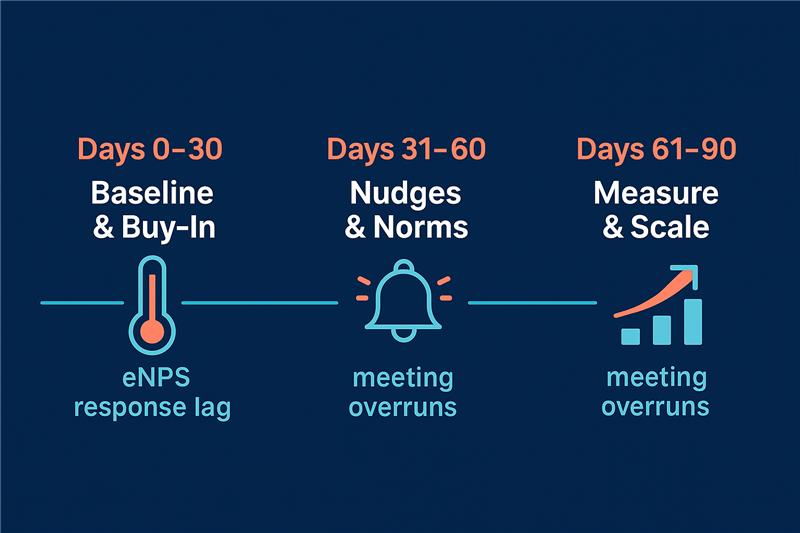
A tightly scoped pilot shows value inside one quarter.
Days 0–30: baseline and buy-in
-
Run a baseline pulse or assessment with one volunteer team.
-
Share anonymized results within 72 hours, then agree on two quick experiments, such as a 25-minute meeting cap and a 24-hour async-reply norm.
Days 31–60: nudges and norms
-
Turn on manager nudges or action-tracking features.
-
Send a mid-cycle pulse to gauge traction, then publish a one-page “working agreement” that notes wins and one stubborn blocker.
Days 61–90: measure, decide, scale
-
Compare trend deltas: eNPS, response lag, and meeting overruns. Gartner reports that HR pilots showing quantifiable gains within 90 days are 2.4 times more likely to secure phase-two funding (per Gartner press release).
-
If results improve, add a second cohort. If not, adjust and retest before a wider rollout.
Leaders see evidence in 12 weeks, and you’ll have real data to defend the next-round budget.
Individual Tools Shortlist
Below you’ll find quick, no-spin portraits of the most referenced platforms in 2026. Each blurb tells you what the tool excels at, who tends to love it, and one “watch-out” to check in demos.
TeamDynamics
TeamDynamics is built for modern work teams. A short validated assessment will place your team into one of 16 TeamDynamics types based on how team members communicate, process information, make decisions, and execute. Then the platform generates an interactive and shareable report to prompt conversations, retrospectives, and offsites-and everybody also receives a “CoDynamics” profile indicating where the person’s working style is similar to or different from the team’s default style. Managers also get tactical guidance on how to structure meetings, decisions, and workflows for their specific team type.
It’s intentionally standalone-no HRIS or IT setup, no integrations, just sign up and invite the team. Pricing is simple: a free rapid-result sampler, TeamDynamics Pro at a one-time $39/user for teams (2–20 users), Solo at $29 for individuals, and Enterprise/Consultant tiers by request. For fast-moving orgs that want immediate, work-context insights (and a common language to make invisible dynamics visible), the low-friction rollout is a feature, not a limitation.
CultureAmp
CultureAmp is a safe choice when you need breadth and credibility at scale.Its big draw is a deep benchmark library across industries and regions, which helps you contextualize team performance and engagement signals rather than reading scores in isolation.rather than reading scores in isolation. If you’re running a multi-country program, the built-in guidance and templates accelerate launch while AI-powered recommendations help managers move from “interesting data” to action.
The caution is cost discipline: per-seat pricing can climb as you pass the 1,000-employee mark. Before you expand, pressure-test who really needs analytics authoring rights versus read-only dashboards, and design a lean role model so your bill scales with impact, not headcount.
15Five
15Five’s value proposition is consolidation: weekly check-ins, 1:1s, goals, engagement, reviews, and coaching in one workflow so frontline managers don’t juggle five tools. That unified rhythm builds better habits-especially when you standardize prompts and surface focus areas from pulse data, a hallmark of modern team-performance software. The Kona AI coach adds just-in-time nudges that translate insights into micro-behaviors during the week, not just at review time.
The tradeoff with an ambitious roadmap is enablement load. As modules evolve, you’ll want a lightweight change-management cadence-release notes plus 10-minute manager walkthroughs-so settings (visibility, question banks, calibration rules) don’t drift. Pilot new features with a few teams, document the “happy path,” and only then scale.
Workleap Officevibe
Officevibe shines when you need speed and simplicity: you can launch a pulse in minutes, tune cadence to reduce fatigue, and hand line managers clean, actionable reports that don’t require a PhD in analytics. Recognition and lightweight feedback loops are native, which helps you build positive rituals alongside measurement.
For enterprises expecting deep segmentation, modeling, or driver analysis, note the analytics ceiling. Many larger firms pair Officevibe with their own BI layer to enrich cuts (tenure, job family, region), stitch in HRIS context, and perform longitudinal analyses. If that’s you, plan the export pipeline and governance up front.
Microsoft Viva Glint
Viva Glint’s advantage is ecosystem fit. If you use Microsoft 365 already, all survey data flows directly into Viva Insights, giving you the behavioral signals (meetings and collaboration patterns) combined with sentiment for a complete view. With Copilot, you can scale open-text summarization in seconds and surface themes, recommended actions, and draft communications for managers.
The flip side is admin complexity: the portal and configuration will feel dense if your team isn’t fluent in Microsoft’s stack. Budget time for tenant setup, permissions, and a short “Viva literacy” bootcamp so HR, IT, and People Analytics share the same mental model before launch.
CliftonStrengths (Gallup)
CliftonStrengths brings a massive install base and a mature ecosystem of certified coaches, manager toolkits, and team-grid visualizations. The shared vocabulary (“Learner,” “Achiever,” etc.) makes strengths talk accessible in 1:1s and workshops, and the coaching marketplace means you can scale facilitation without building everything in-house.
Its Achilles’ heel is decay without reinforcement. The benefits fade if managers don’t weave strengths into weekly rituals-check-ins, delegation, and recognition. Treat it as an operating system, not a one-off offsite: set prompts in your 1:1 agenda, refresh team maps quarterly, and measure whether strengths language shows up in performance narratives.
Team Diagnostic Survey (6 Conditions)
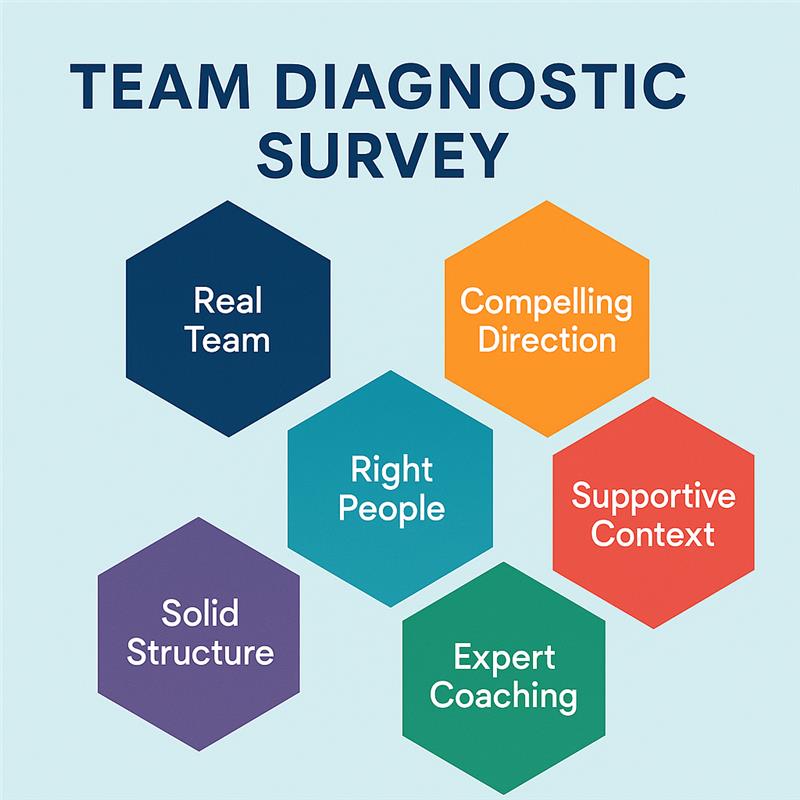
The 6 Conditions TDS is the research-first option for teams that want diagnostic clarity. It maps the six drivers of team effectiveness (real team, compelling direction, right people, solid structure, supportive context, expert coaching) and surfaces where to intervene-composition changes, role clarity, norms, or sponsorship. For senior or cross-functional teams, that prescriptive lens can save months of trial-and-error.
Because it’s typically facilitated by certified practitioners, plan budget and time for a proper debrief and action design. The payoff is rigor with a change plan you can actually execute; the risk is treating it like a survey. Get a facilitator who will stay through the first sprint of implementation so insights convert to behaviors.
Pricing Realities: What Buyers Actually Pay
Pricing pages often feel vague, so here are live numbers pulled on October 15, 2025:
-
Per-assessment tools
-
CliftonStrengths Top 5: $24.99 per person (Gallup store)
-
Everything DiSC Workplace: ≈ $90 per person from major distributors such as DiscProfile
-
Five Dysfunctions online team test: $56.50 per person (Table Group)
-
-
Seat-based SaaS Culture Amp, 15Five, and Officevibe quote $8–12 per employee per month for bundles that cover engagement, performance, and AI coaching, according to 2025 buyer reviews on SoftwareAdvice. A 250-person company should plan on $30k–40k per year once required modules and minimum contracts are added.
-
Consultant-led diagnostics Certified partners price the Team Diagnostic Survey or comparable executive off-sites at $10k–20k per leadership team, which covers pre-work, one-day facilitation, and three follow-up coaching sessions, per 6 Conditions partner rate sheets.
Remember the hidden costs: manager prep time, follow-up pulses, and licenses for new hires can add 20–40 percent to year-one spend. Run a total-cost-of-ownership check and judge tools by price per action you can take, not by sticker alone.
Risks & buyer guardrails
Even the smartest tool can backfire without safeguards. Keep these five risk zones top of mind:
-
Validity and bias: Ask for the technical manual and psychometric validation. If the vendor can’t share it, walk away; no UI can fix a shaky instrument.
-
Over-labeling: Strengths colors and personality letters are conversation starters, not destiny. Remind teams that labels describe tendencies, not ceilings, or you’ll hear “that’s just my type” used as an excuse for missed deadlines.
-
The action gap: Gartner’s 2023 survey found that only 33 percent of employees believe their company will act on feedback. Build nudges, action plans, and coaching libraries into your pilot; then track how many findings turn into calendar-blocked tasks.
-
Data governance: Confirm SOC 2, SSO, role-based access, and export controls before you sign. Publish anonymity thresholds in plain English; employees spot fuzzy math a mile away.
-
Cadence fatigue: Too many pulses or workshops create survey burnout. Keep questions short, celebrate visible wins, and fold recognition into the rhythm so feedback feels reciprocal, not one-sided.
Treat these guardrails as non-negotiable, and your new platform will become a catalyst, not the cautionary tale everyone whispers about in Slack.
Conclusion
Effective teams do not grow because of prettier dashboards - they grow because of tighter feedback loops and faster follow-through. Use a simple, non-technical problem statement to begin assessing the success or failure of your pilot, then drill down to depth when the problem is specialized and urgent or breadth when the need is to build one data spine for engagement, performance, and capability. Keep the pilot smaller and time-locked (90 days) if possible, wire nudges and ownership into the workflow, and focus on measuring outcomes that matter in the real world: less time overrun in meetings, fewer days to respond, clear priorities, and fewer handoffs getting lost in chat.
Consider validation, governance, and cadence mandatory, not your usual project paperwork. Ask for psychometrics, publish anonymity rules, and right-size pulse frequency to your ability to act within two weeks. AI assistants and consolidated suites can shrink the gap from “signal spotted” to “action taken” to a single workday-but only if you close the loop visibly and often. Do that, and the specific platform becomes secondary; the compounding effect of clear commitments and timely action is what turns a set of surveys into a system your teams actually trust.
Team assessment tools are software solutions designed to evaluate team performance, collaboration, communication, and individual strengths. They help organizations identify gaps, improve productivity, and build stronger, more cohesive teams.
In 2026, with hybrid and remote teams becoming the norm, assessment tools provide data-driven insights into team dynamics and employee engagement. They help leaders make informed decisions about training, hiring, and performance improvement.
Look for features like personality and skills analysis, performance tracking, AI-driven insights, real-time reporting, and integration with HR or project management platforms. User-friendly dashboards and customization options are also essential.
Pricing varies widely depending on features and team size. Most tools offer subscription models starting from $5–$15 per user/month, while enterprise solutions can range from $1,000–$10,000+ annually with advanced analytics and support.
Start by defining your team’s needs—whether you want to measure collaboration, leadership, or productivity. Compare tools based on usability, integrations, reporting capabilities, and cost. Reading real-world case studies or reviews from 2026 can help ensure the best fit.