
What we'll cover
Share with your community!


Get Free Consultation
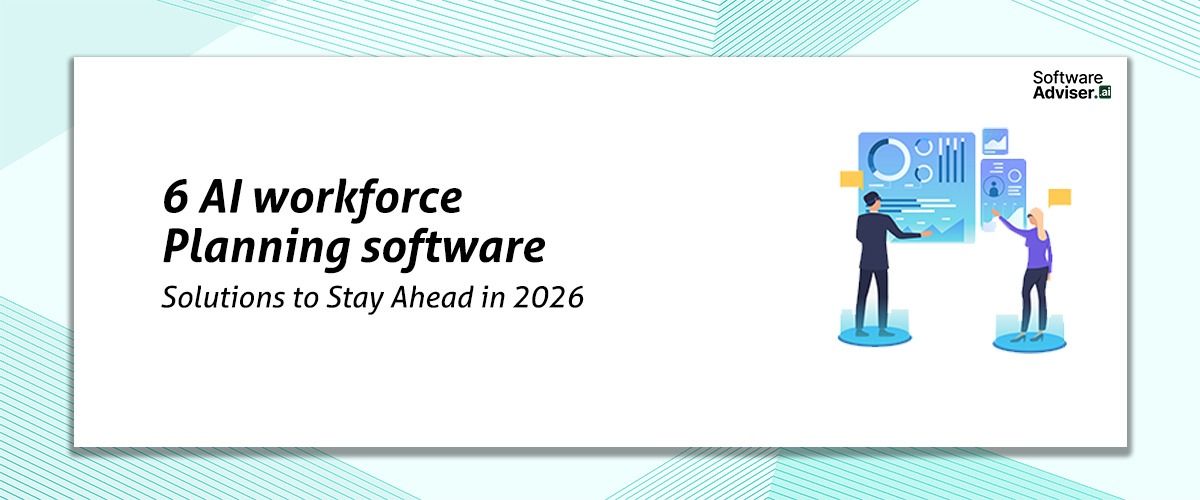
6 AI Workforce Planning Software Solutions to Stay Ahead in 2026
 David N. Wilks
In 2026, the uncertain US labor market wants more than basic spreadsheets. It expects predictive velocity. And as organizations transition from traditional structures to skills-based and as remote-hybrid fluidities rise, traditional forecasting cannot keep up. Progressive firm executives are using AI-powered personnel planning solutions to draw the connections between finance, talent acquisition, and operations on the go. These tools are transforming how firms estimate hiring requirements, pinpoint critical skill gaps, and enhance internal mobility via next-gen predictive analytics and automated scenario planning.
What is AI Workforce Planning Software, and why is it important to US firms in 2026?
AI Workforce Planning Software is an enterprise technology category that combines human capital data, financial forecasts, and operational indicators to estimate an organization’s future talent needs. Unlike traditional, backward-looking HR reporting, these solutions apply machine learning algorithms and natural language processing to predict complex organizational developments. They’re always tracking current employee skills, forecasting future skills gaps, modeling the cost of changes to headcount, and tuning internal mobility pipelines so human capital is intimately tethered to overarching company strategy.
With the labor market becoming more turbulent, with human-AI hybrid teams emerging and acute skills shortages the norm, this software has become an operational essential for US firms navigating 2026. Data shows that US job listings needing AI-specific skills have grown more than 140% year-over-year, and organizations can’t rely on static yearly headcount planning to be competitive. Talent executives are leveraging AI-powered technologies to transition from static job titles to dynamic, skills-based operating models where recruiting and upskilling are aligned to real-time market demands.
There is also enormous pressure on company bottom lines from economic realities such as changing tariff regimes, supply chain reallocation, and tight domestic compliance requirements. In 2026, American companies will actively embrace AI workforce planning to reduce labor expenses and stop staff attrition before it occurs. “By using real-time engagement signals and salary parity data, these solutions can anticipate voluntary resignations weeks in advance, allowing managers to take proactive steps to implement retention initiatives and maintain organizational stability.
How does AI Workforce Planning Software help US companies stay ahead of hiring needs?
AI Workforce Strategy In software, talent acquisition is no longer a game of catch-up; it’s automated and predictive. In the frenetic pace of the U.S. employment market of 2026, if you start a job request after waiting for a resignation letter or new project approval, you are already behind the curve.
Different platforms employ various automated processes to help American businesses stay ahead of the recruiting curve:
1. Dynamic What-If Scenario Modelling
Instead of fixed yearly budget spreadsheets, AI software connects the Human Resources Information Systems (HRIS), AI payroll software, and financial planning data into one real-time testing ground. Executives are able to model large-scale structural changes in real time to know precisely how headcount and labor expenses will change.
2. Automated Requisitions & Predictive Attrition Modeling
Rather than responding to an employee’s departure, machine learning algorithms detect small anonymised signals, such as altering timesheet habits, engagement survey scores, tenure milestones, and localized wage outliers. Early Probability Prediction the algorithm predicts a high probability of voluntary attrition for internal teams or important specialized positions up to 6 months in advance.
Pipeline Generation Trigger, When expected attrition is over a threshold, the software automatically generates an unapproved or draft job request. This motivates talent acquisition teams to develop applicant pipelines ahead of the official opening of the role, reducing typical time-to-hire by as much as 60%.
3. Real-Time Skills Gap & Task Disruption Tracking
The electronic world moves too fast for strict job classifications in 2026. AI systems are constantly ingesting resumes, project histories, and performance indicators throughout the organization using natural language processing (NLP) to create a dynamic skills inventory.
What are the main advantages of AI Workforce Planning Software for expanding teams?
Predicts voluntary attrition and builds talent pipelines before openings to speed up the hiring process.
It gets the most out of your hiring dollars by targeting the appropriate skills gaps, so you don’t waste money on duplicate recruits. Continuously balances workloads among fast-scaling internal teams to keep growing pains and burnout at bay.
It automates the mapping and promotion of existing workers into new high-growth positions, releasing latent internal potential. Enables rapid strategy adjustments via dynamic what-if scenario modeling in real-time for expansions or changes in finance. Removes the guesswork from increasing by replacing subjective manager intuition with accurate, data-driven headcount predictions.
Which Features should you look for in the best AI Workforce Planning Software?
1. Critical Strategic Elements
- Continuous What-If Scenario Planning: Enables you to rapidly understand the impact of major business events like mergers, unexpected budget cuts, or accelerated development into new locations on your future headcount budget and payroll cost.
- ERP and HRIS Bidirectional Integration: Integrate effortlessly with your existing technology stack in a secure environment to unite financial, talent acquisition, AI ERP software and operational KPIs in real time.
- Advanced Skills Ontology and Inference: Using natural language processing (NLP) to scan resumes and project histories, it creates a dynamic internal skills inventory, uncovering hidden staff strengths and emerging technical gaps.
- Predictive Attrition & Early Churn Warning: Monitors behavioral data, pay gaps, and burnout indications to proactively notify managers months ahead of predicted voluntary leave.
2. Improved Operational and Governance Capabilities
- Automated Requisition Triggering: Automatically opens pre-approved draft job requisitions when the system recognizes an inevitable skill deficit or talent gap, drastically reducing recruiting lead times.
- External Sourcing Market Intelligence: Tap into external labor markets to acquire up-to-date wage standards, identify hot places of talent concentration and fine-tune your regional hiring budgets.
- Agency Governance and Compliance: Controls Stay on top of local labor compliance, contractor standards, and internal equity rules to ensure your automated personnel flows are equitable and audit-compliant.
What are the top 6 AI Workforce Planning Software Solutions for US Businesses in 2026?
1. Rippling
Rippling puts HR, Finance, and IT infrastructure into one data layer, so workforce planning is one equation. In 2026, leaders can generate complex headcount reports with simple prompts, plot salary standards in 185 countries, and build visual org charts on the move using Rippling AI. Its headcount feature removes the need for spreadsheets, seamlessly mapping available jobs to live budget bands. If a manager tries to hire outside of pre-approved pay guardrails, the platform will activate automated routing procedures to shut down the process. At the end of the day, it’s a financial and operational forecasting engine all-in-one, designed to reduce organizational scaling friction.
2. Paylocity
Paylocity merges basic HR and payroll with predictive workforce analytics for mid-market and growing organizations. The platform’s AI Dashboard Summaries and specialized Headcount Planning capabilities utilize real payroll data to automatically track organizational forecasts vs actual labor spending. For organizations with operational or frontline workers, our Scheduling+ engine uses daily sales predictions and revenue data to optimize shifts. The AI alerts managers to localized overtime dangers, human qualification gaps, and labor budget overruns before they hit the ledger. It’s a secure, highly collaborative space to bridge the gap between recruitment managers and corporate finance.
3. Salesforce (MuleSoft & Tableau AI)
Salesforce is tackling the enterprise-scale workforce planning challenge by embedding Einstein AI and Tableau analytics deep within organizational resource planning. It’s not a stand-alone HRIS but a confluence of siloed employee data, sales funnels, and customer relationship metrics through MuleSoft interfaces. The prediction approaches correlate future pipeline data to the exact skill sets required to complete those contracts and estimate future human demands. By 2026, autonomous agentic processes will be able to identify areas of human-AI hybrid teams where there are capacity constraints or job disruption. This makes it the must-have solution for major sales-driven organizations that want their recruitment efforts to pivot on a dime in lock-step with market revenue trends.
4. BambooHR
BambooHR provides easy-to-understand, conversational data analytics designed for the needs of fast-growing small-to-medium enterprises (SMBs). Bamboo AI allows HR professionals to run bespoke reports, monitor turnover trends, and evaluate hiring success with simple plain-text instructions. The AI doesn’t spit out thick data grids, but real-time summaries of teams that are at danger of burnout or showing odd time-off tendencies. Now the platform has additional pay management and benchmarking elements to assist expanding teams in constructing equal salary bands without external experts. It’s a remarkably simple, centralized environment that liberates HR professionals from administrative spreadsheets to focus on strategic culture.
5. Workleap
Workleap’s AI capabilities are strongly concentrated on the manager layer of operations to decrease organizational friction and voluntary employee churn. Its dedicated Manager Agent operates as a co-pilot, monitoring daily performance indicators, pulse surveys, and objective progress to map the real-time health of the team. The AI proactively writes performance reports, identifies hidden team engagement decreases, and pre-populates 1:1 agendas with useful conversation topics. It integrates with other technologies, such as Workday and BambooHR, pushing crucial employee attitude and skill data back into the larger corporate planning loop. It enables scaling firms to hold consistent leadership quality across fluid, hybrid teams before talent retention difficulties derail growth.
What Trends will Shape AI Workforce Planning Software Across the US Market in 2026?
- Hyper-accurate demand-sensing engines merge live data streams, such as CRM pipelines and supply chain shifts, to quickly estimate labor volume and staffing demands.
- The complete shift to skills intelligence replaces static, obsolete job names with dynamic internal skills graphs that automatically track real-time capacity gaps.
- Agentic AI autonomous scheduling creates and updates complicated personnel schedules, assuring total compliance with regional labor laws and union regulations.
- Predictive attrition algorithms that assess modest AI employee engagement software trends and salary standards to identify voluntary departure risks weeks before a resignation happens.
- The ascent of human-AI hybrid team modeling empowers corporate executives to proactively chart the optimal division of work between human employees and automated digital agents.
- Unified cloud data layer convergence effectively blends HRIS, ERP, and payroll data to break down operational walls between HR professionals and financial planning teams.
How do you Choose the Right AI Workforce Planning Software for your Business?
1. Pinpoint Your 1 Operational Pain Point
- Finance-HR disconnects: Promote systems like Workday Adaptive or Anaplan that connect talent acquisition directly to live corporate budgets.
- Critical talent gaps: Focus on skills intelligence systems, such as Gloat, to find hidden, internal talent and to identify reskilling pathways.
- High voluntary turnover: Look for heavy analytics solutions like Visier that employ predictive machine learning to highlight churn risk weeks in advance.
- Mid-market scaling: Think all-in-one tech stacks like Rippling or Paylocity for payroll, IT provisioning, and workforce planning all in one dashboard.
2. Experiment with the AI Capabilities of the Platform
- Automated skills inference: Avoid technologies that force employees to update their skills manually. Look for NLP engines that scan actual job outputs to create skills graphs.
- Active demand sensing: Make sure the software is immediately connected to your active business data, such as sales pipelines or CRM indicators, to estimate impending labor quantities.
- Proactive requisition triggers: Choose systems that leader proactively talent needs and automatically create draft job descriptions to expedite time-to-hire.
3. Align the Tool with Your Data Maturity
- Disparate, Manual Data Layer: Establish your basic foundation first with centralized HRIS technologies like BambooHR to remove spreadsheet confusion.
- Centralized, mature ecosystem: Leverage powerful AI overlays such as Orgvue or Gloat that integrate smoothly with your existing tech stack through safe APIs.
Conclusions
With firms navigating the uncertain talent difficulties of 2026, static headcount modeling is no longer a feasible option. The most certain approach to connect human capital with real-time financial aims and operational demands is to use predictive AI-driven workforce planning. Ready to shift your team from reactive hiring to proactive talent optimization? Find out more about these platforms at softwareadviser.ai. As a major digital B2B software marketplace, it offers a one-stop shop to effectively discover, assess, and acquire the right enterprise technologies designed just for your expanding infrastructure.
Companies today increasingly need to fulfill both operational and logistical challenges. The supply chains are highly affected by market swings and co [...]
David N. Wilks
In today's highly competitive US marketplace, where consumer expectations have never been higher, traditional support staff are overwhelmed by an incr [...]
David N. Wilks
Managing a small enterprise today requires wearing multiple hats, but the digital shifts of this year are completely transforming how local companies [...]