
What we'll cover
Share with your community!


Get Free Consultation
6 Powerful Features of AI Sales Tracking Software
 Dokas mile
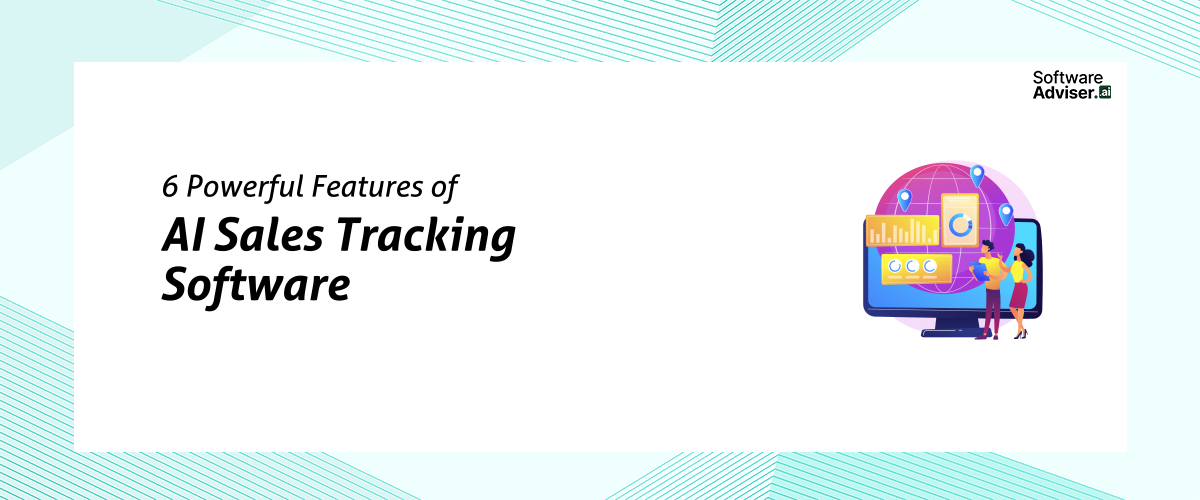
AI sales management software is changing how we run revenue operations by combining 6 revolutionary capabilities into a single source of truth. The automated CRM logging of Sales Reps is an example of how time-consuming it can be for reps to log data in their CRM. The predictive lead scoring component is powered by machine learning technology and assigns a numerical score to each lead based on prospects’ past behaviors to help direct efforts towards high-value leads that will result in successful sales conversions. The conversation intelligence aspect relates to analyzing the emotional state of buyers during phone conversations and allowing companies to understand and keep track of changes to those emotional states over a period. The real-time guidance component provides sales reps with customized talking points while they are on the phone with prospects. The automated follow-up sequencing component of this software sends out custom email communications to potential customers automatically, ensuring that your business will not miss out on opportunities for realized revenue.
What is AI Sales Tracking Software?
It's a modern tech called AI sales tracking software. It utilizes artificial intelligence, machine learning, and natural language processing technology. It can monitor and analyze an entire sales pipeline through every stage of the sales process in real time, and also optimize the sales process in real-time. Unlike most traditional static CRMs, which depend on the salesperson to log and enter their activity regularly, this is more of an automated artificial intelligence system that works with sales representatives to track all of their activities automatically (emails, phone calls, scheduled meetings, etc.) from all different communication sources and combine them into one accurate source of truth for sales management and the enterprise team.
In addition to recording activity, this intelligent sales software converts data into actionable intelligence so companies can track their sales progress towards closing deals. This software continuously looks at historical deal trends and real-time customer behavior to create a lead scoring model (predicting which leads are most likely to convert), forecast the revenue that each quarter will generate with extreme accuracy, and identify accounts at risk of churning. This way, sales departments will no longer rely on their gut to make purchases, and sales professionals will spend the majority of their time interacting with high-value activities while providing their management team with the data-driven visibility they need to scale their companies.
What Core Features should I expect from AI Sales Tracking Software?
Automatically Capture Data Activities and Log Them Into CRM: No need for manual data entry, automatically integrating all of your important activities into your CRM - emails, calls, etc.
- Predictive Lead/Opportunity Scoring: Ranks prospects using machine learning algorithms based on their historical data, allowing sales agents to identify those leads poised for conversions.
- Conversation Intelligence: Allows sales agents to access/record, automatically transcribe recorded telephone calls, as well as identify whether customers have positive or negative sentiments towards the product and whether they reference any competitors during the call, as well as highlight opportunities for coaching discussions.
- AI-Powered Sales Forecasting: Rather than basing your sales forecasts on hunches, the use of AI provides you with accurate sales projections using pipeline health and historical win rates across all of your reps.
- Guidance for What to Do Next: Provides live assistance by giving you suggestions for очереди to follow up on prospects with, and/or when to follow up with these них, and/or what information ты might need to continue to move them through the pipeline.
- Automated Follow-Ups and Email Sequences: Ensure that you don’t lose any hot leads through the cracks by automatically sending out personalized emails to all prospects based on their behaviours.
What data sources does AI Sales Tracking Software rely on to Generate Accurate Sales insights?
First and foremost, AI software that tracks sales relies on first-party sources of data related to the communication that companies have with one another. The software connects directly with an organization's communications hub (e.g., its email server, calendar applications, and cloud-based phone or video) to ingest and analyze large quantities of raw text data from emails (i.e., content of emails), transcript data from Zoom or Teams meetings, and dialer logging information for the AI to analyze customer sentiment, track response timeliness, and establish velocity for a deal. This internal data (i.e., activity) will then be compared to historical CRM data (i.e., past wins/losses/sales cycles) in order to form a baseline for "normal" buyer behavior.
Additionally to using internal communication channels, AI will utilize third-party intent and firmographic data average revenue per AI employee assistance programe to provide a more complete the marketplace by tracking trends in companies’ news and hiring e.g., through third-party vendor data), tracking executive leadership changes within organizations e.g., news articles, social media - LinkedIn as well as monitoring websites and downloading content on those websites to capture digital body language e.g., exactly when a potential customer is researching a solution. By bringing together internal communication and external buying signals, the AI creates a robust ecosystem of data that can be used for revenue forecasting and identification of pipeline risks with a very high degree of accuracy.
How Accurate are the Forecasts and pipeline Predictions produced by AI Sales Tracking Software?
In general, the accuracy of modern AI-based sales tracking software for forecasting revenue at the aggregate level is usually around 90% to 95%. On the other hand, traditional period forecasting techniques such as spreadsheets and stages tend to have low accuracy rates of around 45% to 65%. The reason that AI has this high degree of accuracy is that it eliminates the ability to have a human's gut-feeling bias and incorporates machine learning algorithms that use multiple variables to track real-world customer behaviour.
One of the most important differences to keep in mind with AI is that while the forecast for revenue is highly accurate, it is much more challenging to predict the outcome of individual accounts. Revenue forecasting appears more accurate because the over-indexing of accounts cancels out the under-indexing of accounts. Individual deal forecasts typically fall within an 80% to 85% range. In addition, AI can review active changes that impact deal performance, such as the passage of time, decision-maker engagement through email, and the presence of an economic buyer within a potential client, within weeks, rather than the weeks to months that it would take a salesperson.
Therefore, the accuracy of AI in forecasting deals is only as accurate as the quality of data input into the AI. For example, if an advanced forecasting model includes out-of-date records in a CRM, missing contact information, and unused prospect database records, then the ability of AI to forecast accurately will be significantly reduced.
Is AI Sales Tracking Software a Practical fit for Small and mid-sized Businesses in the US?
Yes, AI sales tracking software is highly practical and increasingly essential for small and mid-sized businesses (SMBs) in the US. With modern platforms offering affordable tier pricing and out-of-the-box setups, lean teams can now leverage tools that were once exclusive to Fortune 500 enterprises.
Here is why it is a practical fit for SMBs:
- Acts as a Force Multiplier for Lean Teams: A typical sales rep in the SMB space usually has multiple roles, including prospecting, closing deals, and managing AI accounting. With AI automating the manual data entry and follow-up processes, this allows a small team (3-5 reps) to create the same volume and efficiency of work as a much larger department.
- Affordable Entry Points: Previously, six-figure enterprise-level SaaS contracts were almost gone. Many enterprise-level CRM and sales solutions now have affordable “seat-based” pricing, typically between $15-$50 per user/month, making these solutions widely available as budgets grow.
- Eliminates Costly Human Forecasting Bias: SMB's work on tight cash flow margins where even one lost deal can be devastating. Having AI create revenue projections enables SMB leadership teams to make smarter decisions about hiring, inventory, and scaling.
- Maintains Institutional Knowledge: For small companies, employee turnover can be an issue due to the loss of client history and relationships when a rep leaves. Having AI log every email and phone note and touch point with a prospect and create a complete history of every contact with a customer ensures that a business retains 100% of its customer data.
- Shortens New Hire Onboarding: Most SMBs do not have dedicated corporate training departments. The use of AI to record calls and provide real-time feedback can serve as an automated coach for helping new sales hires understand their sales pitch, handling objections, and ultimately selling more.
What does AI Sales Tracking Software typically cost, and how should I measure ROI?
- Estimate Rep Hours Gained Back (Cost of Admin Drop): Track hours saved by your sales team due to automated CRM logging and automated transcription of calls using AI. For example, if AI saves 10 reps on average 6 hours each week, then 60 hours are now available per week for your team to focus on activities that contribute directly to customer satisfaction and generating revenue through sales.
- Evaluate Lift in Close Rate (Win Rate): Compare the historical Win Rate against your current Win Rate after introducing AI to assist in deal scoring and conversation intelligence. A lift between 2% and 5% in the current Win Rate; for example, directly correlates with AI's ability to prioritize high-intent opportunities and identify deals that may be at risk of not closing.
- Record Reduction in New Hire Ramp Time: Measure how quickly new sales reps achieve their monthly sales quotas. Organizations that utilize an automated AI repository library for coaching and live next-step guidance often experience 25% to 30% reductions in onboarding timelines for new sales hires, resulting in faster revenue generation for each group of new hires.
- Evaluate Forecasting Accuracy for Sales: Collect actual closed sales revenue and compare it with the revenue forecasted by AI at the start of the quarter. Moving from a 60% accurate traditional sales forecast to an accurate AI-generated 90% or better forecast reduces costly excess inventory overhead, stabilizes company cash flow, and eliminates quarterly revenue fluctuations.
How does AI Sales Tracking Software handle data security and US compliance requirements like CCPA?
By applying the zero-trust security architecture that leverages multiple layers of protection, enterprise-grade AI sales-tracking software can secure its record of all client communications, call recordings, and contact information by encrypting them using Advanced Encryption Standard (AES) with 256-bit encryption when stored, as well as Transport Layer Security (TLS) v1.3 when transmitted.
To prevent any unauthorized exposure of this information by personnel within the organization, the enterprise utilizes the Role-Based Access Control (RBAC) model for access control and Mandatory Multi-Factor Authentication (MFA) at log-in to limit the visibility of client records to only those sales representatives who have been granted access based on the pipeline to which they are assigned.
The enterprises that utilize the software spend considerable resources validating technical controls externally through ongoing independent audits and by utilizing third-party vendors that maintain compliance with SOC 2 Type II or ISO 27001 to ensure that there is rigor in data hygiene practices. As a provider of compliant services under various US data privacy mandates (such as the California Consumer Privacy Act /CCPA), the software enables enterprises to automate the governance of any personal or private information collected about a consumer through its data subject access request.
DSAR functionality, which allows for the manufacturer of a complete and specific compilation of all communication between the enterprise and consumer, including emails, call logs, transcripts, and CRM logs, in accordance with state laws providing consumers with rights to know or delete their data within the timeframe that has been specified by the respective state law. In addition to DSAR capabilities, these enterprises also implement extremely granular Consent Management settings to comply with strict limitations against automated decision-making and data enrichment.
How long does it take to fully implement and onboard AI Sales Tracking Software Across my Team?
- Integrating First Tech Stacks (Days 1–5): The first stage of integration for this process is connecting your email infrastructure, calendars, and any other communication features using out-of-the-box API connectors (in most cases). This part usually happens so quickly that you hardly know it is being done.
- Training AI Models with Historical Data (Weeks 1–2): The second stage of the process requires collecting all the historical data necessary to establish a baseline for forecasting models. So, over those two weeks, a historical baseline will be established on all CRM data, including previous activity on deals closed and previous email threads, in order for the AI to have sufficient information on which to build its predictive model.
- Custom Configuration & Governance (Weeks 2–3): In weeks three and four, the sales leadership team and operational leadership will begin to work together to configure custom data fields, establish compliance rules (like redacting sensitive information from recorded calls), and assign role-based access privileges.
- Structured Training & Adoption by Sales Representatives (Weeks 3–4): Once custom fields have been configured, we will begin the hands-on training process, where sales representatives will learn how to leverage conversational intelligence insights, see real-time pipeline alerts, and eliminate logging daily to their CRM systems manually.
- Optimization & Full Functionality (Months 2–3): By the end of the first quarter, the AI's forecasting models will be utilized to run pipeline reviews by management, and any strategy adjustments based on actual results achieved will be made by the end of the second quarter.
What Level of Ongoing Support and Training should I expect from an AI Sales Tracking Software Vendor?
When collaborating with an AI sales tracking software vendor, the ongoing support and training model is heavily influenced by spending tier and seat count. For small to mid-sized businesses with standard, out-of-the-box licenses, support is primarily digital and self-directed. You can expect 24/7 access to an interactive help center, guided video tutorials, and technical support via email or live chat ticketing systems. To facilitate long-term adoption, vendors provide automated interactive walkthroughs within the user interface to assist sales representatives in utilizing the new generative AI features or identifying potential changes in the pipeline dashboard as they occur.
In mid-market and enterprise-level deployments, vendors will move you out of generic ticketing queues and assign a dedicated Customer Success Manager (CSM) to your account. This resource not only helps with overcoming technical issues, but they also function as an extension of your Revenue Operations (RevOps) team. Your CSM will conduct monthly or quarterly business reviews, evaluate usage data concerning your sales reps, and present comparisons between your performance against industry benchmarks. If the data indicates your sales reps are not using the AI’s real-time guidance for next steps, your CSM can create an environment in which your sales reps can develop confidence in using the AI’s insights.
The fact that the artificial intelligence (AI) program alters itself and learns from experience makes it so that the vendor education process is not a one-time training session; it is a continual process that will occur over and over again until the organization has sufficient experience using the AI software and can manage it on its own. High-quality vendors typically provide their customers with train-the-trainer opportunities or workshops for all frontline sales managers on the use of the AI program's features, such as conversation intelligence and/or predictive analytics, for their weekly coaching sessions. As the machine-learning models created from the customer's data are updated and improved, the vendors will provide additional resources to help professionalize and define the predictive lead scoring parameters and the customer's forecasting process, ensuring that AI functions well for the evolving sales cycle.
Conclusion
Sales representatives can reclaim time, eliminating the need for manual input by automating (or partially automating) CRM Log Station sales workflow processes. Predictive Lead Scoring leverages machine learning algorithms to identify the most valuable prospects for outreach so that you can dedicate your time to creating the most significant opportunities possible (rather than wasting time on non-productive prospects). Conversation Intelligence is both an analysis of customer sentiment based on historical voice call data and allows for ongoing monitoring and adjustment of that customer’s sentiment (if required).
FAQ's
AI Sales Tracking Software uses machine learning and predictive analytics to monitor sales pipelines, automate data capture, score leads, and forecast revenue. It replaces manual CRM updates and spreadsheet reporting with real-time, AI-driven insights that help sales teams prioritize the right deals at the right time.
Most US sales teams report seeing measurable ROI within 3–6 months when CRM data is clean and processes are established. According to industry benchmarks, 86% of sales teams using AI tools report positive ROI within their first year. Teams starting from scratch typically need 6–9 months.
Yes—particularly platforms designed for scalability. Many AI Sales Tracking Software solutions offer tiered pricing, starting as low as $49–$85 per month, making them accessible to smaller teams. The key is choosing a platform that delivers immediate workflow improvements without requiring a dedicated data science team to operate it.
Buying the wrong tool in the wrong order. Most teams invest in outreach automation or analytics before solving the intelligence gap. According to McKinsey, companies that implement AI in the correct sequence—intelligence first, engagement second, analytics third—report 10–20% boosts in sales ROI compared to those that skip foundational layers.
Generative AI has rapidly transformed enterprise software, moving from a competitive feature to a core business capability. Organizations are increasi [...]

David N. Wilks
In the year 2026, US retail will be about more than basic data dashboards, instead featuring autonomous, predictive operational layers that protect pr [...]
David N. Wilks
In the current rapidly developing digital world, it is not sufficient for traditional file cabinets and cluttered cloud folders to provide what busine [...]