
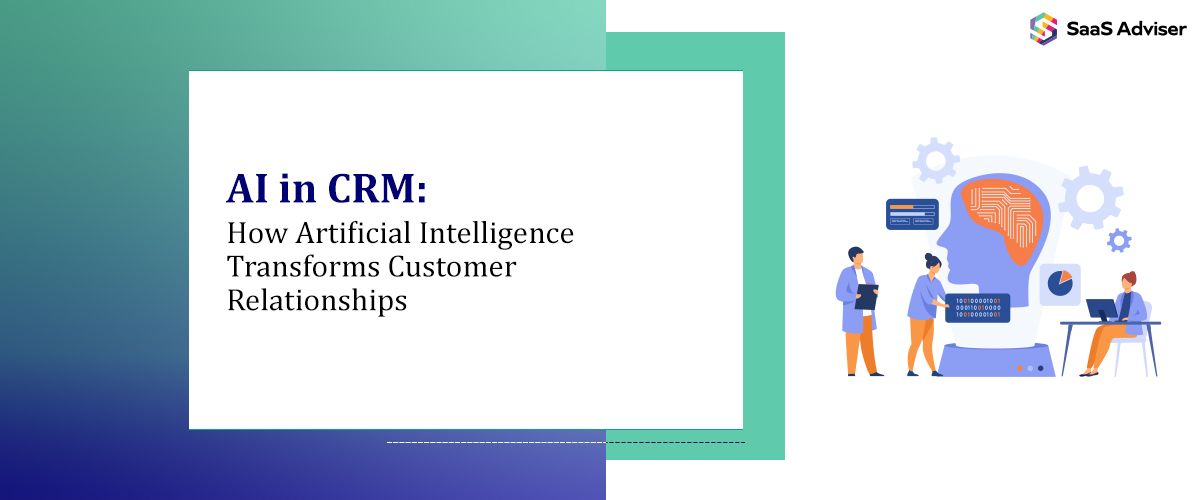
AI in CRM: How Artificial Intelligence Transforms Customer Relationships
Customer Relationship Management (CRM) has long been the backbone of sales, marketing, and service. It provides the central database for all customer interactions. However, in the hyper-personalized, real-time economy of 2025, a static database isn't enough.
This is where AI in CRM in USA, takes center stage, transforming traditional platforms into proactive, intelligent growth engines. This blog will explain the AI in CRM systems revolution, detailing the key features, significant benefits, and exciting future where CRM and AI work together to create customer relationships that are both efficient and deeply personal.
What is AI in CRM?
Simply put, AI in CRM is the implementation of AI technologies, including ML development , Natural Language Processing (NLP), and Generative AI, in the customer relationship management software itself.
The conventional CRM systems are data warehouses; they store data. The AI-driven CRM systems process that data, analyze it on a massive scale, learn about it, and utilize the insights to automatize processes and make predictions about customer behavior. The aim of artificial intelligence and CRM is to transform the system into an active, intelligent collaborator for each team that interacts with the customers.
It is this combination that transforms an AI-based CRM into more than a place to record the activities through it but a strategic tool that can propose the next best action, assist businesses in anticipating the needs, and propose a solution to the issue before they even occur.
 Looking for Online CRM Software? Check Out SaaS Advisor's List of the Best Online CRM Software in USA.
What are the Benefits of AI-Powered CRM?
The advantages of AI and CRM integration are enormous, and it affect all customer lifecycle phases, including outreach and loyalty. It is this combination that is the force driving the success of the modern AI enabled CRM.
1. Lead Scoring
The classic problem: sales teams waste time on unqualified leads. AI in CRM solves this with predictive lead scoring. Machine learning algorithms analyze historical data (job title, engagement history, website visits) to accurately rank leads by their likelihood to convert. This ensures sales reps focus their efforts on the highest-value prospects, maximizing efficiency.
2. Predictive Engagement
Through the prediction of the complex behaviour patterns, AI powered CRM systems can correctly determine when a customer is likely to churn or upgrade or even receptive to a particular offer. This enables teams to proactively and promptly reach out and make the reactive support become strategic and progressive.
3. Customer Insights
AI can process mountains of structured and unstructured data (emails, chat logs, social media posts) faster than any human. This leads to profound customer insights, enabling precise audience segmentation and the discovery of hidden trends in customer behavior and preferences.
4. Sentiment Analysis
AI in customer relationship management can analyze the emotional tone and context of customer communications, whether through phone calls, emails, or chat. Sentiment Analysis alerts service teams in real-time if a customer is frustrated or about to churn, allowing an immediate, empathetic human intervention before the situation escalates.
5. Personalized Experiences
AI-based CRM aims at hyper-personalization. AI is no longer just the segmentation of content but the dynamic personalization of content, product suggestions, and messages by real-time behavior. This makes all interactions with customers relevant and on time and contributes a lot to enhancing interaction.
6. Improved Sales Pipeline
AI assists sales managers by providing more accurate sales forecasting. By analyzing pipeline metrics, deal history, and rep activity, the AI for CRM tool can pinpoint deals at risk and suggest the next best action for a sales representative, streamlining the entire sales pipeline process.
7. Campaign Optimization
Marketing teams benefit significantly. AI in CRM continuously tests and refines campaign elements, from email subject lines and send times to ad copy and landing page content, to ensure optimal performance, leading to higher conversion rates and better return on ad spend.
8. Better Decision-Making Through CRM Insights
When teams understand CRM data enhanced by AI analytics, they make smarter, data-driven decisions. AI helps you understand CRM metrics more deeply by surfacing hidden patterns and actionable insights that manual analysis might miss.
How AI and CRM Work Together For Your Business in 2025?
In 2025, the synergy between CRM and artificial intelligence defines business agility. The two technologies operate as a single, intelligent loop, a necessity driven by AI in the CRM software market, which surged past USD 4.1 billion in 2023 and is projected to reach USD 48.4 billion by 2033, reflecting the growing emphasis on customer experience and retention:
-
CRM Collects Data: The CRM platform serves as the central data hub, logging every interaction.
-
AI Analyzes Data: The artificial intelligence in CRM (specifically Machine Learning algorithms) then continuously analyzes this data to identify patterns, predict outcomes, and provide context.
-
AI Automates Action: Based on the analysis, the AI enabled CRM triggers automated tasks, surfaces actionable insights, and provides real-time guidance to human employees.
This feedback loop transforms raw information into directed action. As a case in point, in the real estate industry, AI CRM real estate systems utilize market data and historical sales trends to determine how likely a particular lead is to bid on a particular house and inform the agent instantly with a tailor-made advice script. It is through this that the two technologies make modern decisions that are data-driven.

Did You Know?
The industry research showed that the implementation of AI to CRM increased the lead conversion rates up to 35% and saved the sales reps up to 20% on the time spent on manual data entry.
Top Features of Artificial Intelligence in CRM
The core capabilities of CRM artificial intelligence manifest in specific, powerful features designed to boost productivity and customer satisfaction.
1. Automated CRM Processes
Time-consuming administrative processes are a significant waste of the time of employees. These are managed by AI via Automated CRM Processes like
-
Emails and phone calls will be logged automatically. Features like linkedin message sync allow AI-powered platforms to automatically capture LinkedIn conversations, keeping customer interactions centralized and eliminating manual data entry.
-
Maintaining contact records with a lookup.
-
The best-suited agent is based on complexity and skill to assign them support tickets.
2. Sales Optimization
AI acts as a personal sales coach for every representative. Features for Sales Optimization include:
-
Next Best Action recommendations surfaced in real-time during a call.
-
Automated meeting scheduling based on team calendars and client availability.
-
Analysis of call recordings for conversational effectiveness and compliance.
3. Automated Email Marketing
The current AI-based CRM systems are no longer simple email automation. They make the content personalized at scale:
-
Generative AI will be able to compose preliminary and personalized follow-up emails.
-
Automated Email Marketing will control the times that it sends out an email, depending on when a particular contact is most likely to open the email.
-
It is a dynamically adjusted product recommendation in the email depending on the latest activity of the recipient on the website.
4. Data Entry Automation
An essential attribute of keeping the data clean, Data Entry Automation will reduce human error and provide the accuracy that the AI models require. The AI can extract data from email signatures, social accounts, and open records and automatically update the fields of contacts.
5. Customer Behavior Prediction
This is the core of predictive power. By leveraging predictive analytics, the system can:
-
Forecast customer lifetime value (CLV).
-
Predict which existing customers are high-potential candidates for upselling or cross-selling opportunities.
-
Model the risk of customer churn.
6. Lead Management
In Lead Management, the AI analytics CRM helps sort the signal from the noise. It automatically qualifies, scores, and routes leads to the correct sales rep based on criteria that go far beyond simple demographic data, allowing for highly targeted follow-up strategies.
The Future of Artificial Intelligence and CRM
The future of CRM and artificial intelligence is quickly trending towards self-driven systems that are capable of managing complete processes with minimum human intervention, with a view to creating immersive and highly intuitive customer experiences.
1. Hyper-Personalization
The goal is a segment of one. Future systems will leverage every piece of data to create truly unique customer journeys, using generative AI CRM tool features to draft unique landing pages, product catalogs, and service resolutions for every single individual in real time.
2. Automation & Efficiency
Anticipate almost complete Automation and Economy of repetitive work. Most of the data logging, compliance checks, and lead nurturing will fall under the task of AI, leaving the human staff to work on complex problem-solving and high-touch relationship building.
3. AI-Powered Chatbots
AI-Powered Chatbots will evolve into sophisticated virtual assistants that use massive knowledge bases to answer complex questions, execute transactions (like processing returns or scheduling appointments), and even manage entire accounts, all while maintaining human-like conversational quality.
4. Immersive Experiences (AR/VR)
New technologies, such as the implementation of Augmented Reality (AR) and Virtual Reality (VR), will become a part of artificial intelligence in crm systems. Suppose that a service technician is a remote, AI-guided maintenance worker who uses AR glasses, and the entire interaction and data are automatically recorded in CRM to create a lifelike support experience.
Pro-tip
To prepare for the future, focus now on data quality. No matter how advanced the AI, its predictions will only be as good as the data you feed it. Prioritizing clean, accurate data today is the best investment for future AI-based CRM success.
Conclusion
AI as an upgrade to CRM is not a luxury; it is a change of paradigm in the direction of how successful businesses interact with their clients. With the combination of the forecasting capabilities of artificial intelligence and the hierarchical framework of CRM, businesses will not only respond to the needs of their customers but also project them. It is this groundbreaking collaboration of CRM and AI becoming one that will be the driving force that will shape market leaders in 2025 and beyond and provide levels of personalization, efficiency, and growth never seen before.
Challenges include poor data quality, resistance to change from employees, and the difficulty of integrating new AI systems with older, legacy CRM infrastructure.
Industries with high volumes of customer data and complex sales cycles, such as financial services, e-commerce, telecommunications, and real estate, benefit significantly.
They improve customer experience by enabling 24/7 support via chatbots, providing proactive assistance, and delivering hyper-personalized, timely communication across all channels.
AI analytics in CRM plays the role of identifying patterns, predicting future outcomes (like churn risk or purchase intent), and automatically surfacing actionable insights to sales and service teams.
CRM artificial intelligence analyzes historical sales data, market trends, and pipeline health in real-time to generate more accurate and dynamic sales forecasts than traditional manual methods.