
What we'll cover
Share with your community!


Get Free Consultation
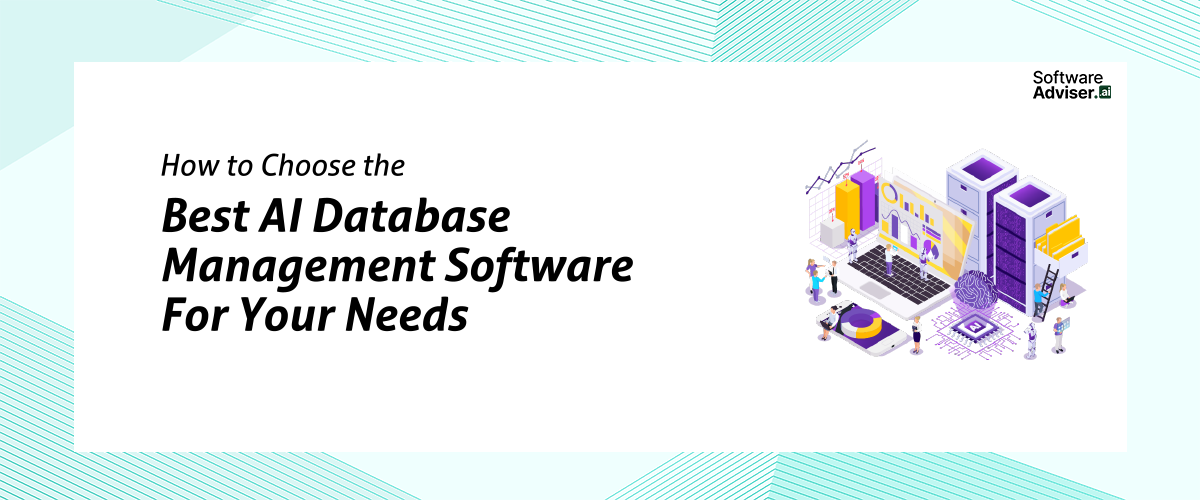
How to Choose the Best AI Database Management Software for Your Needs
 Dokas mile
Finding the perfect AI Database Management System (DBMS) may feel quite challenging owing to the myriad of new technologies in use today. You need to go beyond the marketing claims to check if you can work with your required level of technology with the appropriate level of reliability. It is not enough to just save your data, but also make sure that this AI database management software will remain safe and secure and will not be subject to any unauthorized access. Such a solution should have the appropriate level of performance in terms of the speed of storage.
What Is AI Database Management Software?
AI DBMS stands for the new era of data storage, which has emerged out of old traditional methods of data storage. In the past, databases used to be older forms. They would only be good for structured data; however, the need for more complex forms of data storage has come into play. AI database management software has come to handle big data analytics as well as analytical clouds. Thus, we must keep in mind that its main function is to perform big data analytics and process every form of data.
Not only do these sophisticated management systems work as a platform for storing AI-driven workloads, but they also embed intelligence into the mundane database processes for better optimization. This implies that the system would do what would take human resources lots of time and effort, such as performing various tasks at the back of the system, without the need for large amounts of manual input. For example, using the advancements in machine learning, an AI-enabled DBMS can optimize requests and make necessary adaptations based on constantly shifting data patterns, identify any security breaches and reallocate the resources necessary for meeting the requirements of the workloads.
Why Does AI Database Management Software Matter in the US Market?
The US technology industry has been changing rapidly, and AI database management software has become one of the most competitive software markets in the world. Companies in various industries, such as finance, healthcare, AI ecommerce software, and others, have been working on the implementation of AI technologies to get the best possible performance from their data. However, it should be noted that using AI in all cases depends on the input data. Traditional data architectures are incapable of handling huge amounts of unstructured data in real time. Thus, there is a necessity to create AI-optimized database systems.
The increase in AI DBMS implementation in the US is not only due to performance, but also because of serious regulatory requirements that exist. With strict data privacy laws such as California's CCPA/CPRA, federal health legislation like HIPAA, and strict rules on finance, American companies can see serious legal and monetary repercussions due to misconduct with regard to consumer data. New AI technologies solve this problem through the use of highly developed methods of data governance, role-based access control systems, and secure vector isolation in their design.
The implementation of intelligent database tools represents an important economic trend for American organizations faced with continuous hikes in costs and a critical lack of labor force. The region of Silicon Valley and other tech areas of the USA are experiencing a profound shift to self-management of databases through the implementation of self-tuning, predictive indexing, and automatic allocation of cloud resources based on artificial intelligence processing. Furthermore, by simplifying the routine and complicated processes of database optimization through technological investments, American organizations are capable of reducing their spending on cloud computing as well as minimizing the problems connected with failures.
What Features Should You Look for in AI Database Management Software?
- Native Vector Support: The database must have the ability to save, categorize, and retrieve high-dimensional vectors using advanced methods like HNSW and IVFFlat.
- Automated Performance Tuning: Using tools that utilize AI technology will make it possible to achieve zero-intervention self-optimization.
- Hybrid Search Capabilities: The software should provide for the integration of structured query processing and vector-based processing to get the best possible results.
- Robust Enterprise Security and Compliance: One needs to make sure that the solution provides a high level of enterprise security.
- Seamless Integration Pipelines: The database ought to have integrated connectors and APIs for easy interaction with major frameworks.
- Dynamic Scalability: It is important to find a cloud-based database solution that ensures independent scaling of storage as well as computing resources.
How Does AI Database Management Software Improve Data Security?
AI database management systems help in securing the information since it has moved from passive protection mechanisms to cutting-edge protection methods. Conventional databases typically rely on protection built on the past since they depend on human intervention to check for attacks. With AI databases, there is no chance of missing attacks since it continuously looks for abnormalities in the patterns of accessing information. The system looks for a normal level of accessing data and detects any abnormality, such as downloading too many documents, which could flag up an attack.
With the help of AI-driven database administration tools, users can enhance data security through automated data governance and intelligent data masking procedures, which are necessary for compliance with modern laws like HIPAA and CCPA. The solutions employ natural language processing (NLP) to automatically analyze formats and label many types of private information, ensuring the protection of intellectual property and individual information. Via this software, users are able to automatically remove sensitive coding or to mask danger spots in real time, and also enjoy the full capabilities of an automatic vulnerability management tool that scans the computer for weaknesses before they attract the attention of hackers.
Which US Businesses Benefit Most from AI Database Management Software?
- E-Commerce and Retail: Here, real-time vector search technology is applied to provide hyper-personalized recommendation engines for product recommendations as well as visual search technologies for matching user intent.
- Banking and Financial Services: Here, in the banking sector, AI-based anomaly detection is used to identify fraudulent transactions and compare them with complicated market data patterns to help have a clear picture of the subject.
- Healthcare and Life Sciences: This system is important in managing medical images, AI employee mental health processing large genomic data, and handling EHRs safely.
- Cybersecurity Providers: Automated database monitoring is used here for identifying new hacking threats and detecting any harmful network activity.
- Digital Media and Entertainment: In the entertainment sector, semantic data management technologies are used to provide customized content for users, automate the processes of video tagging, and enhance users' experiences through engagement.
- Logistics and Supply Chain: As for logistics, predictive analytics and time series of data have been very useful in providing optimization of products' transportation and prediction of consumers' demands.
How Much Does AI Database Management Software Cost?
Prices vary greatly depending on the amount of data that you have to manage, the amount of query traffic that your queries involve, and whether you want to use the self-hosted or managed option. However, organizations have to pay for the supporting infrastructure along with software engineering resources for deployment.
- Cloud-Free Versions: Managed cloud service providers also provide a free tier, which has limited storage of about 1 GB to 5 GB to be used solely for development purposes.
- Pay-As-You-Go Construction Models: Serverless index uses a consumption-based model, meaning that storage will be charged around $0.33 per GB on a monthly basis, along with a per-million read or write operation charge.
- Standard Production Packages: A small business can expect to pay at least $20 to $50 monthly on active compute utilization and usage when scaling up its business model.
- Dedicated Computing Clusters: Businesses use dedicated computing clusters for high-end rendering to obtain reliable performance on a clustered computing environment.
- Enterprise Class Architecture: Organizations that work on processes that require over 100 million vectors will pay platform fees that start from around $500 every month.
How Do You Choose AI Database Management Software Options?
To effectively compare AI database management software options and choose the ideal platform for your infrastructure, evaluate them using these six critical pillars:
- Measuring Performance and Latency: Examine Queries Per Second (QPS) metrics and latency metrics under real heavy workload situations rather than just looking at the public benchmark numbers. Good systems should give performance measures and latency numbers only when it comes to high-dimensional vectors.
- Architectural Features: Decide if you prefer using a specialized, lightweight system such as Pinecone and Milvus designed specifically for AI embeddings, or stick to your regular relational data systems with pgvector for all your data needs.
- Quantitative Evaluation of Search Capabilities: Critically examine whether the database is able to effectively combine both semantic search and traditional search methods such that structured data, such as SKUs, cost, and time, can be searched for successfully.
- Remembering Trade-offs Between Recall Rate and Resources: Understand how flexible the indexing algorithms used by databases can be, as they allow you to have different levels of recall depending on your needs.
Conclusion
Choosing the proper AI database management software entails weighing performance, security, and scalability. In order to take the guesswork out of your decisions, use a specialized procurement platform. One of the best choices available is softwareadviser.ai, the SaaS Marketplace for you to Discover, Compare, and Buy any Business Software. This platform allows you to simplify the process of evaluating software because it allows you to filter the systems based on their architecture, built-in integrations, and pricing models. With their curated database, your engineers will be able to bypass the lengthy procurement processes and confidently purchase a robust software solution that meets the specific needs of your business concerning AI.
FAQ's
Traditional databases hold structured data in fixed rows and columns. AI databases store, index and search complex unstructured material such as text, images and audio using mathematical vector embeddings that allow for speedy search based on conceptual meaning.
In many cases, you can extend your existing infrastructure with specialised extensions, such as installing the open source pgvector plugin on a conventional PostgreSQL database, but more heavy AI applications could run better on a dedicated, purpose-built vector database.
These intelligent solutions utilise embedded machine learning to automatically detect, tag, and mask personally identifiable information (PII) on the fly, eliminating data leaks and remaining compliant with severe privacy standards like HIPAA and CCPA.
No, most major vendors offer good open source versions or free tiers of cloud management, which allow developers to build, test, and prototype lightweight applications entirely for free before moving to paid production tiers.
Hybrid search runs a standard keyword match and an AI-based semantic vector search in parallel and then intelligently collates both result sets to provide the user with the most accurate and contextually relevant information.
Running a profitable kitchen today takes more than just cooking notable food; it all comes down to how fast you get food to the consumer's door. In 20 [...]

David N. Wilks
In the highly competitive 2026 US job market, organizations are shifting away from fragmented legacy checklists toward cohesive, hyper-personalized di [...]
David N. Wilks
US property groups face a constant struggle tracking endless lease renewals, multi-state commercial buys, and complex vendor disclosures. For years, r [...]